What Are the Controversies as Art Being Legally Protected Data?

Artists have a sense of ownership to the work that they produce, often times rightfully so. They want to be able to create original work and not have it be stolen and claimed as someone else’s original work. They want to be able to make profits off of their work by touring it around the world, performing it, possibly selling their work to others to have it reproduced. All of types of artwork and media are copyrighted to protect those artists, from plays and musicals, to music both aural and written, dances, visual art, images, logos, poetry, books, and video games. The data lies in the works themselves; plays, books, and poetry in the words. Music in notation and audible sound. Images in colors, shape, texture. Dances, even, in notation, recorded performances, and the physical movement itself.

The controversies arise when the copyright is abused, and when the boundaries between what makes each individual piece of art different is blurred. In February 2019, a handful of theatres across the country were producing To Kill a Mockingbird, a stage play adapted by Christopher Sergel. At the same time in New York City on Broadway, a new adaption of the same book by Aaron Sorkin premiered, and the producer, Scott Rudin, shut down the productions of a different playwright. Rudin closed eight productions of Sergel’s To Kill a Mockingbird (including one in Salt Lake City at the Grand Theatre) because of a 1969 contact, even though a representative of Harper Lee’s (author of To Kill a Mockingbird) estate approved the shows to be produced in the first place.

When art is plainly plagiarized, as with Kelsea Ballerini’s CMA performance, that is a clear violation of someone’s artistic work and legacy. However, to create art, one is inspired by other art. Art builds on itself and is constantly changing; even the most famous artists drew from other pioneers. Michael Jackson’s dance style was influenced by Bob Fosse and Fred Astaire. Hollywood music producers ‘sample’ music. The music of the 80’s, the orchestra hit, was inspired by Stavinsky. Plays are adapted from books (Great Comet of 1812 from War and Peace, West Side Story from Romeo and Juliet) and other sources. Even William Shakespeare’s plays were slightly, if not completely inspired by other plays and stories. The connective tissue between different works in nearly endless. When iconic pieces of art are translated and redefined in a new context, that is merely part of the process of creating new art. The plays written by Sorkin and Sergel were completely two different pieces of work. They were adapted from the same source and have the same narrative spine and characters, but the dialogue isn’t the exact same for every scene, the structure isn’t the same, the subtext isn’t, and the theme isn’t. They aren’t the exact same pieces of work, otherwise that would be plagiarism. Rudin was unjustified in shutting down the eight production’s of Sergel’s play, and this instance only shows that inspiration and plagiarism (even adaptation) are vastly different.

Sources:

Alter, Alexandra and Paulson, Michael. “‘Mockingbird’ Play Publisher Demands $500,00 from Harper Lee Estate.” New York Times, 8 Mar. 2019, https://www.nytimes.com/2019/03/08/theater/mockingbird-broadway-harper-lee-dispute.html?fbclid=IwAR00ARJAuNjKCYpJ5FXtjB_nAJberafhq0S2qKKaBFcyEVdvf0Oaj0zXtFo.

Alter, Alexandra and Paulson, Michael. “Legal Threats from Broadway’s ‘Mockingbird’ Sinks Productions Around the Country.” New York Times, 28 Feb. 2019, https://www.nytimes.com/2019/02/28/theater/scott-rudin-mockingbird-broadway.html?module=inline.

Wingenroth, Lauren. “Can Music Artists Stop Stealing From Choreographers Already?” Dance Magazine, 19 Nov. 2018, https://www.dancemagazine.com/can-music-artists-stop-stealing-from-choreographers-already-2620680049.html.

“The Sound That Connects Stravinsky to Bruno Mars.” Youtube, uploaded by Vox, 15 May 2018, https://www.youtube.com/watch?v=8A1Aj1_EF9Y.
America’s Opioid Epidemic Is No Longer About Prescription Painkillers Alone

My whole life I’ve been witness to what drug addiction does to individuals and families. My father has been a heroin addict my entire life and 5 years ago I watched my brother struggle with his addiction to painkillers. Needless to say I’ve been following America’s opioid crisis hoping to see a change, but the problem has only gotten worse and to my surprise heroin and fentanyl have become more popular among opiate drug abusers. I can’t help but wonder have these drugs replaced prescription opioid painkillers amidst this epidemic or are they just adding to the death toll and why have they become so popular?

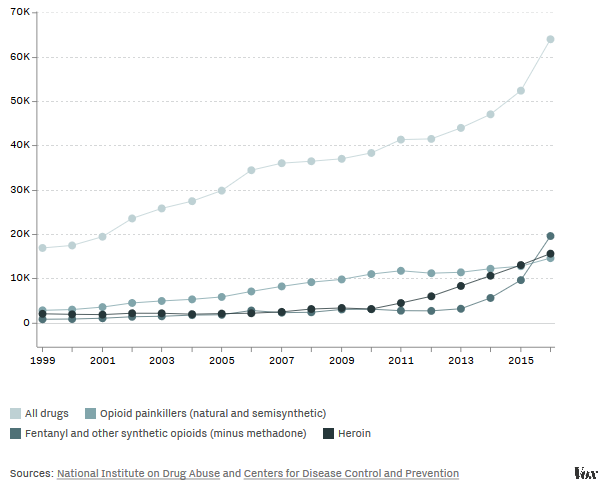
When most people think of America’s opioid crisis the first thing that generally comes to mind is prescription pain pills. Over the last two decades the U.S. has faced a deadly epidemic. An article on Vox.com asserts that it was started by what was intended to change pain management for the better, legal prescription drugs such as Oxycontin and Percocet prescribed by your family doctor. Ever since 1999 pain killer deaths have been on the rise, however the U.S. is now facing bigger problems amidst this crisis. In 2010 the epidemic started to change and something interesting happened; heroin related deaths started to sharply increase. By 2013 deaths by another drug called Fentanyl, a synthetic opioid, started to rise. By 2016 both heroin and Fentanyl contributed to more deaths than opioid painkillers alone and the Fentanyl death rate even surpassed deaths due to heroin, rising 264% between 2012 and 2015.. The graph below is a visual representation of the lives taken during the U.S. opioid epidemic spanning the last 20 years.

Drug overdose deaths in America
*The numbers for 2016 are preliminary estimates

While the graph is proposed to have been made using data from the CDC and the National Institute on Drug Abuse (NIDA), it only aligns with the data and graph found on the CDC website. A similar graph from the NIDA shows that the heroin death rate has never risen above the opioid death rate. I find this peculiar because they cite the CDC as a source for their graph. The discrepancy between these two well established and trusted entities makes me wonder what the actual heroin related death rate is and who has it right. The article mentioned above states that heroin deaths are currently higher than opioid deaths in the U.S. and the CDC states a verifiable source for their data claiming the same thing, so my bet is on the CDC for accuracy.

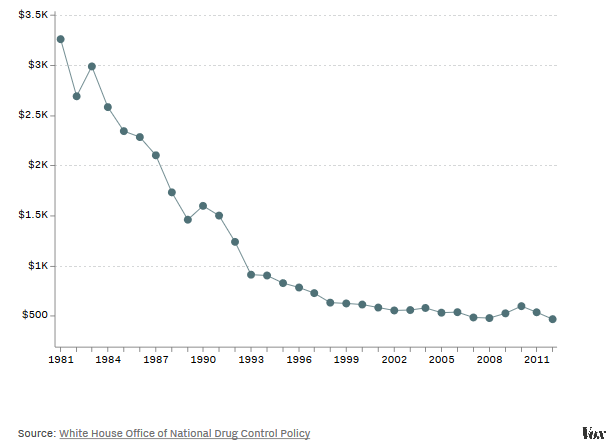
While the graph above shows what happened it doesn’t really show why. According to the Vox article many opioid users switched to using heroin because it’s so cheap, often cheaper than candy bars. The graph below shows that heroin cost $3260 per gram in 1981 and dropped to $465 per gram by 2012, thus making the drug much more available and cheaper than prescription painkillers. The CDC states that individuals who use prescription opioid painkillers are 40 times more likely to use heroin and 45% of heroin addicts are also addicted to prescription opioid painkillers. Many states have even set a limit of 7 days for opioid prescriptions and this too has driven people to find other means to satisfy their need which has led many to start using heroin. Others have turned to fentanyl. Not only is it more potent (50-100 times more potent than morphine) than other opioids, when illegally made it is even cheaper than heroin. However many deaths from this drug are actually due to it being laced in heroin and cocaine because of its low-cost and increased euphoric effects. People who buy the laced drugs are not often aware of the fentanyl and accidentally overdose.

The price of heroin per pure gram in inflation-adjusted dollar

While it’s evident that heroin and fentanyl account for more deaths, opioid painkiller deaths from overdose are still at an all time high. The introduction of cheaper heroin and illegally made fentanyl didn’t replace painkillers in America’s opioid crisis, they added to the problem and significantly increased drug related deaths across the U.S due to their low-cost and availability. As death rates from all three substances continue to rise and account for more deaths than car crashes and gun deaths on a yearly basis it becomes ever more important to reduce prescription opioid abuse, increase access to treatment programs and ensure access to naloxone (a drug that can reverse opioid overdose).

References

Lopez, German, and Sarah Frostenson. “How the Opioid Epidemic Became America’s Worst Drug Crisis Ever, in 15 Maps and Charts.” Vox, Vox, 29 Mar. 2017, http://www.vox.com/science-and-health/2017/3/23/14987892/opioid-heroin-epidemic-charts.

“Opioid Overdose.” Centers for Disease Control and Prevention, Centers for Disease Control and Prevention, 19 Dec. 2018, http://www.cdc.gov/drugoverdose/opioids/fentanyl.html.


Does Teach For America benefit students beyond their standardized test scores?

Teach For America (TFA) is a nation-wide program where college graduates serve two-year terms as teachers or principals at underserved schools. The organization was founded in 1989 by Princeton graduate Wendy Kopp (“Research,” n.d.). Since then, over 50,000 people have participated in the program (“Who we are,” n.d.). In 2010, the nonprofit received a $50 million Investing in Innovation (i3) grant from the US Department of Education to expand the program (Clark, Isenberg, Liu, Makowsky, & Zukiewicz, 2015). TFA maintains a page on their website detailing (favorable) publications on the effects of the program; the organization claims that one study (Backes & Hansen, 2015) “found suggestive evidence that corps members had an impact on several non-tested outcomes. Students taught by corps members in elementary and middle school were less likely to miss school because of unexcused absences and suspensions than students taught by non-Teach For America teachers in the same school” (“Research,” n.d.). However, this conclusion is unwarranted given the actual, less substantial findings of the study.

Compared to the authors of the TFA site, the study’s authors are more honest in communicating the realistic significance of their findings. Based off of their analysis of data on non-tested indicators of student success, they conclude elementary school students of TFA instructors showed a reduction in unexcused absences and days of suspension. At the middle school level, students of TFA members likewise experienced declines in unexcused absences and days of suspension (Backes & Hansen, 2015, p. 20). While these findings appear promising, the researchers note that only the results of elementary days of suspension and middle-school unexcused absences are statistically significant, the former only marginally. Similarly, initial analysis finds middle school TFA teachers’ students’ unexcused absences to decrease by 7% compared to their non-TFA classmates, but taking into account the higher baseline of unexcused absences among the populations that TFA members are recruited to teach, the change reduces to only 4%. The largest difference in proportions between TFA and non-TFA students was in the change in days of suspension in elementary school students; however, Backes and Hansen (2015) mention that “it is hard to know whether this particular result is replicable in different data” (p. 21) due to a low baseline of days of suspension and a high standard error in the data. With the minor significance of this analysis’ findings, TFA’s announcement that the study yielded “suggestive evidence that corps members had an impact on several non-tested outcomes” (“Research,” n.d.) is misleading. 

This analysis also found that elementary students of TFA instructors experienced a 1.7% increase in GPAs compared to their non-TFA-instructed peers. The TFA site does not include this in their summary of the findings, but given that the organization cites this study in its entirety, it is still worthwhile to evaluate the merit of this conclusion. The authors define the difference in GPAs as only “at least marginally significant” (Backes & Hansen, 2015, p. 20), and the effect was not present at the middle school level. While these considerations diminish this minor difference’s significance, it is also important to note that teachers are the ones who determine these GPAs; not all of a student’s teachers will be TFA-affiliated, of course, but this variable does allow for the possibility of grade inflation by TFA members. 

In an effort to demonstrate quantifiable value in their program, Teach For America evaluated Backes and Hansen’s (2015) overly generously when summarizing it on their site. The incremental and potentially bias-influenced differences in TFA- and non-TFA-instructed elementary and middle school students’ unexcused absences, days of suspension, and GPAs in reality are not as encouraging as TFA claims. 

References

Backes, B. & Hansen, M. (2015). Teach For America impact estimates on contested student outcomes. National Center for Analysis of Longitudinal Data in Education Research. Retrieved from https://caldercenter.org/sites/default/files/WP%20146.pdf

Clark, M. A., Isenberg, E., Liu, A. Y., Makowsky, L., & Zukiewicz, M. (2015). Impacts of the Teach For America Investing in Innovation scale-up. Mathematica Policy Research. Retrieved from https://teachforamerica.app.box.com/s/wyuu1rpqogxmksat86mnuk16sur981le

“Research.” (n.d.) Teach For America. Retrieved from https://www.teachforamerica.org/support-us/research

“Who we are.” (n.d.) Teach For America. Retrieved from https://www.teachforamerica.org/what-we-do/who-we-are

What Can We Learn From the Data of Disaster Relief?

A few days ago I was listening to podcast that briefly mentioned the inequalities of disaster relief. The podcast made me remember how I felt two years ago reading about the slow response and lack of funding for Hurricane Maria in Puerto Rico compared to Hurricane Harvey. I remember talking to my father about the injustice of the situation. However, I never really thought about how disaster relief might reinforce inequalities within smaller communities. I never considered the disparities between homeowners and renters, hourly wage earners and salaried employees, or how disasters affect people of different races in different ways.

I started searching the internet for more information, and I found a sociological research article called “Damages Done: The Longitudinal Impacts on Natural Hazards on Wealth Inequality in the United States” written by Junia Howell and James R. Elliot. This research article examined damage data and concluded “that natural hazard damages and how relief is provided afterward exacerbate the growing gap between white and black wealth” (Howell and Elliot). In this blog post, I will take a closer look at the work of Junia Howell and James R. Elliot in an attempt to gain a better understanding of what our country can learn from the data of disaster relief.

The rapid effects of climate change have resulted in record breaking storms all over the United States. In “Damages Done: The Longitudinal Impacts on Natural Hazards on Wealth Inequality in the United States” Howell and Elliot found that as local hazard damages increase, wealth inequality also increases. The researchers talk about how the majority of research conducted on natural hazards are qualitative and utilize a case study approach. In this study, the researchers instead used a qualitative approach. They developed a longitudinal population-centered study approach linking a sample of adults in the United States to information on local damages attributed directly to natural hazards. The researchers then examined the ways race, education, and homeownership interacted with the effects of local hazzard damage.

The approach the researchers used required them to track and cross compare data on the wealth of nearly 3,500 families, county-level natural hazard damages, FEMA aid, neighborhood socioeconomic factors, and county size for every U.S. county from 1999 to 2013. They used data from a geocoded Panel Study of Income Dynamics (PSID), Spatial Hazard Events and Losses Database for the United States, FEMA, and data from the U.S. Census Bureau.

The use of secondary data required the researchers to make minor adjustments so that the data would better fit their model – like adjusting for inflation and adjusting wealth upward by the global minimum to ensure that there wasn’t any negative values. The researchers also decided to limit their sample to all adult females (one per household) “present in the PSID from 1999 to 2013 who participated in at least four of the seven interview waves”. In the past I have been concerned that the use of secondary data offeres the potential for a researcher to be biased in their interpretation. Researchers have the discretion to decide what is “relevant” to their study and could manipulate the data in ways that fit their model, when in reality the model should be changed. However, I beileve that Howell and Elliot did an effective job analysing their robust data set, and provided good justifications for their data and sampling choices.

Model 7 of Table 2 and Model 5 of Table 4 in Howell, Junia and James R. Elliott. 2018. “Damage Done: The Longitudinal Impacts of Natural Hazards on Wealth Polarization in the United States.” Social Problems. DOI: 10.1093/socpro/spy016.

The map above shows the the cumulative property damage caused by natural hazards in each county from 1999 to 2013. The two graphs below the map display the predicted wealth accumulation attributable to natural hazards for white people and black people. The model simulated wealth accumulation over time for white and black respondents by creating a net of average accumulation from 1999-2013, and held “starting wealth in 1999, educational attainment, age, nativity, marital status, number of children, homeownership, residential mobility, annual insurance premiums paid, neighborhood socioeconomic status, and county population and index of urban development constant at their means”. The model was complex, but the results were clear. Even when everything else is equal, white people accumulate more wealth after a disaster and black people lose wealth.

Today, climate change is rapidly worsening and natural disasters are expected to rise exponentially. The findings from Howell and Elliott’s study illusrate the ways in which federal aid is failing those who could need it the most. Natural disasters give us enough to worry about without the fear of deeping inequality. As a country, we need to address the findings from this study and reevaluate the way federal aid is administered after a disaster.

Works Cited:

Junia Howell, James R Elliott; Damages Done: The Longitudinal Impacts of Natural Hazards on Wealth Inequality in the United States, Social Problems, , spy016


Are there standard characteristics that humans use to classify people as having big or no personalities?

Humans often classify people as having “big personalities” or “no personalities.” These classifications have connotations, and grouping people into one of these categories has big implications for how we view that person. Although each of us has an innate sense of what it means for someone to have a big or no personality, we don’t have a standardized definition for either of these descriptors. Are there specific characteristics that we associate with people who we think of as having big or no personalities?

A study done at Ouachita Baptist University looks at patterns in character traits that we associate with people having big or no personalities. The study had one hundred and four participants that were recruited from Amazon Mechanical Turk. There were sixty four females and forty males; seventy eight of the participants were caucasian, eight were African American, seven were Hispanic or Latino, five were Asian, and the rest were either multi- or non- identified. The study used multiple questions and data analysis methods to look for characteristics that align with big and no personalities. First, participants were asked to define what it means to have “big” and “no personalities.” Next, they were asked to name two fictional characters (from movies, TV shows, books, etc.), one that has a big personality and one that has no personality. Lastly, the participants used the Ten Item Personality Inventory to rate their own personality and the personalities of both fictional characters that they chose. This inventory breaks down personality into five major (predefined) domains (extraversion, agreeableness, conscientiousness, emotional stability, and openness to new experiences).  To analyze the data, researchers first looked at participants definitions of big and no personality. They used the CQR-M procedure to group the responses into categories. The domains they created for no personality included four categories: boringness, low emotional expressiveness, low uniqueness, and reservedness, and the categories for big personality included eight categories: sociability, energy, uniqueness, emotional expressiveness, confidence and assertiveness, fun and humor, interestingness and complexity, and agreeableness. The next stage of analysis found that there is significant difference in the ten item personality index between characters with big and no personalities. According to the conclusions of the study, extraversion, agreeableness,and openness were much higher in characters who participants characterized as having big personalities. The researchers use these findings to assert that there is a common group of traits that people use to make judgments about whether someone has a big or no personality.

An important issue with this study is the limited sample. All participants came from Amazon Mechanical Turk, which is not representative of the population in the United States. Joining Amazon Mechanical Turk is elective and is likely to attract a specific demographic. The first major issue with the methods of this study is with the first stage of categorizing using the CQR-M procedure. During this part of the study, raters grouped the responses of participants (in which they defined big and no personalities) into larger categories. This is problematic because the people creating the categories have their own ideas about what it means for someone to have a big or no personality, and they might misinterpret or oversimplify participants responses to fit into their own predetermined boxes. There is was wide variety of how participants defined what big and no personalities are, and some of the things that were grouped together are highly questionable. The created domain of energy included words like “animated” and “lively” while the created domain of emotional expressiveness included traits related to extraversion. Should animated have been included under emotional expressiveness instead of energy? The line between these two domains seems very subjective, and similar questionable groupings were established for each domain.

This table shows the frequency of each domain description for people defined as having a lot of personality. Some of the domain categories had very low frequencies but were still used as a defining characteristics of people with “big personalities.”

One thoughtful step taken by the researchers was controlling for the role that each fictional character played (whether they were a protagonist, antagonist, supporting character, or incidental character). They found only one significant association between the character being incidental and the character being rated as having no personality. In the discussion section the authors argue that, because most of the nominated characters were protagonists and antagonists, that “main characters are simply more salient than non-main characters, and thus any differences may not be a reflection on the actual degree of knowledge about the character” (18). This defense of one of the limitations of their study is weak. If characters are incidental, by definition they do not have a major presence in the plot, so of course they will not have very developed personalities. To correct this problem, the study should have removed incidental characters from their data.

Overall, it is problematic to use this study to conclude that there are definable definitions for people having no personality and a big personality. We need to be mindful of trying to use these descriptors as if they have a standardized definition, because this study, although it claims to, does not prove that one exists.

Referenced:

Fayard, J. V., Clay, J. Z., Valdez, F. R., & Howard, L. A. (2019). What Does it Mean to Have “No Personality” or “A Lot of Personality”? Natural Language Descriptions and Big Five Correlates. Journal of Research in Personality. doi:10.1016/j.jrp.2019.02.004, https://sci-hub.tw/10.1016/j.jrp.2019.02.004

Gosling, Samuel D, et al. “A Very Brief Measure of the Big-Five Personality Domains.” Science Direct, Elsevier, 2003, gosling.psy.utexas.edu/wp-content/uploads/2014/09/JRP-03-tipi.pdf.


Better Technology Benefits NICU Infants

In neonatal intensive care units (NICU) across the country, premature babies in need of constant monitoring are attached to wires and electrodes that take vital signs of the baby. Electrocardiograms are attached to the chest, while tiny devices that measure blood oxygen saturation, SpO2 are wrapped around the feet. These crucial measurements often come with hassle. It is hard to cuddle babies and do simple tasks like change a diaper, without interfering with the wire systems. It is also invasive for the baby.  The tape adhesives for the electrodes irritate the skin, and some babies in the NICU develop scars later in life. An article recently came out with a study that demonstrates a new technology that surpasses the wires and invasive nature of adhesions to infants. Science Magazine produced a research article summary called “Binodal, wireless epidermal electronic systems with in-sensor analytics for neonatal intensive care” about a study that created a wireless and  pad that gently adheres to the skin’s surface that continuously transmits accurate vital sign data called ECG EES and PPG EES. I am interested in this study because as a nursing student, this technology could develop to a wide variety of patients and change patient care for the better. So now I wonder in what ways will EES pads benefit infants in the NICU?

There are a couple ways the innovation of the ECG EES will be beneficial to infants and infant care units. One of the beneficial properties is how gentle the pad is on neonate’s skin. For patients being admitted to the NICU, one would not think some of the most damage a neonate can suffer is from abrasion of the skin. Removing sticky electrodes on the skin’s surface can cause up to “15% of a neonate’s total skin surface area can be traumatized daily”(Chung et al, 6). Infants in the NICU are at high risk for damage, “by age 7, more than 90% of children born preterm (<30 weeks gestation) and previously cared for in the NICU exhibit residual scars secondary to monitoring probes, adhesives, and invasive medical interventions”(Chung et al, 6).  Before testing it on a skin’s surface, research teams tested the adhesion pad in a variety of ways to find what aspects of mechanical stress the pad would be undertaking. The reason to test for mechanical stresses is to show how the EES devices “ decrease risks for skin injury relative to existing clinical standards”( Chung et al, 6). They tested EES pads that included microfluidic and did not include microfluid. “..Microfluidic chambers provide mechanical isolation between interconnected components and the skin” ( Chung et al, 2). Shear and normal stress was tested between the ECG EES and the skin, and as shown in the image below, the test with the ECG EES containing microfluid are less than the skin’s threshold of sensation : ~20kPa. This means that when stress is applied to the ECG EES pads that contain microfluidic chambers, the stress won’t affect the infant’s skin.

One of the reasons the application of this study is so important in the world of medicine, is how new technology will benefit the patients. Because they have designed devices with compassion that leads to better care for the infants, healthier babies will be the outcome.  The neonates benefit from non invasive wireless data collector pads because they will physically be healthier by not getting their skin ripped off and be will given more skin to skin contact as a result of ECG EES. Having skin to skin contact, or being able to cuddle a baby stabilizes the infant more quickly. Below is an image of the EES device being put to use so a mother can hold the infant without a jumble of wires.

Another important aspect of these wireless devices are the accuracy of what they measure. The devices were tested against the gold standard of measurements, or clinical standard  readings. For example, the heart rate, respiratory rate and temperature were measured and compared. The accuracy is obviously seen in the images below. After doing extensive lab testing for these products, volunteer adult participants vital signs were measured using normal gold standard operations and ECG EES devices.

They used this data to show the validity of the ECG EES technology on healthy adult volunteers to be further advanced to clinical trials. They then did the same test on healthy neonates, and measured vital signs against gold standards, mechanical force applied to skin, and compatibility when submerged in water. This further exemplifies the robustness of this study because as it goes through each stage of testing, the results are still safe and accurate. An important consideration for this developing technology is expense. While the ECG EES devices are as accurate and safer for infants compared to regular electrode monitoring, advancements in technology can get expensive and may reach to only better funded hospitals. However, the article argues once fully developed, the cost will become less than $20.00 USD, and therefore become common in US hospitals. Because the devices are also reusable, there will be greater potential to distribute in developing countries. That being said, large companies who may buy the technology can charge more and it may not get distributed to those in need.

This research went through years of lab testing and is in the middle of clinical trials. This technology not only has the capability of helping infants in the NICU become healthier by taking away the harmful adhesives and allowing more skin to skin contact, but also by helping nurses with constant monitoring of temperature, ECG, and heart rate. ECG EES devices are reusable, which will benefit the waste hospitals produce and can be implemented in other units of a hospital setting. It may be a new learning curve to apply these devices to NICU units, but in the end it will be favorable.

Resources:

Chung, Ha Uk. “Binodal, Wireless Epidermal Electronic Systems With In-Sensor Analytics For Neonatal Intensive Care”. Science.Sciencemag.Org, 2019, http://science.sciencemag.org/content/sci/363/6430/eaau0780.full.pdf. Accessed 1 Mar 2019.

Are numbers more important than experience in an Honors College

Despite the efforts being made in recruiting students from diverse backgrounds in the Honors College at Westminster, it is somewhat unreasonable to expect more than two racial minority students in an honors classroom. Being a minority myself, I wanted to explore whether minority students have a different experience than their white counterparts in an honors program. Rigsby, Savage, and Wellmann, in their 2012 research called “African Americans in Honors Programs” claim that African American students in the Honors College at Western Kentucky University (WGU) are less engaged in their Caucasian counterparts due to lack of support from within the Honors College. If their claim is true, how do we make Honors Colleges more inclusive in order to improve minority participation and experiences?

In their research, Rigby, Savage, and Wellmann interviewed five African American young adults of the Western Kentucky University (4 women, 1 man, age range: 18-21) in the residence hall of one of the researchers. One of the participants was interviewed by all three researchers and had a 5-item interview that lasted approximately four minutes, because of their schedule limitation. The rest of the interviewees were interviewed together by two researchers and had a 13-item focus group interview that lasted around 55 minutes. The interviews were transcribed and data was coded manually for both groups, and transcripts were analyzed for prevalence of theories used, and recurring themes among the feedback from participants themselves.

The researchers claimed to have found that African American students are less likely to identify with being an Honors College student than their white counterparts because minority students tend to have multiple, segregated aspects to their identity. Moreover, they also found that African American students benefit from social integration and involvement, and that they tend to engage in environments that they feel supports them. By the way, this is how involvement and support are defined in the study:

Involvement: the potential for these [minority] students to partake in Honors College initiative.

Support: the perception of there being students and faculty who physically resemble the participants concerning race and the ability of the Honors College to meet their needs.

The researchers believe that, and talk extensively about the need to increase the number of minority students in Honors Colleges, by recruiting more students of color. The finding suggest that the students interviewed want more minority representation in the student body in order for them to feel a part of the Honors College like their white peers. The study concludes that the most important step in improving African American students’ experience and participation in the Honors College would be to increase their visibility in Honors College through brochures and other media outlets like Honors College website and social media pages.

I believe that increasing the enrollment of African Americans in the Honors College might be one way to increase involvement and help minorities identify with the program. In the interview process, it was revealed that none of the students interviewed knew each other. If there had been a significant number of African American students in Honors, it would provide more room for friendships to blossom and might lead to a more inclusive community within the program. However, the study does not truly access the reasons of a non-inclusive community and the implications of using a non-existent diverse group of students to attract incoming students.

First, the researchers claim that African Americans have low involvement in the Honors College, and do not identify with the program like their white counterparts do without using any statistically significant evidence. Nor are any white students interviewed to show higher levels of involvement in the program. The study looks at a difficult question, but provides an oversimplified solution to it. If we take the researchers’ word for it and assume that there is a discrepancy in the participation and inclusion of white students and African American students in the Honors program, the study claims that increasing the percentage of minorities would be improve inclusion within the program, and hence motivate minority students’ participation. However, there are other issues evident in the study that don’t get addressed just by increasing enrollment. The study mentions how African American students feel the need to prove their academic merit to their white counterparts, “disprove negative…stereotypes to their peers and professors”, and defend their ethnicity because they are often the only minority in the classroom. Moreover, the participants also claim that they do not feel supported or included by their white peers in the Honors College, and hence tend to participate in activities outside of the program where there are more people of color. These are the implications of societal structures being replicated within the Honors College: the African American population is a minority in regards to income, wealth, and representation in most institutions. Though I don’t know what the solution might be, this issues does not get the attention that it deserves in the study.

Additionally, just increasing the percentage of minority students might not increase the solidarity within the group. In the study, none of the participants knew each other. As it often happens, there might be competition among minority students to be the only one included in the elite, majority of privileged students. Similarly, the study suggests that using minority students in brochures and social media platforms to falsely advertise to potential students and attract them into the program is ethical. Diversity does not happen overnight, and even if the number of minority students does go up, without the former mentioned structural change, these new students will still be in a non-inclusive community. I get the feeling that the researchers might not care that much about minority experience in the Honors College, but only want to increase their presence statistically. I believe that minority student participant is highly dependent on the experience they have in the Honors community, and without making the community more inclusive, participation cannot be expected to grow.

Resource used:

https://digitalcommons.wku.edu/cgi/viewcontent.cgi?referer=https://www.google.com/&httpsredir=1&article=1000&context=research_prog_eval

A Misinformation Outbreak

In the year 2000, the U.S. government declared measles to be eliminated, meaning for more than twelve months, there had been no endemic cases of the disease within the country (cdc.gov).  Widespread use of the measles vaccine since 1968 resulted in steadily declining incidence of the disease. Then, it all began to change.  A 1998 study, that has since been debunked, misguidedly linked vaccines to autism, and accelerated an anti-vaccination social movement. Over the past 10 years, a steadily increasing number of outbreaks have occurred within communities that do not have a high enough percentage of vaccinated individuals for herd immunity to be effective.  In 2018, the CDC reported 372 confirmed cases of measles in the U.S. This is more than three times the count in 2017.  2019 is already off to a raucous start, with 159 cases as of February 21st (cdc.gov).  Despite the fact that “Anti-vaxers” are a relatively fringe group, misinformation has spread widely and rampantly, and has manifested as physical health consequences.  What role do Facebook’s algorithms have in propagating the spread of misinformation?

Websites, most notably in this case Facebook, give small fringe groups a platform to reach a huge audience.  The ease of sharing articles on this platform makes for quick sharing of information and all the associated benefits and consequences.  Facebook’s algorithms are designed to find content that users are most likely to be interested in.  As a result, people see pages similar to those that they already interact with, and content posted by friends, who likely hold similar world views. The result is a bubble effect. People end up seeing only one side of a story.  Daniel Kahneman would refer to it as the “Availability Heuristic”.  There is no shortage of peer reviewed journal articles to combat anti-vaccination messages, but because the links to anti-vaccination content are far more available in certain networks, this is what they see as true and base their beliefs on.

Vax

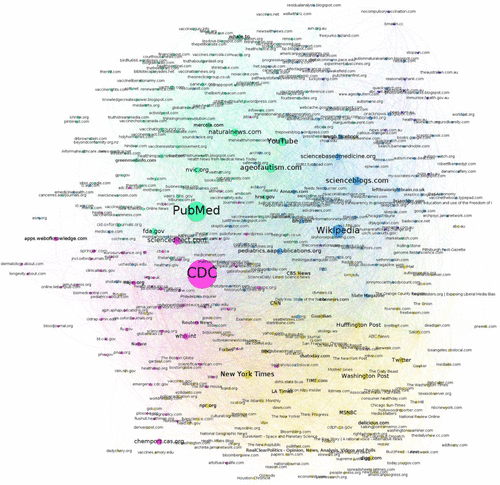
Figure 1. The network map of the top 500 publishers about vaccines by hyperlink degree centrality, demonstrating social clustering, who is linking to one another, and how frequently: a vaccine-hesitant community (green), a health and science community (pink), a provaccine community (blue), and a mainstream media community (yellow) that used language common to both provaccine lay audiences and science.

A 2018 study analyzed the influence of vaccination related information sources based on Hyperlink Indegree Centrality, meaning the number of times the source is linked to on other web pages. The labelling is based on the most common vaccine sentiment found on each of these sources; individual stories from these sources may lean a different direction.  As shown in the figure, there is very little overlap between the different types of sources. When an individual posts on Facebook about a vaccine-related topic, they will see content with similarly hyperlinked sources, and as a result have only have background data from limited sources.

It is a problem that Facebook has recognized, and announced a need to address. A Facebook VP stated, False news is harmful to our community, it makes the world less informed, and it erodes trust. It’s not a new phenomenon, and all of us — tech companies, media companies, newsrooms, teachers — have a responsibility to do our part in addressing it” (Facebook.com). Potential options for changing the algorithm could include not featuring known anti-vaccination posts as suggested content for users, or by putting anti-vaccination material farther down the list of search results (Cohen & Bonifield, 2019).  It is a complicated balance between censorship and limiting the spread of harmful misinformation, but adjusting the algorithms to promote a wider dispersion of verified information would help to limit instances of availability bias when it comes to information about vaccines.

References

Cohen, Elizabeth, and John Bonifield. “Facebook to Get Tougher on Anti-Vaxers.” CNN, Cable News Network, 26 Feb. 2019, http://www.cnn.com/2019/02/25/health/facebook-anti-vaccine-content/index.html.

Kahneman, Daniel. Thinking, Fast and Slow. Farrar, Straus and Giroux, 2015.

“Measles Cases and Outbreaks .” Cdc.gov, Centers for Disease Control and Prevention, 25 Feb. 2019, http://www.cdc.gov/measles/cases-outbreaks.html.

“Working to Stop Misinformation and False News.” Facebook.com, 7 Apr. 2017, http://www.facebook.com/facebookmedia/blog/working-to-stop-misinformation-and-false-news.

Oral genetics & cavities

Every six months or so a checkup at the dentist results in the news of new cavities or a perfectly clean mouth, which often appears to reflect one’s attention to oral hygiene. If the news is new cavities, reflecting on how detailed one was with their daily regiment and advice from the dentist generally ensues. I recently went to the dentist and was told that I have a cavity on one of my molars which was very surprising because I floss and brush my teeth every single day. This lead me to question what other factors come into play with oral hygiene (besides diet). Knowing that my father has a very unfortunate history with his many tooth-related ventures, I wondered whether or not cavities are merely genetic phenomena and if, even though I floss and brush every day, I’m bound to have oral hygiene troubles.

A study contributed to by many institutions, including the J. Craig Venture Institute, examined the presence of oral microbial bacteria in 485 twins from age 5-11 via mouth swabs. Twins of both dizygotic and monozygotic types appeared, to increase the range of similar genotypes and thus the specificity of the results. Caries, age, and sugar are three factors that were in consideration as a cause of increased bacteria, as shown below. The image below also represents a basic separation of the heritable and environmentally-determined bacteria in the subjects who were more and less similar.

Cell Press 2017

In bacteria that were highly heritable, age, sugar, and caries appeared to increase with decreased bacterial presence, showing a negative correlation. In bacteria mainly modulated by the environment, caries seemed to increase as the abundance of bacteria increased. In other words, the environment has a large impact on the number of bacteria and therefore carries within the mouth, but in cases of heritable bacteria, an increase of age and a decrease of sugar intake will decrease the damaging effects that bacteria can cause. Also, heritable bacteria appear to not have a relationship to caries present in the mouth. All in all, the study found that
1. Heritable oral bacteria do not cause or lessen the existence of caries. 2. Environmentally-derived bacteria, from one’s diet, for example, do impact the presence of caries and often remain similar in number between genetically similar individuals. 3. With age, heritable bacteria may decrease.

“Thus, while the human oral microbiome composition is influenced by host genetic background, potentially cariogenic taxa are likely not controlled by genetic factors” (Cell Press 2017).

In conclusion, the Cell Press study shows that heritable oral bacteria is, in fact, genetic, but has no clear relationship with the presence of cavities and can decrease as one ages. Therefore, having misfortunes with my oral hygiene is partially genetic, but the presence of heritable bacteria that I have will decrease over time and does not cause cavities. It’s my environment (i.e. diet) that most heavily influences my oral hygiene state. Knowing that cavities can’t be blamed on genetics, more caution should be taken when choosing what foods to eat (sugar, carbohydrates, etc…) that could potentially be cariogenic.

*Caries = cavities

References:

Gomez, Andres, et al. “Host Genetic Control of the Oral Microbiome in Health and Disease.” NeuroImage, Academic Press, 13 Sept. 2017, http://www.sciencedirect.com/science/article/pii/S1931312817303463.

Ethical Materialism; Will Money Make Me Happy?

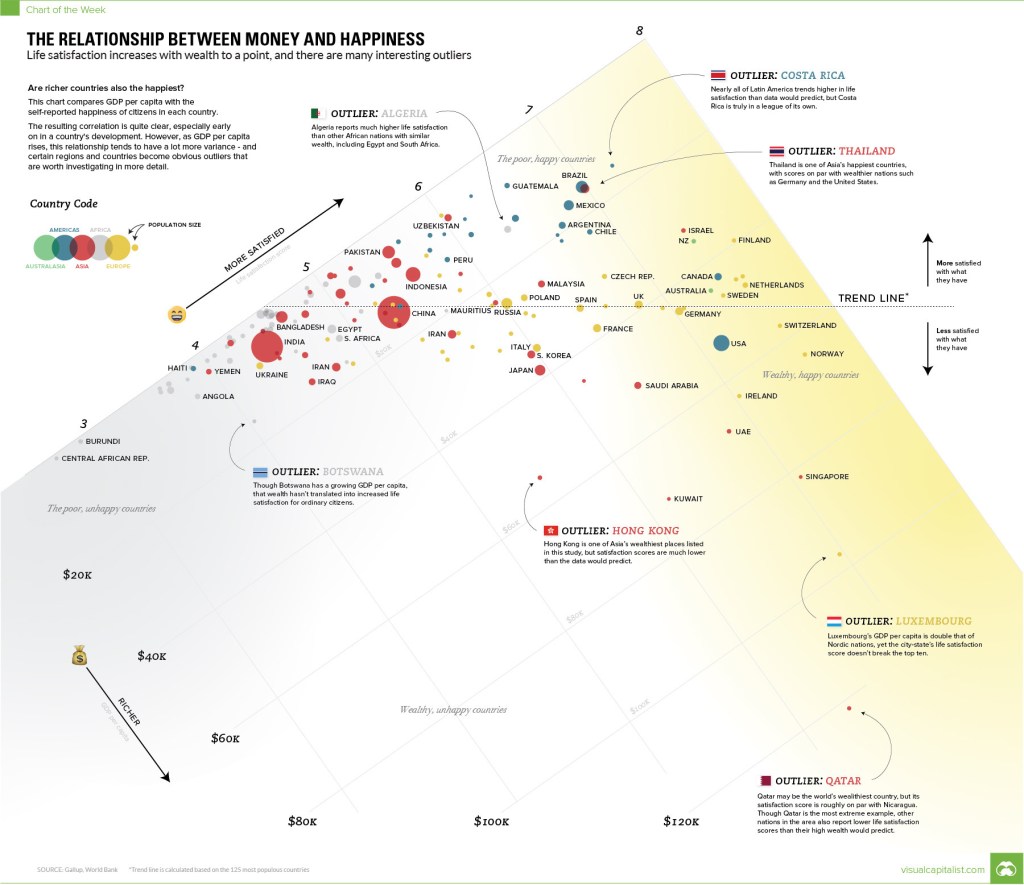
We have all heard the cliché adage, “money can’t buy happiness”. However, the contradicting grade school retort “well, no one ever looks sad on a jet ski” brings up an interesting ethical question; What is the relationship between money and happiness? The folks at Visual Capitalist believe that they have found the answer to the question, and conveniently graphed it for us. In their survey of the relationship, they came to the conclusion that yes, money is tied positively with happiness, to a point. In line with the diminishing marginal utility of money, the data, based on reports from the World Bank and the World Happiness Report 2017, shows a relationship confirming that money is only as good as it provides for the material needs of a person, and then does not provide the same amount of happiness per dollar, at a diminishing rate.

The graph itself is a visual ensemble of grid points which intersect with nations at points reflecting GDP per capita as an indicator of ‘happiness’.

https://www.visualcapitalist.com/relationship-money-happiness/ for a higher resolution image

In this chart, average household income is the only variable of happiness used, but shows a surprising trend that money only provides happiness to a certain limit, and that the trend is not a general rule.

Nearly half of the countries used in this data set are below the ‘happiness trend line’, which would refute a supposed positive correlation of an increase in money with an increase in happiness. However, half of the countries are also above that line, almost implying that the study itself is inconclusive. That’s only partially true, because the interesting results are in the early increases of money by regional specificity. Central and South American countries increase their happiness with initial average money increases between $10K and $20K at an incredible amount, whereas middle eastern countries and south Asian countries do not follow the same trend, floating below the trend line. This seems to imply a cultural significance in happiness, which correlates nicely with the variables used in determining happiness in the World Happiness Report 2017; GDP per capita, social support, healthy life expectancy, freedom to make life choices, generosity, and perceptions of corruption.

So, to give money its due credit, it does play a role in living well. The scattered results seem to imply that money increases happiness when it meets living standards, that is can provide the basic material necessities of life. However, money as a measure of GDP per capita is not an adequate measure because the averages taken for a nation ignore incredible gaps of disproportionate incomes (i.e. income inequalities) that may account for datasets from the middle east.

Money and happiness do have a relationship, but that relationship is dependent on other factors and is subject to diminishing marginal happiness (or utility) around the $40K-$60K markers. The strongest case for money increasing happiness seems to lie in actuality in the $10K-$20K markers in Central and South America. However, I personally believe that there are other factors not accounted for here when comparing on a global scale, such as the cost of living standard which varies incredibly between cities, let alone nations. There are also religious and cultural factors which place less on material wellbeing to focus on mental or spiritual enlightenment which may skew the data. As for Ethical Materialism, the jury has still not reached a verdict.