Does eating nuts decrease the risk of a diabetic person developing a cardiovascular disease?

Modern, developed society is moving into an era of preventative healthcare. Instead of focusing only on how to cure diseases that people already have, researchers are increasingly concerned with determining how to prevent people from ever developing them. Because of the importance of diet in determining how healthy people are, a lot of preventative healthcare measures concern what people eat, and nuts are one food item that many scientists argue have lasting health benefits. One study done on people with diabetes claims that eating nuts, particularly tree nuts, can greatly reduce the chances of people developing cardiovascular diseases. Could eating nuts really decrease the likelihood of diabetic people developing heart issues?

The study, published by the American Heart Association, was done on 16,217 men and women with diabetes. The goal of the study was to compare the participant’s nut consumptions to their risk of developing cardiovascular diseases. Nut consumption of each participant was tracked using a validated food frequency survey, in which people had to input information about their dietary habits. Participants in the study updated their answers to the survey every two to four years. After collecting data about people’s food consumption, researchers did a follow up during which they assessed the frequency of cardiovascular disease and death in the participants. During the follow-up, scientists found 3,336 instances of cardiovascular disease and 5,682 deaths. The participants were broken up into categories based on their nut consumption. The health data was then compared between two groups of the participants, those who ate at least five servings of nuts every week and those who ate less than one serving of nuts every month. The authors of the study claim that people who increased their nut intake after being diagnosed with diabetes had an eleven percent lower risk of developing cardiovascular disease, a fifteen percent lower risk of developing coronary heart disease, a twenty-five percent lower cardiovascular disease mortality, and a twenty-seven percent lower overall mortality.

There are a few issues with the study that immediately stand out. For one, the authors provide no information about the sampling methods that they used. Although the sample size is relatively large, there are no clues as to whether the sample is truly representative of the population, everyone with diabetes in the United States. It is also concerning that the participants only had to update their food intake surveys every two to four years. People’s eating habits can vary quite a bit over the span of two years, and just because they ate a lot of nuts (or didn’t) for a few months out of one year does not mean that they consistently ate them (or didn’t) over four. To make this study’s results more conclusive, scientists should have tracked nut consumption much more frequently.

The researchers statistically controlled for a few outside causes of cardiovascular disease including sex/cohort, body mass index at diabetes diagnosis, smoking status, diabetes duration, nut consumption before diabetes diagnosis, and diet quality. In controlling for these variables, scientists can conclude that the changes in risk of cardiovascular disease that they observed was not caused by any of the factors listed above. Controlling for these variables was an important step, and the researchers argue that by controlling for these factors, they prove that the changes in cardiovascular disease rates were directly associated with nut consumption. However, the study needed to control for many other variables to ensure that they results that they got really were related to nut consumption. They should have also controlled for level of exercise, family history of diabetes and diet, and alcohol usage, just to name a few. It is possible that nut consumption is also related to these variables, and that there is no real association between nut intake and cardiovascular diseases.

The study’s questionable experimental and statistical design should make readers hesitant of their concluding claim. Although increased nut intake may decrease the risk of people with diabetes developing cardiovascular disease or dying, more research needs to be done before anyone can claim that there is a strong association between eating nuts and having a healthier heart.

Reasons for racial divide in post-secondary enrollment

James S. Coleman, along with other researchers claimed that level of aspiration is predictive of career choices, future earnings, and consequently, social mobility. Given that African Americans showed high aspirations in the 1960s, equivalent social mobility has not be observed.  (Equality of Educational Opportunity, 1966) There are some clear flaws in the assumption that a person can move up in socio-economic status just by having the desire to, since it does not take into account financial constraints, academic preparation, and access to information regarding admission process. In order to address these flaws and to contextualize Coleman’s claims, the Equality of Educational Opportunity report concluded that plans for higher education are a result of socialization in the family during high school years. More recently, the national longitudinal data set, High School Longitudinal Study of 2009 attempts to quantify the factors that might affect post-secondary (college) enrollment, including student aspiration. In this blog post, I look at a side-by-side comparison study of the EEO and HSLS:09 by Schneider and Saw (S&S) to assess the validity of their conclusions and some methodology used in HSLS:09.

The HSLS:09 study was started with 9th graders in 2009. The first follow-up was conducted in the spring of the students’ eleventh grade, and the second when the students were in twelfth grade. The participants were graded on various scales including, but not limited to direct aspiration (their answer to what they thought their highest level of schooling would be),  measures of interest-shown, commitment to school and persistence, and enrollment in AP/IB or higher level math courses. The participants were divided based on race, namely white, black, Hispanic, Asian, and other. The results in the study show arithmetic mean and standard deviations for each question/category that is supposed to be related to or indicative of college aspirations in high school students, and the percentages in each race that enrolled in some kind of higher education/training program in 2013, right after graduating high school.

S&S conclude, from analyzing HSLS:09 report that while blacks show significant, and sometimes more aspirations for postsecondary education on a group level, “the gap in college enrollment between advantaged groups (white and Asian) and disadvantaged groups (black, Hispanic, and multiracial) persists. They make important disclaimers like the HSLS:09 can only be generalized to 9th graders in 2009, and comment on the exclusion of delayed college-going behavior, and college persistence and graduation rates. Unlike Coleman’s all encompassing hypothesis, S&S also provide possible explanations for the difference in white and black postsecondary enrollment, like difference in quality of school district, and level of competence of higher level courses in schools that different demographics enroll in. They claim that the low-income, minority students that enroll in higher level courses would be predominantly going to school with low resources, with fewer qualified teachers, and unstable administration, which might explain their not pursuing postsecondary education.

There are a some weaknesses in the methodology used in HSLS:09, and S&S’s interpretation of data in their study. First, HSLS:09 report is made on the assumption that college aspirations equal actual intention or realistic expectation of going to college. First generation and low-income students tend to be more enthusiastic about going to college in order to alleviate their social standing, but might not have the same expectation of going to college as their more privileged counterparts. This might be an alternative explanation to why white students don’t show as much aspirations as black or Hispanic students. Additionally, asking questions about college application to school counselor, taking a campus tour, meeting with admissions counselors, are all used as positive indicators of college aspiration. Minority students significantly outperform white students in this scale, especially black students. However, this difference might be a result of white students already having the foundational knowledge of college application process and requirements, and having other sources to ask questions to, like their parents or relatives. This inquisitiveness of minority students might be an indication of not having adequate information and resources, instead of aspirations. Finally, the HSLS:09 does not adequately represent ethnic differences in its data collection. All whites are grouped together, all Asians are grouped together and so on. The use of arithmetic mean might not adequately represent the data we are looking at. Not all kinds of Asian do well, and the data is probably skewed because of that. Moreover, there is a significant population of low-income white people that need assistance but is included in the same pool as middle class and upper class whites.

Abbreviations:

EEO : Equality of Educational Opportunity

S&S: Schneider and Saw

HSLS:09: High School Longitudinal Study of 2009

Resource used:

https://www.jstor.org/stable/10.7758/rsf.2016.2.5.04?Search=yes&resultItemClick=true&&searchUri=%2Ftopic%2Fminority-group-students%2F%3Frefreqid%3Dexcelsior%253Ab89115bdb228966fb2a73dfadb48e3a7&ab_segments=0%2Ftbsub-1%2Frelevance_config_with_tbsub

Resource(s):

Is Red Meat Bad for You?

Many of my friends and family have been switching to a red meat free diet. Generally, they seem to support this decision through either prospective environmental benefits, or health benefits. The environmental benefits are well supported, as the meat industry clearly produces a heavy carbon footprint. With regards to the health benefits, anecdotally I have heard many people claim that they “feel better” after cutting red meat from their diet; but this is not enough to prove red meat is unhealthy. I want to know: Is red meat considered a healthy food option?

To find out, I followed the standard procedure in answering any generic question in the modern age: I googled it. This grueling methodological process led me to an article entitled “Is Red Meat Bad for You, or Good? An Objective Look” from a website called HealthLine. This articles attempts to answer the question that is its namesake by providing lots of data from three different categories: Distinctions between kinds of meat, nutritional data of the average red meat portion, and data from studies concerning red meat’s links to diseases like cancer, diabetes, and heart disease. The article uses these three data sets by considering the data about types of meat to assist in analysis of studies that argue red meat is unhealthy, and then weighing that analysis against the raw nutritional benefits of red meat. Through this data, the articles provides a compelling study driven argument that “there is no strong evidence linking red meat to disease in humans” and that “properly cooked red meat is likely very healthy”.

The article explains the key differences between types of red meat, including the risks and benefits associated with them. This includes processed meat, conventional red meat, and grass-fed, organic meat. The article then asserts that these differences are vital in comparing studies that concern the health benefits/risks of red meat, since these categories each have different proven nutritional compositions. This is a responsible framework to set up for analyzing the data from different studies, because it acknowledges that “red meat” is a broad category and should be broken up into smaller, more measurable pieces. It also introduces an important metric of quality to the question at hand.

The article then details the known nutritional benefits of red meat. This is helpful data because when determining if a food is healthy, the nutritional facts are vital. This is also helpful because many studies are trying to prove that red meat is unhealthy. We need to be able to weigh the risks determined in those studies appropriately against the known benefits in order to successfully answer the question at hand.

The article then cites numerous scientific studies as data both in support of and against red meat. The article assesses the credibility of studies linking red meat consumption to various diseases, and determines that because they are observational studies, they are not conclusive. It then proposes that randomized controlled trial based studies would be more conclusive, because they contain less margin for confounding factors. While the observational studies established a correlation between red meat consumption, the randomized controlled trials did not.

By looking for more reliably unbiased data, and by including additional metrics for evaluating that data, this article answers the question of whether or not red meat is healthy in a logical and transparent way. Each data source is cited and linked, which makes the argument more reliable as well.

Man Verses Machine; Will AI Increase Inequality?

Or, ‘Did the 19th Century Luddites Understand Capitalist Employment?’

The inequalities of income and wealth in our society is the determining feature of our nation’s economic and political success. In comparison with other developed, capitalist nations, the United States ranks tenth in income inequality and second when state redistributive functions are accounted for. According to Emmanuel Saez’s research, in 2012 the top one percent of families made 22.5% of gross income, up from 10.8% in 1982, while 90% of the population only accounted for 49.6%, down from 64.7% in 1982. Richard Wolff’s research shows that wealth inequality is even worse than income inequality, with the top fifth of families holding 88.9% of all wealth in America. Inequality is a severe economic issue, for our capitalist system of production is based in consumer demand, and the largest demographic of consumers are those most hurt by growing income and wealth inequality. Productivity has increased 74.4% from 1874 to 2013, however, hourly compensation has only increased by 9.2% in the same span of time. The difference between productivity and compensation shows us that employer profits are increasing while workers compensation is not matching the revenue they generate. There are a number of causes for this gap, likely globalization, the lack of collective bargaining, and specifically advances in technology. Simply put, the cause of inequality in its most general form is hyper-efficiency in profit-generation. Further more, new research is showing that advances in AI may replace up to 50% of jobs in the united states. Will the advances in artificial intelligence increase income and wealth inequality in the US? If employment trends follow their historical trends, then the introduction of AI into the workforce will most likely increase the unequal distribution of income and wealth.


In a study posted by the World Economic Forum, the current speculation (the risk) regarding the percent of the workforce that will be replaced by automation in the US is 47%, relatively low compared to less developed nations. However, that is nearly 50% of the US workforce which human workers will be excluded from. This is important because workers are consumers (see Marx’s simple circuit of for laborers, C-M-C), and consumer spending makes up 68% of the US economy. Over 2/3 of the economy is driven by workers, and 50% of the workforce is at risk of replacement- that is, exclusion from a wage.

https://www.weforum.org/agenda/2018/04/ai-has-a-gender-problem-heres-what-to-do-about-it/

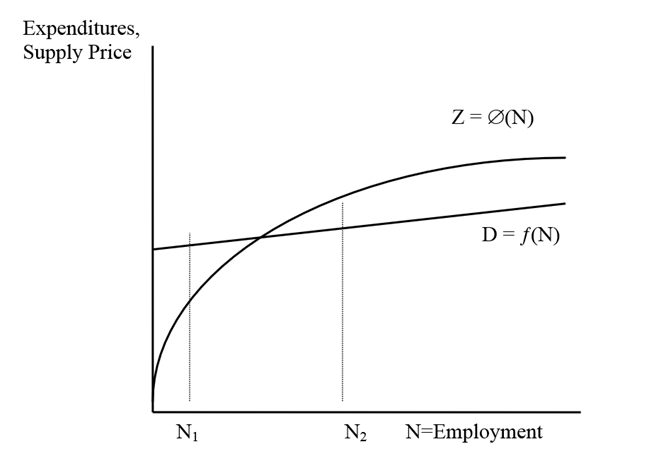
So how exactly will the introduction of artificial intelligence increase inequality? The answer lies with John Maynard Keynes. In The General Theory of Employment, Interest, and Money, John Maynard Keynes calls the principle of effective demand the “explanation of poverty in the midst of plenty.”[1] As an explanatory device of understanding the allocation of wealth in an economy, the principle of effective demand is a powerful tool in the pursuit of understanding economic inequality because it is the aggregate of the fundamental axioms of allocation and distribution in a capitalist economic system. The first characteristic of the principle of effective demand is that “the propensity to consume and the rate of new investment determine between them the volume of employment.”[2] Employment is determined by the willingness of consumers to part with their money (the propensity to consume is the first factor of the Demand schedule, D1), and the rate of corporate investment into production and wage compensation (The second factor in the sum of the Demand schedule, D2) driven by the expectation of profit (Z). The production schedule of privately owned means of production is dictated by the profit off sales to consumers, and access to the products of the privatized means of production is dictated by money, acquired through a wage.

[1] Keynes, John Maynard. The General Theory of Employment, Interest, And Money. (New York; First Harvest/Harcourt) 1964, page 30

[2] Ibid, page 30

The Principle of Effective Demand, Courtesy of John P. Watkins

The employment of AI (i.e. a preference for capital [K] over labor [L]) is an example of the aforementioned hyper-efficiency in profit-generation. Furthermore, the shift in employment preference towards capital is a result of the neoliberal policies enacted in the Reagan era. The progressive moment following the Great Depression and WWII did cause the cost of human labor to increase, and put more people in employment, but set up the conditions which increased shifting of the employer preference towards the employment of more capital than human labor. Capital does not need humane working conditions. Capital does not take breaks or go on vacation. Humans were not designed. Humans evolved randomly through mutations that happened to benefit our existence. Capital is designed to work. Capital is efficient, and efficiency is the doctrine of profit. The progressive movement saw a decline in the seventies, as did the age of prosperity, and the “need for flexibility in production was extended to the need for flexibility in labor markets.”[1] This is owning to the growth of “post-fordist production techniques based on the information and communication technology revolution”[2],which caused the strengthening of capital utilization unless workers gave up their benefits and left the unions, thus devaluing their capabilities.


[1] Bowles, Paul. Capitalism. (Great Britain; Pearson Education Limited) 2007, page 18

[2] Ibid, page 18


In conclusion, if employment trends follow the same model of the past 50 years, income and wealth inequality will increase with the introduction of artificial intelligence in the workforce. The inequality may even be furthered by the economic crises following the worker displacement and efficient production, such as a crisis of overproduction and underconsumption. Unless policy trends which historically favor the 1% become more humanistic, and take into consideration the workers whose backs the American economy rests upon, artificial intelligence will become the danger to society it has been represented as in fiction. Except, instead of The Terminator, it will be The Baconator (artificial intelligence under the employment of McDonalds, I am aware this is a stretch) which upsets the modern era.

The Rags to Riches to Rags Story

Despite my best efforts, I often have difficulty mustering sympathy for those who make millions of dollars annually for doing something I consider to be “useless”.  But over these last few weeks, as we have engaged with all manner of sociological theories I keep coming back to the question of why it is so many professional athletes go broke so quickly after leaving their career.

To begin this discussion I think it’s important to understand what exactly the numbers are.  According to an article by Chris Dudley, an estimated 60 percent of NBA players alone go broke within five years of leaving the league and a similar phenomena is seen in the NFL where approximately 78 percent of players go bankrupt after just two years (Dudley 1).  I feel as though it’s important to note here that, while Dudley does not cite specific information, the fact that someone brought it up in class discussion seems to indicate that it is somewhat reliable. These numbers, if accurate, are shocking. I can’t imagine this is something commonplace among other high-earning occupations.

So what exactly might be behind this?  Dudley’s own diagnosis is that professional athletes are the victims of predatory contracts, aggressive financial advisors who direct the players towards scams, and alienation from their wealth (Dudley 2-3).  This is also coupled with the fact that the actual earning period of professional athletes, unlike other high-earning occupations, is only a few years (Dudley 2). As a result of these compounding factors, professional athletes come into vast sums of money very quickly and are encouraged to use it while they have it only to discover that they didn’t save any for a rainy day.

I think this pattern of behavior among professional athletes is somewhat of a microcosm of James Coleman’s theory of social capital.  The two fundamental elements of social capital can be seen in the way professional athletes relate to those who they place in charge of their wealth.  Those two elements being both trustworthiness of the social environment and the extent of the obligations held (Coleman 2). As professional athletes come into tremendous sums of money, they turn to financial advisors to manage it, no doubt under the assumption that they manage with the athlete’s interests in mind, and the more money they make, the more they come to rely on their financial advisors.  

It is in this relationship that we can observe that social capital is often created and used in an imbalance.  Athletes, not wanting to be burdened with the direct management of their resources, place trust in their advisors but the advisors, seeking to make money for themselves, take the trust placed in them and run with it.  This isn’t, of course, to say that all financial managers are leeches (#notallfinancialmanagers) but it is certainly illustrative that Coleman’s theory is not always balanced. Just as some economic models presuppose rational action and equal distribution of information, it is easy to imagine that social capital operating in the same fashion.  But given the fact that people lie or cheat adds an entirely different wrench into the equation. Humans, both in physical and social markets, do not always act rationally or honestly.

Sources Accessed:

Money lessons learned from pro athletes’ financial fouls” – Chris Dudley

Human Capital and Social Capital” – James Coleman

Vaccines and Autism

Do people still believe in the link between vaccines and autism? If so, whom?

The flaws behind one survey that seeks to answer this question.

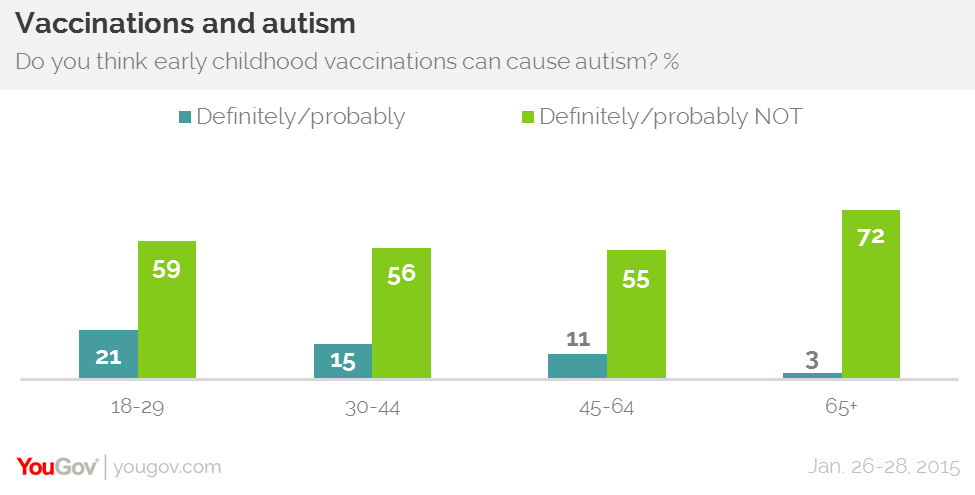
YouGov is an American company that supplies poll data to its paying clients via online surveys taken by its users. In 2015, one of their panelists Peter Moore published an article titled “Young Americans most worried about vaccines”. The article discussed two questions from the survey and displayed a graph for each with the results. These are shown below.


When looking at these two graphs, I realized that each percentage combination per age group does not add up to 100%, which means that participants might have abstained for the question or YouGov simply chose not to display the answer given by the other percentage of participants. This can be problematic because viewers don’t know where the other participants lie. Coupled with this curiosity, I also wondered what types of participants were being surveyed and if this was a representative sample.

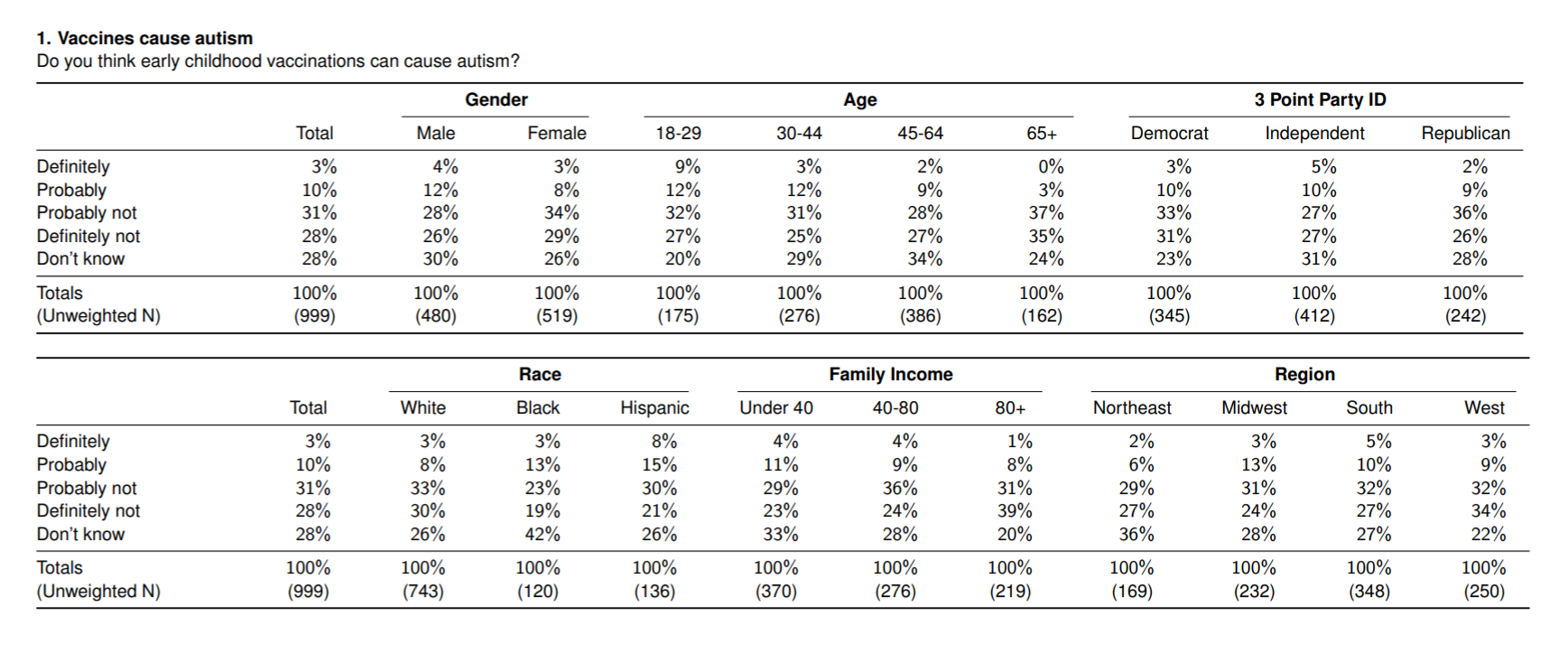
After finding the full version of the results from the YouGov survey, I found that Moore’s graphs and general article information were highly simplified versions of the full results. Simplifying data makes writing easier because one is able to focus on what is important to their claim or pointed subject, like two specific questions in this case; However, Moore left out important details about how the data was collected and grouped for the sake of simplicity. Below is an example of a question from the full report.

YouGov

The full results from the online poll group surveyors by age, race, gender, etc… as well as “Definitely” to “Definitely Not” as well as “Don’t Know”, yet all groups are combined to differ only by age in Moore’s presentation of the findings. Referring back to the missing percentage in his simplified graphs, one can see that there is not a category for “Don’t Know” like there is in the full results, and each response type is combined with another rather than separated. Simplifying data results is not necessarily a good or bad thing, but it can limit the ability of viewers to have accurate and holistic information on the findings, as they only have access to a small piece of the results.

While the data from this survey might be helpful in answering questions related to people’s beliefs of vaccines and autism, it isn’t wholly representative of American and even human/world views. YouGov collects data via online surveys and offers cash prizes to those who participate after they have accumulated a certain amount of points. This means that the people who are represented in these results all willingly took this survey most likely because they were receiving a cash prize, and they are all people who have accounts with YouGov, not general internet participants. An example of this being incomplete representation is the idea that more millennials use the internet than older people, so millennials overall are being better represented, whereas individuals 65+ are being generalized by those who happen to use the internet, have YouGov accounts, and chose to participate in this poll. These are some general issues with online surveys and point out some things to consider when finding data to rely on to answer questions.

Overall, there are some flaws in Moore’s analysis of YouGov’s results detailing people’s responses to questions about vaccines, as well as the initial surveying by YouGov. The information given by both is not representative of all people’s beliefs nor even those of all Americans, but it can give one some idea of what people currently think about the connection between vaccines and autism, especially in relation to their age.

References:

Moore, Peter. “Young Americans Most Worried about Vaccines.” YouGov, 2015, today.yougov.com/topics/lifestyle/articles-reports/2015/01/30/young-americans-worried-vaccines

“YouGov | About.” YouGov, 2018, today.yougov.com/about/about/.

Citizenship and the 2020 Census

Beginning in April, the U.S. Supreme Court will hear oral arguments concerning the legality of the Trump administration adding a citizenship question to the 2020 census.  The reasoning that the Department of Justice gives for the addition is that to be able to efficiently enforce Section two of the Voting Rights Act, which prohibits voting discrimination based on race or membership in a minority group (Lind, 2019).  Opponents to the question argue that this addition will discourage millions of immigrants living in the U.S. from filling out the survey, and will threaten the integrity of the data set.  What are the potential problems with underrepresentation in the U.S. census count?

The U.S. constitution requires a count of all people people within the U.S. every ten years (art. 1, sec. 2).  This has been interpreted to include all people, regardless of citizenship status.  This count is used to determine representation in congress, designation of voting districts and allocation of funds. Every ten years, the government goes through the task of trying to count every human being residing within the United States. This is an enormous undertaking that requires public cooperation.  In 2010, only 72% of Americans responded with the forms by mail (Lind, 2019).  Temporary census takers were hired to fill in the rest of the gaps, but renters, people experiencing homelessness, and topographically complex areas made the process much more difficult, census takers in some cases having to visit houses up to six times.  Estimates are around 95% accuracy (Lind, 2019). However, because low-income and minority populations tend to have more transient housing situations, these are the communities in which undercounting more often occurs.

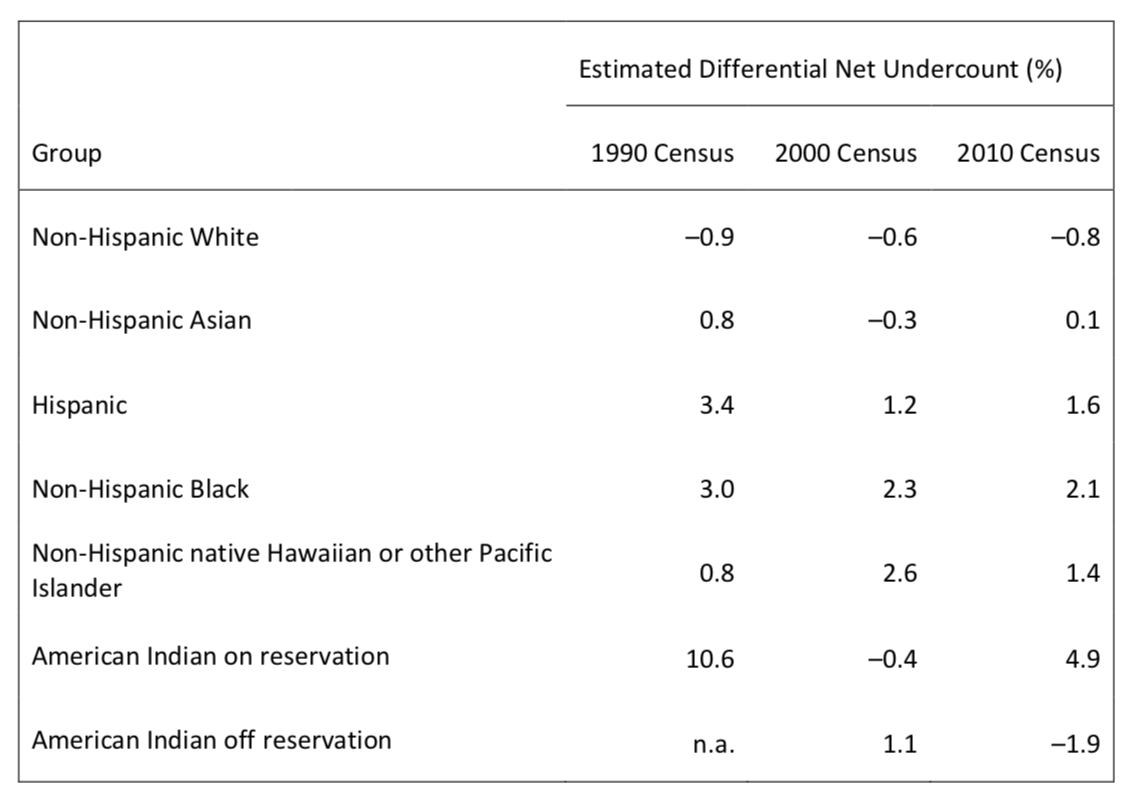
Table 1. Estimated differential net undercount rates for demographic groups in last 3 censuses. Screen Shot 2019-02-16 at 2.03.25 PM

H. Hogan, P. J. Cantwell, J. Devine, V. T. Mule Jr, V. Velkoff, Quality and the 2010 census. Popul. Res. Policy. Rev. 32, 637–662 (2013).

The above chart shows estimations of undercounting in the past three censuses.  With the current census questionnaire, it is estimated that Latino populations were undercounted by 1.2 percent in 2000 and 1.5 percent in 2010. Although the Census Bureau says that this change was not statistically significant, with the growing Latino population, this proportion will continue to grow larger.  The 2010 census had an average measured error of 0.6% for states.  If the same error holds true for the 2020 census, researchers project that Texas loses and Minnesota gains a seat.  If the error increases to 0.7% Florida will lose a seat, and Ohio will gain a seat.  If the error increases to 1.7%, Texas will lose a second seat, and it will go to Rhode Island (Seeskin, 2018). These changes are not the result of demographic shifts, but from errors in data.  States with high minority populations face the impacts of these errors.  Less representation means that their specific needs hold less priority in governmental decisions, and the areas that they live in receive receive a smaller proportion of allocated funds.

This is all before the addition of the citizenship question. The worry is that the census could pass along citizenship data to immigration authorities, which could lead to deportation.  Although the Census Bureau cannot legally share individual’s information with other branches of government, the current administration’s policies on immigration and citizenship do not breed confidence.  Opponents predict that many people without citizenship status, and even immigrants with citizenship would be less inclined to fill out the form if they have to answer a citizenship question.  As of 2016, nearly 44 million immigrants lived in the U.S., making about about 13.5% of the total population (Zong, et al, 2018).  If this huge proportion of the population is not accounted for in the census, it will result in significant changes in allocation of resources, with mainly low-income and minority populations affected.  It should also be noted that this is the first time that congress is using a cost target instead of an accuracy target, which brings into question how committed this administration is to getting an accurate count.

References

H. Hogan, P. J. Cantwell, J. Devine, V. T. Mule Jr, V. Velkoff, Quality and the 2010 census. Popul. Res. Policy. Rev. 32, 637–662 (2013).

Lind, Dara. “The Census Lawsuit Headed Straight to the Supreme Court, Explained.” Vox.com, Vox Media Inc., 15 Feb. 2019, http://www.vox.com/policy-and-politics/2019/2/15/18226578/census-supreme-court-lawsuit-citizenship-question.

Seeskin, Zachary. “Balancing 2020 Census Cost and Accuracy: Consequences for Congressional Apportionment and Fund Allocations.” Northwestern Institute for Policy Research, 11 May 2018, www.ipr.northwestern.edu/publications/docs/workingpapers/2018/wp-18-10.pdf.

Zong, Jie, et al. “Frequently Requested Statistics on Immigrants and Immigration in the United States.” Migrationpolicy.org, 27 Feb. 2018, http://www.migrationpolicy.org/article/frequently-requested-statistics-immigrants-and-immigration-united-states.

Is the Increase in Participatory Politics Racially Representative?

Participatory Politics is defined as “Interactive, peer-based acts through which individuals seek to exert influence on issues of public concern”. Data from the Participatory Politics Study by New Media and Youth Political Action suggests that 41% of young people ages 15-24 engage in participatory politics, most of which is in the social media realm. 

(Cohen & Kahne YPP Study)

Donald Trump and Alexandria Ocasio-Cortez may be political opposites, but they share one major trait in common: their knowledge and influence over social media platforms which encourage participatory politics. Facebook comment wars are commonplace, Instagram and Twitter have become legitimate sources of information for millennials and younger generations, and participatory politics is growing in popularity and scope. However, when analyzing the increasing trend of participatory politics, it is important to analyze the minority level of engagement so that political figures may accurately spread information that can be seen/heard by their intended audience. So, does the increase in participatory politics accurately represent the minority youth?

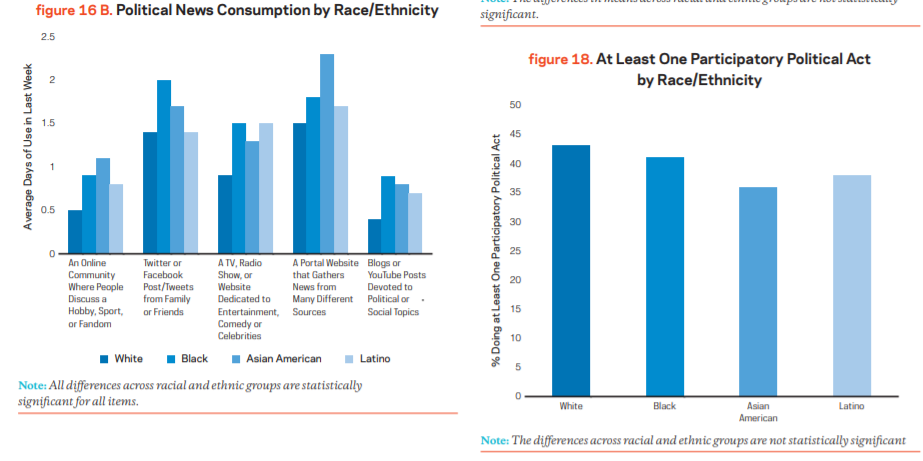
Cathy J. Cohen of the University of Chicago and Joseph Kahne of Mills College (along with their respective research teams) conducted a survey with 3,000 participants aged 15-25 years old. Their participant base included “large numbers of Black, Latino, and Asian-American respondents” (Cohen & Kahne 9) from a variety of states and socio-economic backgrounds. The diversity of this data-set is promising and draws from minority groups to be more representative, so Cohen and Kahne drew the following graphical conclusions from their survey:

Figure 16 B shows that the general youth currently gather their information from participatory channels such as Twitter and Facebook as well as interpersonal relationships, instead of traditional forms of media such as newspaper and magazines. Furthermore, the disparity between races and their average participatory actions within a week, is significantly less than most would assume—as seen in figure 18 on the right. The four surveyed races have a similar percentage of participatory political acts, and visit/interact with multiple channels of information gathering; meaning that activity in participatory politics is racially diverse according to this specific sample.
            The conclusions drawn from the sample are sound, however the sample is not entirely representative. Cohen and Kahne admit that “Because the sampling design deviated from a simple random sample of the population, particularly in its oversampling of minority groups, the raw data are not a representative sample of young people in the US” (Cohen & Kahne 40). However, a priority of the study was to include more minority youth, so the claim that it is not a simple random sample is true, but it should not detract from the validity of the study. If anything, this study should be expanded upon to include more minority races, and gather more respondents to continue to legitimize the sample and its conclusions.
            From Cohen and Kahne’s study, it is apparent that the racial differences within participatory politics do exist, but the differences are not as large as one may have previously thought. It is important to recognize the racial and socio-economic limitations of minority groups so that others can help to bridge the divide, and create a more cohesive society that is politically informed and has equal opportunity to exercise their privilege to participate in political issues.

References:
Cohen, Cathy J, and Joseph Kahne. Participatory Politics. MacArthur Foundation’s Digital Media and Learning Initiative, ypp.dmlcentral.net/sites/all/files/publications/YPP_Survey_Report_FULL.pdf.

The implications of online learning for gender equality in the workforce

The Digital Age has undoubtedly broadened the accessibility of information, and the American education system has begun to evolve accordingly. The Heritage Foundation announced that “online learning is revolutionizing K-12 education and benefiting students” (Lips, 2010). The same publication describes that “[a]s many as 1 million children (roughly 2 percent of the K-12 student population) are participating in some form of online learning” (Lips, 2010) and cites a meta-analysis from the U.S. Department of Education that found that “students who took all or part of their class online performed better, on average, than those taking the same course through traditional face-to-face instruction” (U.S. Department of Education, 2010, p. xiv). The Heritage Foundation article repeatedly mentions online learning’s potential to reduce taxes because of its lower cost compared to funding educators. However, by advocating for this cheaper alternative to traditional methods of education, the Heritage Foundation perpetuates the effects of sexism in the workforce.

Despite making up the majority of the field, women continue to face discrimination in education. The number of male principals is disproportionate to how many teachers are men. While 76% of public and private K-12 teachers are female (U.S. Department of Education, National Center for Education Statistics, Schools and Staffing Survey, 2012c), women hold only 51.6% of principal positions at public schools (U.S. Department of Education, National Center for Education Statistics, Schools and Staffing Survey, 2012b) and 55.4% at private ones (U.S. Department of Education, National Center for Education Statistics, Schools and Staffing Survey, 2012a). At the postsecondary level, women are more likely than men to fill lower level professor positions such as the roles of assistant professor, instructor, and lecturer (U.S. Department of Education, National Center for Education Statistics, 2016). Similar to the demographics of hierarchies in the K-12 system, only 30% of college presidents are female (American Council on Education, Center for Policy Research and Strategy, 2016). Furthermore, a study in Pennsylvania found a pay gap between male and female educators, even when accounting for outside factors (Barnum, 2018). Therefore, not only do women complete most of the work in the education profession, they are undervalued as represented by their unfair remuneration.

Because of the gender disparities in the education field, a shift towards online learning would mainly disadvantage women. This report from the Heritage Foundation promotes online learning by emphasizing its low cost; specifically, the author cites Terry M. Moe and John E. Chubb’s Liberating Learning, where the authors “estimate that a school could reduce its teaching staff by approximately one-sixth if elementary school students spent one our per day learning electronically” (Lips, 2010). Ideologically, replacing educators with digital systems represents a systemic lack of respect for teaching as a profession. Rather, this push for online learning paints teaching as formulaic and mechanical.

The Heritage Foundation advocates for replacing teaching staff, of whom the majority are women and facing a gender pay gap, with online learning systems. This notion continues to resist the view of teaching as a profession and, if enacted, would mainly disadvantage women instead of men in the sector, who are more likely to hold more powerful positions.

References

American Council on Education, Center for Policy Research and Strategy. (2016). American College President Study. College presidents, by gender. Retrieved from http://www.aceacps.org/summary-profile/

Barnum, M. (2018). Chalkbeat. In female-dominated education field, women still lag behind in pay, according to two new studies. Retrieved from https://chalkbeat.org/posts/us/2018/06/15/in-female-dominated-education-field-women-still-lag-behind-in-pay-according-to-two-new-studies/

Lips, D. (2010). The Heritage Foundation. How online learning is revolutionizing K-12 education and benefiting students. Retrieved from https://www.heritage.org/technology/report/how-online-learning-revolutionizing-k-12-education-and-benefiting-students#_ftn5

U.S. Department of Education, National Center for Education Statistics, Schools and Staffing Survey. (2012). Average and median age of private school principals, and percentage distribution of principals, by age category, sex, and affiliation: 2011-2012. Retrieved from https://nces.ed.gov/surveys/sass/tables/sass1112_2013313_p2a_002.asp

U.S. Department of Education, National Center for Education Statistics. (2016). Fast facts: Race/ethnicity of college faculty. Retrieved from https://nces.ed.gov/fastfacts/display.asp?id=61

U.S. Department of Education, National Center for Education Statistics, Schools and Staffing Survey. (2012). Number and percentage distribution of public school principals by gender, race, and selected principal characteristics: 2011-2012. Retrieved from https://nces.ed.gov/surveys/sass/tables/sass1112_490_a1n.asp

U.S. Department of Education, National Center for Education Statistics, Schools and Staffing Survey. (2012). Total number of select public and private school teachers and percentage distribution of select public and private school teachers, by age category, sex, and selected main teaching assignment: 2011-2012. Retrieved from https://nces.ed.gov/surveys/sass/tables/sass1112_20170221001_t12n.asp

U.S. Department of Education, Office of Planning Evaluation, and Policy Development. (2010). Evaluation of evidence-based practices in online learning: A meta-analysis and review of online learning studies. Retrieved from https://www2.ed.gov/rschstat/eval/tech/evidence-based-practices/finalreport.pdf

Cannabis: What happened to Utah’s legalization? Is there a wall separating church and state, or should we “build that wall,” too?

Cannabis, marijuana, or its more informal name, “weed”, has an interesting history both globally and specifically in the United States. Upon analyzing actual data about the way that cannabis benefits the people that are treated, one might find it hard to rationalize why cannabis should be illegal in the first place. I pondered this question myself, and specifically thought about Utah and how this past midterm, we just passed a law that would legalize medical marijuana to some extent. The LDS church wasn’t shy to create a “compromise” with the state within weeks of the turnout. This was met with a lot of question regarding how Utah separates church and state- and if that distinction really exists at all.

The overarching question is what’s everybody’s problem with weed in the first place? A quote from History.com even makes a note of marijuana compared to alcohol: “It’s worth noting that research has shown alcohol to be more dangerous than marijuana. In addition, cannabis doesn’t really cause superhuman strength, and the U.S. Drug Enforcement Administration’s fact sheet on the drug says that “No death from overdose of marijuana has been reported.” That said, marijuana’s legality- or non-legality, in this case- seems to have a lot to do with church influence, since multiple sources of data that would be too long to list in this post suggest that there’s no real science to support the danger of marijuana.

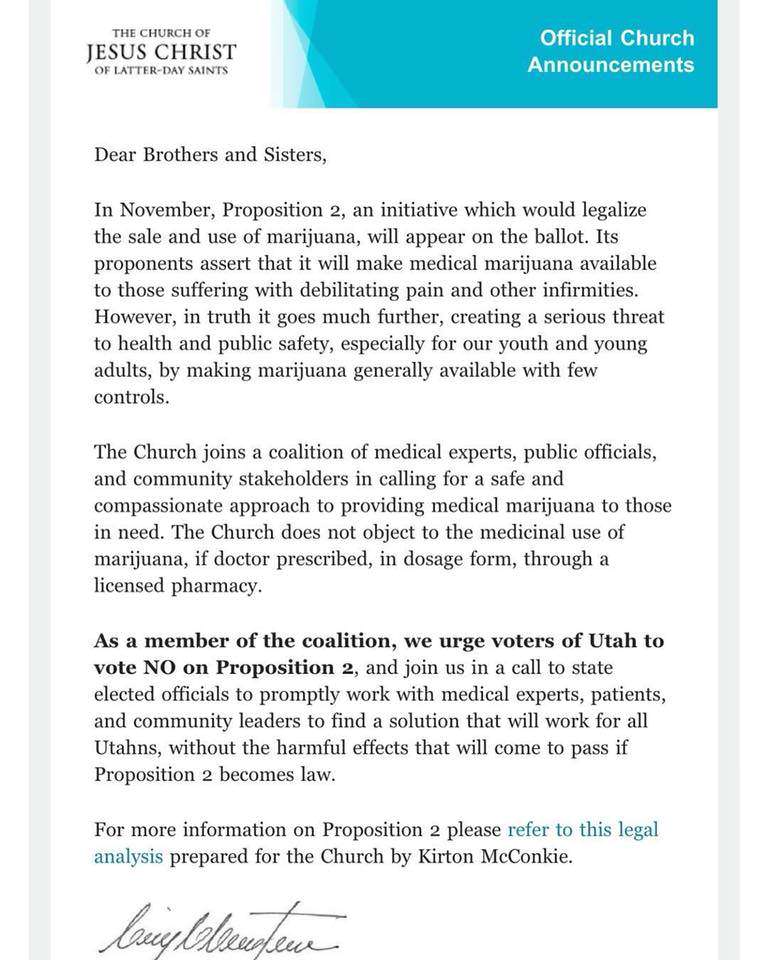
The LDS church sent the following email out to all of its members and potential voters shortly before midterms:
7kd2q0v.jpg

If there was actual data that demonstrated that marijuana is a threat to our youth, there may be a case for their call to action; however, once again, data seems to suggest otherwise. The National Insititute for Drug Abuse, a national goverment website, reports this, following the conclusion that there are few indications from research of cannabis as a gateway drug: “…the majority of people who use marijuana do not go on to use other, “harder” substances. Also, cross-sensitization is not unique to marijuana. Alcohol and nicotine also prime the brain for a heightened response to other drugs and are, like marijuana, also typically used before a person progresses to other, more harmful substances.” Based on this information, and the information earlier cited, it doesn’t seem like the church’s claim of the proposition being a “serious threat to health and public safety” is an actual, legitimate claim.

What happened following the eventual passing of Proposition 2 is the LDS church offering a compromise with the government about the proposition. Because, for whatever reason, the government needs to compromise with a religious body that supposedly is kept separate from the government. What this data appears to show is that the factual data doesn’t actually matter when it comes to decision making, in Utah in this case, but not limited to. It’s all about relationships between different structures of power, which doesn’t seem to discount religious institutes as the constitution would suggest. The LDS church has been a heavy influence on Utah politics for as long as Utah has existed, but it’s not the only example of religion having too big of an influence on politics. The United States’ and Trump’s own secretary of education Betsy Devos has insisted that christian schooling should be mandatory in the education system. As far as building a wall is concerned, perhaps Trump might be more concerned with creating stricter guidelines for how far the church can intervene in politics- especially in Utah.


Sources:


https://www.history.com/news/why-the-u-s-made-marijuana-illegal

https://unewswriting.wordpress.com/2018/11/28/the-aftermath-of-passing-proposition-2-in-utah/

https://www.drugabuse.gov/publications/research-reports/marijuana/marijuana-gateway-drug