Does Realistic End of Life Care Education in Undergraduate Students Help Nurses Give More Compassionate Care?


An NPR article written by Blake Farmer explores a university’s way to improve end of life care for nursing students. The new technology they are using are actors portraying death, using verbal cues that students usually do not hear with robot simulations. They also use actors to emulate dying patient’s family members. Nurses often have to confront patients and their family members with bad news, so by using actors as an education tool, hopefully students focus on how to communicate bad news with compassion. Possessing compassion is extremely important in a nurse’s roles as a healthcare provider, as they help patients and family members through difficult processes. More realistic education tools are becoming more popular because of surveys and research studies that show “death anxiety among young nurses” (Farmer). Does this actually prepare nursing students for what’s to come? Does it help rid their anxiety? Does teaching compassion help with care curriculum? I began looking into the research studies mentioned in the NPR article to find information on the questions I posed.
In 2011, the Department of Health Administration and Nursing at the Virginia Commonwealth University Medical Center sought to find gaps in end of life care in continuing education. Surveys were conducted and found that “twenty-five percent of the respondents do not believe they are adequately prepared to effectively care for a dying patient”( White 2011). Symptom management and how to talk to patients and family members rated one on the top competency inadequacies. Implications of this study result in improving educational curriculum for nurses. In care education for undergraduates, this survey is important because if there can be realistic end of life care education in undergraduate students, it may be beneficial in practice.
Because more realistic end of life care is becoming more prominent today, hopefully inadequacies in caring for patients will decrease. On a personal level, I know that if I have effective tools and skills to communicate with patients and family members about end of life care, I can be better at my job and help alleviate stress for family members.
A review done by “Nurse Education Today” evaluated end of life care in curriculum for undergraduate nursing students. This review was done because “research suggests that nursing students have anxieties and difficulty dealing with death and dying” (Gillan). The review done found minimal content in end of life care in textbooks, and 3% of 311 nursing programs  surveyed in the United States have courses dedicated on end of life education. Results like this can set nurses up for failure in the future. No wonder nurses are stressed and anxious, their field requires end of life care that is a lot more complicated than taking vitals. Compassion and communication are critical for nurses providing valuable care. Realistic end of life education can help cultivate compassion and communication tools for future nurses, which not only help the care they give, but the care we all might receive.
Works cited:
“End of Life Care Education, Past and Present: A Review of the Literature.” NeuroImage, Academic Press, 7 July 2013, www.sciencedirect.com/science/article/pii/S0260691713002098.

White, K R, and P J Coyne. “Nurses’ Perceptions of Educational Gaps in Delivering End-of-Life Care.” Current Neurology and Neuroscience Reports., U.S. National Library of Medicine, Nov. 2011, www.ncbi.nlm.nih.gov/pubmed/22037333/.

https://www.npr.org/2019/01/19/686830475/morphine-and-a-side-of-grief-counseling-nurses-learn-how-to-handle-death

https://uncw.edu/simlab/

Simplifying Recycling May Be Complicating Its Future

Single-stream recycling, the practice of throwing all types of recyclable material into one bin, is incredibly convenient. Some studies have shown that a switch from multi- to single-stream has increased recycling in the U.S. between 30 and 50 percent. But does this user-friendly system really increase the amount of material that is re-purposed, or does it feed our landfills and leave re-processors without usable materials to re-use?

The concept of recycling as it is known today emanates from WWII campaigns to save scarce materials so they can be re-purposed by the military. By the 1960s and 70s, recycling became necessary due to the immense amount of waste that appeared as the U.S. economy boomed after the war. Curbside recycling programs appeared around the 1990s, and were successful, although the mentality of Americans began to shift as they saw recycling as a burden without any direct incentives for themselves. Recycling rates dropped or flattened even as recycling programs increased and improved.

Taken from http://www.container-recycling.org

Single-stream is the newest system implemented in the U.S. to increase recycling by reducing the amount of time the average American spends sorting their waste. New sorting facilities and high-tech machines have been developed to increase efficiency and effectiveness, and larger garbage-sized bins are provided to households to give a visual incentive to recycle. However, single-stream recycling has a 15 to 27 percent residual rate – things that are put into recycling bins but cannot be recycled- compared with 1% for multi-stream systems, and 2-3% in dual-stream systems. This contamination not only increases the amount of material that is sent to the landfill, reducing the 30-50% recycling increase by roughly half, but it also can contaminate the materials that could be recycled. Contamination of materials drastically decreases the quality of the recyclables and does not allow for as much re-processing.


“the quality of the material [that post-consumer materials processors] receive from single-stream recyclers is inferior, which forces the manufacturer to downcycle the material (i.e., use it in a cheaper product) or, even worse, send it to the landfill.”

http://www.container-recycling.org

Depending on the levels of contamination and the type of materials being recycled, the apparent benefits of single-stream recycling may decrease to zero, or possibly result in a negative impact on the recycling stream. As more studies are completed, recycling may once again require more time and effort from Americans.

So what would a decrease in convience do to the recycling rates that are already low? Thinking positively, citizens may now be so accustomed to recycling their waste that reverting back to sorting items into separate bins may not have much of an impact on the percentage of materials recycled. However, it is more likely that as recycling once again becomes more time-consuming and remains without a tangible incentive to the recycler, U.S. recycling rates will once again drop. To environmentally conscious Americans, this could be disheartening and it may force some thought into other sustainable practices like reducing single-use materials or repurposing existing products.

“Recycling is the third R, you have to reduce and reuse first.”

https://www.nytimes.com

Sources:

Albeck-Ripka, Livia. “Your Recycling Gets Recycled, Right? Maybe, or Maybe Not.” The New York Times, The New York Times Company, 29 May 2018, http://www.nytimes.com/2018/05/29/climate/recycling-landfills-plastic-papers.html.

Koerth-Baker, Maggie. “The Era Of Easy Recycling May Be Coming To An End.” FiveThirtyEight, ABC News, 10 Jan. 2019, fivethirtyeight.com/features/the-era-of-easy-recycling-may-be-coming-to-an-end/.

Morawski, Clarissa. “Understanding Economic and Environmental Impacts of Single-Stream Collection Systems.” Container Recycling, Container Recycling Institute, Dec. 2009, http://www.container-recycling.org/assets/pdfs/reports/2009-SingleStream.pdf.

“Single-Stream Recycling.” Scientific American, Springer Nature America Inc, http://www.scientificamerican.com/article/single-stream-recycling/.

Waxman, Olivia B. “America Recycles Day 2016: A Brief History of Recycling.” Time, Time, 15 Nov. 2016, time.com/4568234/history-origins-recycling/.

The Spectre of Inflation In A Modern Monetary Economy

The traditional view held of monetary inflation is that an increase in the money supply results in an increase in the price level. The change of price between two periods of time is the general notion of ‘inflation’, described as a percentage. However, the understanding of inflation rests upon a critical axiom which remains unexamined despite the rapid changes that have occurred in the late twentieth century and the twenty-first century; that inflation has been measured in terms of physical currency which have volume and take up physical space. As of 2018, only (roughly) ten percent of the United States’ wealth is expressed in physical currency. The other ninety percent is digital– numbers on computer screens. At this time, we are afforded the chance to inquire whether or not increases in digital currency impact the price level (i.e. does increasing the mostly digital money supply result in inflation?).

In order to determine the percentage of physical currency in circulation, a ten year review of “Currency in Circulation” and the “Gross Domestic Product” from the Federal Reserve Economic Data of St. Louis (FRED) indicate the estimation of physical currency in circulation in the US.

U.S. Bureau of Economic Analysis, Gross Domestic Product [GDP], retrieved from FRED, Federal Reserve Bank of St. Louis; https://fred.stlouisfed.org/series/GDP, January 20, 2019.

Board of Governors of the Federal Reserve System (US), Currency in Circulation [WCURCIR], retrieved from FRED, Federal Reserve Bank of St. Louis; https://fred.stlouisfed.org/series/WCURCIR, January 20, 2019.

“Currency in Circulation” is descriptive of “paper currency and coin held both by the public and in the vaults of depository institutions”, while the GDP is “the market value of the goods and services produced by labor and property located in the United States” unadjusted for inflation. Both data sets show a generally stable incline, with the physical currency consistently about ten percent of the total monetary wealth in America, thus concluding that the other ninety percent of wealth is digital.

When we compare the “Consumer Price Index For All Urban Consumers” to the stable inclines expressed in the previous data sets, we see a similar stability of inclination (although it is worth noting it is less stable and fluctuates more often)


U.S. Bureau of Labor Statistics, Consumer Price Index for All Urban Consumers: All Items [CPIAUCSL], retrieved from FRED, Federal Reserve Bank of St. Louis; https://fred.stlouisfed.org/series/CPIAUCSL, January 20, 2019.


The Consumer Price Index for All Urban Consumers is a measure of the “average monthly change in the price for goods and services paid by urban consumers between any two time periods”, i.e. the price level. The CPIs are based on “prices for food, clothing, shelter, and fuels; transportation fares; service fees (e.g., water and sewer service); and sales taxes.”

The major takeaway from this survey is that there is much more research to do to reach any semblance of a conclusion. I would appreciate available data which splits physical and digital currency expressions as to better compare to the price level. However, I cannot deny there is a general inclining trend within the graphs that indicates there is still the spectre of inflation haunting a nearly digital economy. It is worth addressing that I do not believe there is a causal relationship indicated, as there are moments in the CPI which would indicate a reduction in the inflation rate while the monetary growth was stable, and I am uncertain as to the affects the remnant ten percent of physical currency has on the price level in a physical manner. Thus, we leave this noting a correlation between growth in the physical and digital monetary supply with changes in the price level, and a potential starting point for an inquiry into the other factors which may affect inflation, such as the market power of corporations.

Connection between children’s exposure to plants and their likelihood of developing asthma

People often argue that spending time in nature can have lasting health benefits. Because of this, many people alter their lifestyles and living situations to include more nature. But is there strong scientific evidence to support the claim that being outside can decrease the likelihood of people developing certain health problems? More specifically, could exposure to diverse outdoor plant life decrease the likelihood of children developing asthma?

Professor Roger Ulrich and his team of students at Chalmers University of Technology claim that they found strong evidence suggesting that children who grow up in neighborhoods with diverse plant life are less likely to develop asthma. Using a database called Integrated Data Infrastructure (IDI) which is essentially census data in New Zealand, the researchers were able to track where children lived from birth to age eighteen. They then used satellite images to determine the greenness of the children’s neighborhoods and health records to determine whether or not the children developed asthma.

According to the study, children who live in greener areas with diverse plant life are 6.0% less likely to develop asthma. To explain this finding, the scientists use the hygiene hypothesis. According to this explanation, children that are exposed to more microbes develop stronger immune systems and are less likely to develop conditions like asthma. Because different plants have different microbes, according to this hypothesis, children living in neighborhoods with diverse plant life are less likely to develop asthma.

However, the scientists also found that an increase in certain types of plants, even in neighborhoods with high plant diversity, is associated with an increased risk of developing asthma. For example, children who live in neighborhoods with Gorse were 3.2% more likely to develop asthma. This made me wonder, is there truly a causal relationship between diverse vegetation in a neighborhood and the likelihood of a child developing asthma? A quick google search revealed that gorse is a noxious weed that weed controllers work to remove. What types of neighborhoods provide places for gorse to grow? Because it is a noxious weed, this plant is likely only thriving in poorer neighborhoods that don’t hire landscapers and noxious weed sprayers.

There are many factors that accompany vegetation diversity that could explain the link that these researchers found between plant life and asthma development. The scientists methods did not account for the potential tie between wealth and plant diversity. It is likely that in wealthier neighborhoods, there is a more diverse display of (non-noxious) plants, while in poorer neighborhoods, there is less focus on the diversity of plant life. Essentially, there other threats that accompany poverty (and a lack of plant diversity) that could increase the chances of a child developing asthma. For example, poorer neighborhoods likely have more pollution, inadequate healthcare, and less space for children to safely play outside- on top of having lower levels of plant diversity. Could these factors be causing children in neighborhoods with high plant diversity to stay healthy, and not the plants themselves?

Referenced:

Douwes, Jeroen, and Geoffrey H. Donovan. “Children Living in Green Neighbourhoods Are Less Likely to Develop Asthma.” Medical Xpress – Medical Research Advances and Health News, Medical Xpress, 8 May 2018, medicalxpress.com/news/2018-05-children-green-neighbourhoods-asthma.html.

Donovan, Geoffrey H., et al. “Vegetation Diversity Protects against Childhood Asthma: Results from a Large New Zealand Birth Cohort.” Nature News, Nature Publishing Group, 7 May 2018, http://www.nature.com/articles/s41477-018-0151-8.

Sources:

“Gorse: Ulex Europaeus.” Washington State Noxious Weed Control Board, Washington State, http://www.nwcb.wa.gov/weeds/gorse.

Compromise or full-of-lies? The political data behind the government shutdown

The tumultuous 2016 election was the beginning of never-before-seen political volatility that has left both sides of the isle questioning the future of the American people and the country. Over 800,000 federal employees plead for compromise as the government shutdown enters its fifth week, so why are their concerns falling on deaf ears?   
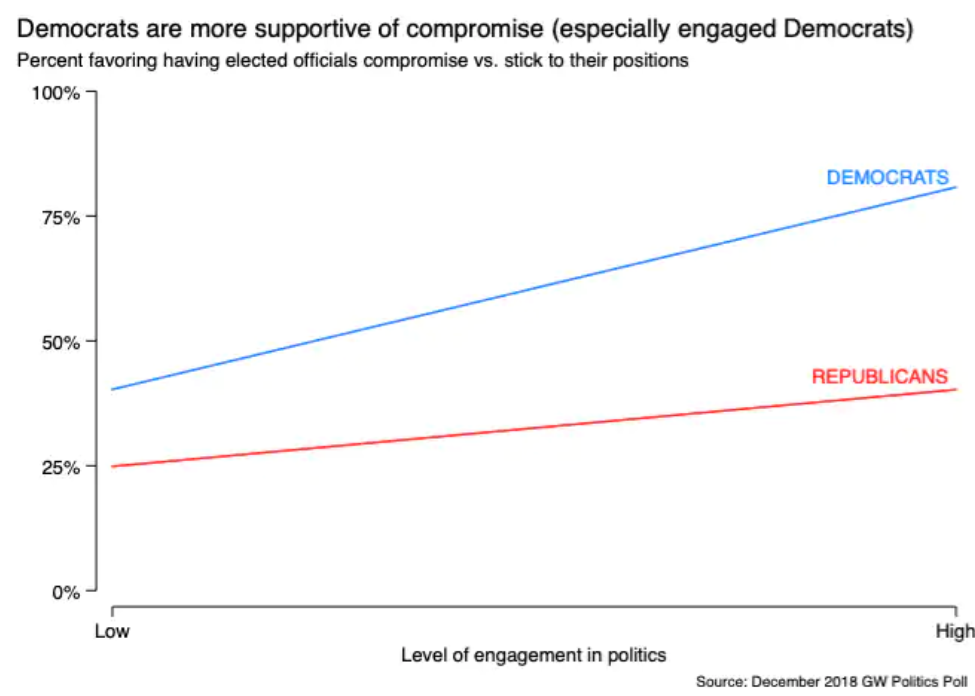
            John Sides from the Washington Post provides the graph below which shows that politically engaged Democrats are more apt for compromise than their Republican counterparts. This data can be applied to the government shutdown fairly easily: House Democrats are eager for a compromise, but the Republican president refuses any proposal that does not satisfy his requirements, leading to a prolonged shutdown. Unfortunately, the data within the graph is not that simple and the conclusion drawn by John Sides is problematic. We must examine the terminology of the data to understand why the conclusion that Democrats favor compromise more so than Republicans is fallacious.

The first flaw with Slides’ conclusion stems from the source of the data which determines the meaning of “political engagement”. The GW Politics Poll is cited in a book by John Zaller, who cites his own “comprehensive theory to explain how people acquire political information from the mass media and convert it into political preferences” (Zaller2011). Novels upon novels have been written about the influence of media within politics, and determining one’s political engagement based on mass media consumption is obviously problematic for a plethora of reasons.
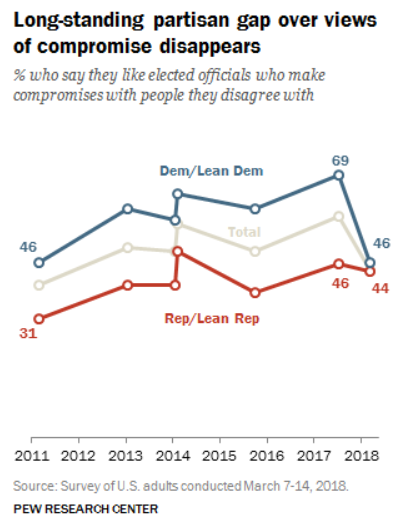
            Slides further confuses the reader by affirming that politically engaged people are also synonymous with those who are more educated—cited with data from the Pew Research center. If one were to look at the same webpage as where Slides found data on the educational gap for compromise, you would see that Pew has determined that the political gap for compromises does not exist as shown in the second graph below.

Slides has selected data that pertains to his argument that Democrats are more willing to compromise, while ignoring data from a source he pulled from in the same article. Despite this obvious dilemma of sources and validity between Slides and Pew Research Center, neither source defines nor scales “compromise”. For arguments sake, it is highly difficult (if not impossible) to argue the existence or nonexistence of compromise when one has not defined what compromise is or looks like.  
            Although Slides attempted to explain the government shutdown through his own lense, the conflicting terminology of politically engaged/educated and lack of definition for compromise create a muddy conclusion that is difficult to discern the truthfulness of the data. If a reader did not click the links Slides provided in the article to discover Pew’s opposing research, their opinion could be based on improper data. As we all have learned, there is more to a graph than what is shown, and this instance is no different. Franklin D. Roosevelt summarizes it best with the quote: “In politics, nothing happens by accident. If it happens, you can bet it was planned that way”.

Sources:
Sides, John. “Many Americans Say They Want Politicians to Compromise. But Maybe They    Don’t.” The Washington Post, WP Company, 16 Jan. 2019,             www.washingtonpost.com/news/monkey-cage/wp/2019/01/16/many-americans-say-they-         want-politicians-to-compromise-but-maybe-they dont/?utm_term=.fb111d5b7f36.
           
“8. The Tone of Political Debate, Compromise with Political Opponents.” Pew Research Center         for the People and the Press, Pew Research Center for the People and the Press, 18 Sept.           2018,   www.people-press.org/2018/04/26/8-the-tone-of-political-debate-compromise-           with-political- opponents/.

Zaller, John R. The Nature and Origins of Mass Opinion. Cambridge University Press, 2011.