Exploring sexual aggression again

Women frequently find themselves in uncomfortable situations where they do not know whether to classify a sexual act as rape. Because I often hear about these episodes from friends, I wanted to explore the nuances of the textbook definition of rape and how straight men would categorize these episodes. I looked at a study published in 2014 by Moorhead and Hinsz in ResearchGate. In this blogpost, I intend to explore why men that perform sexual acts that would constitute rape do not show any hostility towards the women involved.

The sample consisted of a group of 86 mostly white (>90%), male, heterosexual college students with mean age of 21, and standard deviation of 3.6 years. The study aimed to test if there was a significant group of men that would deny raping someone but is more likely to admit to the same when behaviorally descriptive phrases were used, such as “coerce somebody to intercourse by holding them down.” The researchers categorized the men into three groups: men that do not endorse either rape, or intentions to use force, men that deny rape but admit to using force, and men that endorse both. The participants were tested for two indicators: callous sexual attitudes and hostility, to predict group belonging. According to the findings, the researchers were able to establish a relationship between callous sexual attitudes and group membership: the propensity to endorse intention to rape or use force was positively associated with levels of callous sexual attitudes. However, the researchers found that there was an inverse construct of hostility for men that deny intentions to rape but use force.

I thought the study captured a wide range of nuances associated with rape, and successfully provides an alternate to idea that rape constitutes a screaming woman, a villainous man, extreme violence, and sexual purity. Moreover, I also thought that the researchers provided an outlet for women to explore the uncomfortable situations that they shy away from categorizing as rape. However, they do not attempt to explain why men who use force during intercourse to hold down a person would have an inverse construct of hostility, that is, an “affable, trustworthy, and nonreactive” perception of women.

Since the research does get into it, I will attempt to provide some explanations for this observation. First, we are not looking at cases of reported rape, so we do not know the context for sexually aggressive behavior in the encounters the participants are engaging in. Moreover, the inverse construct implies that there isn’t an intention to harm the women involved. This can be explained by the fact that college students that have sexual relations probably know each other outside of the relationship: they might be friends, or romantically involved. So, even though force is being used, the men in this group score low on hostility towards women. More importantly, I think the fact that women in these situations do not get any say in the study is disappointing. Firstly, how would the women classify the act of “coercing somebody to intercourse by holding them down”? Would they, like the researchers classify them as indicators of rape? Additionally, I think it would be interesting to have a study with both heterosexual male and female participants and try to see if there is a relationship between the group of men that admit to using force and women that feel discomfort but refrain from categorizing instances as rape.

Can sports performance be explained by a personality trait

My friend and I were talking about how students get athletic scholarships to get into colleges when he remarked how easy it is for women players to get such scholarships. He claimed that women  don’t even have to be that good or work as hard as boys because there isn’t enough competition. I think that it is generally true that fewer women than men participate in organized sports. This I believed was due to the fact that women growing up aren’t placed in situations where they need to engage in playing a sport, or aren’t encouraged as men are. However, Vaughan, Madigan, and Carter claim that a particular personality trait called the Dark Triad might be imperative in being good at a sport. Especifically, they claim: “It is possible that the Dark Triad facilitate successful sport performance by increasing competitiveness.” In this blogpost, I want to explore what the study’s finding might suggest.

The Dark Triad consists of: 1. Narcissism defined by grandiosity, entitlement, and superiority, 2. Machiavellianism defined by manipulation, self-service, and deceit, and 3. Psychopathy defined by impulsive, unempathetic, and anxious individual.

I looked at their study on the presence of the Dark Triad in men versus women, athletes versus non-athletes, and individual players versus group players. The sample they looked at consists of 1,258 participants with an even combination of elite players, amateurs, and non-athletes, men and women, team and individual players. Because the study has a good sample space, and the tests conducted seem to be established in the field of psychology, I thought the study was a thorough and informative. However, the researchers are very careful not to claim any implications from the results, but only report the findings. For instance, they found the participants in the groups men, elite athlete, and individual player scored higher on the Dark Triad than women, non-elite, and group players. The researchers suggest that elite players might have higher confidence and are assertive, hence they score higher. However, no explanation is given for the difference in gender for DT scores. If male athletes have more of the dark factor in their personality, does this indicate that men and women might be inherently different? Or is there a difference in the scores because women athletes don’t have a high self-perception of their sport performance as men do? At one point, the researchers suggest that the difference in scores between men and women might be because of higher levels of testosterone in men, however they never go into why this would affect the DT scores.

One flaw with the study is that they never specify ethnic origin or socio-economic status of the participants, which I think would bring a whole new dimension to the study. The relationships that are established between the DT score of different group might be completely changed if there variables were considered.

Going back to the claim made by the researchers that a higher DT score might be important in a successful sports career, I think it is worthy exploring how a person’s DT score can be increased even though it is a negative personality trait. Additionally, how does the DT score compare with having Carol Dweck’s growth mindset? Is it possible to have a high self-perception of one’s performance, want to do better yourself at the expense of others, and still have a learner’s view of the world? Though I think that the growth mindset measures one’s ability to get back up from a setback, and the Dark Triad is an overall approach to goals and interpersonal relationships, I think it would be interesting to explore how the two co-exist. And maybe that’ll be my next blogpost. 😉

Resource(s):

Exploring Sexual Aggression

When I had my first sexual encounter, I was dating a person that I knew genuinely cared for me. However, some of the things he wanted us to do, or did without asking made me feel uncomfortable and sometimes I questioned if they were acts of sexual abuse. So I confronted him about them and his response was that he had seen them done so often in pornographic movies that he assumed they would be okay in a real life setting: that was how sex normally is. Women in heterosexual relationships or those who engage in heterosexual sex frequently find themselves in a gray place where they aren’t comfortable with what is happening, but shy away from labeling those acts as acts of sexual abuse or rape. We usually require a woman to fight back, or say “no”, and for the encounter to be violent for it to constitute rape. However, coercion and psychological manipulation are a big part of rape culture and all three of the above criteria might be absent in some instances of rape. In this blog post, I want to look into whether heterosexual men accurately understand the nuances of the acts that might constitute rape.

I looked at a study published in 2014 conducted on a group of 86 male college students with the mean age of 21, and standard deviation of 3.6 years. The study cited that there is a significant population of men who, when used specific labels, decline having raped anyone, but will admit to paraphrased questions such as if they have “coerced somebody to intercourse by holding them down.” The researchers try to find a correlation between hostility towards women and callous sexual attitudes with men that either admit to having intentions of raping, or men that will admit to paraphrased acts that constitute rape. Here, hostility is defined as the tendency to focus on negative interactions with women and to generalize them to all women. Callous sexual attitudes is defined as objectifying women and expecting men to have sexual dominance. The results show a correlation between men that show intentions to use force but deny the intention to rape with high levels of callous sexual attitudes, but not with hostility towards women. A disclaimer: the study does not tell us whether the men that participated had accusations of abuse or rape against them, so we are going to assume that they didn’t.

This is going to sound really bad, but I have to say it. Does using force to hold down a person and coerce them to intercourse always constitute rape? The researchers claim that it does. However, labeling such acts as rape as a third party observer takes away the power from the women in these situations as actors to identify their experience. The study seems to conclude its finding in a hedgehog manner by not looking at all of the other variables. For instance, all sexual acts occur in a physical setting, with at least two people involved. If the said sexual aggression is so prevalent, what do women do whether actively or passively in this physical space to promote or constrain violence? It is likely that if the women considered these sexual aggressions to be rape, they might have spoken against it, making the men in the study more cognizant of acts that might not be acceptable. I have found that it is not only socially accepted, but expected in an American school setting that women claim to like violent sex and big aggressive men, but as soon as a label such as sexual abuse or rape is thrown in, everyone shuns the said act. The ways in which we as a society talk about and think of sex as inherently violent might be a reason for high claimed intentions of rape. For instance, the indicators of “good sex” especially in heterosexual relationships include more violence than boring sex that everyone tends to joke about. So the men in the room that fail to accurately identify instances of rape might only be an extension of a bigger problem of how we view sex and gender roles as a society.

Additionally, people tend to think that college students have a lot of casual sex, but in reality, most sexual encounters still happen within a romantic/friendly setting. Are women who are romantically involved with their partner more likely to comply or fight back? Similarly, how does knowing the person outside of the sexual encounter affect men when they are making a decision to use or not to use force? A likely explanation for the study not being able to find a strong correlation between hostility towards women and men using force during intercourse might be because they happen within a romantic/friendly setting. And if women in these situations comply, is it because the dominant culture assumes that normal sex has some form of male dominance, or because they actually enjoy it?

An important place to go from here I think, is to identify sexual acts that might constitute rape, but aren’t violent and educating people about them. I think that this would allow a lot of women to acknowledge and understand the discomfort that they might feel in their heterosexual sexual experiences, and hence expand the accepted definition of rape. Moreover, even for women that genuinely enjoy these acts of force, I think it is important to investigate the longer term harm (if any) done by engaging in the said acts. It is important to not just label the behaviors as rape but to look at each individual scenario and let the women in them decide for themselves how they felt in those moments. But in the long run, I think we would benefit as a society if we changed the way we think and talk about sex, made it more inclusive of acts that are pleasurable to everyone, and challenged the power relationships we have outside of the bedroom.

Are numbers more important than experience in an Honors College

Despite the efforts being made in recruiting students from diverse backgrounds in the Honors College at Westminster, it is somewhat unreasonable to expect more than two racial minority students in an honors classroom. Being a minority myself, I wanted to explore whether minority students have a different experience than their white counterparts in an honors program. Rigsby, Savage, and Wellmann, in their 2012 research called “African Americans in Honors Programs” claim that African American students in the Honors College at Western Kentucky University (WGU) are less engaged in their Caucasian counterparts due to lack of support from within the Honors College. If their claim is true, how do we make Honors Colleges more inclusive in order to improve minority participation and experiences?

In their research, Rigby, Savage, and Wellmann interviewed five African American young adults of the Western Kentucky University (4 women, 1 man, age range: 18-21) in the residence hall of one of the researchers. One of the participants was interviewed by all three researchers and had a 5-item interview that lasted approximately four minutes, because of their schedule limitation. The rest of the interviewees were interviewed together by two researchers and had a 13-item focus group interview that lasted around 55 minutes. The interviews were transcribed and data was coded manually for both groups, and transcripts were analyzed for prevalence of theories used, and recurring themes among the feedback from participants themselves.

The researchers claimed to have found that African American students are less likely to identify with being an Honors College student than their white counterparts because minority students tend to have multiple, segregated aspects to their identity. Moreover, they also found that African American students benefit from social integration and involvement, and that they tend to engage in environments that they feel supports them. By the way, this is how involvement and support are defined in the study:

Involvement: the potential for these [minority] students to partake in Honors College initiative.

Support: the perception of there being students and faculty who physically resemble the participants concerning race and the ability of the Honors College to meet their needs.

The researchers believe that, and talk extensively about the need to increase the number of minority students in Honors Colleges, by recruiting more students of color. The finding suggest that the students interviewed want more minority representation in the student body in order for them to feel a part of the Honors College like their white peers. The study concludes that the most important step in improving African American students’ experience and participation in the Honors College would be to increase their visibility in Honors College through brochures and other media outlets like Honors College website and social media pages.

I believe that increasing the enrollment of African Americans in the Honors College might be one way to increase involvement and help minorities identify with the program. In the interview process, it was revealed that none of the students interviewed knew each other. If there had been a significant number of African American students in Honors, it would provide more room for friendships to blossom and might lead to a more inclusive community within the program. However, the study does not truly access the reasons of a non-inclusive community and the implications of using a non-existent diverse group of students to attract incoming students.

First, the researchers claim that African Americans have low involvement in the Honors College, and do not identify with the program like their white counterparts do without using any statistically significant evidence. Nor are any white students interviewed to show higher levels of involvement in the program. The study looks at a difficult question, but provides an oversimplified solution to it. If we take the researchers’ word for it and assume that there is a discrepancy in the participation and inclusion of white students and African American students in the Honors program, the study claims that increasing the percentage of minorities would be improve inclusion within the program, and hence motivate minority students’ participation. However, there are other issues evident in the study that don’t get addressed just by increasing enrollment. The study mentions how African American students feel the need to prove their academic merit to their white counterparts, “disprove negative…stereotypes to their peers and professors”, and defend their ethnicity because they are often the only minority in the classroom. Moreover, the participants also claim that they do not feel supported or included by their white peers in the Honors College, and hence tend to participate in activities outside of the program where there are more people of color. These are the implications of societal structures being replicated within the Honors College: the African American population is a minority in regards to income, wealth, and representation in most institutions. Though I don’t know what the solution might be, this issues does not get the attention that it deserves in the study.

Additionally, just increasing the percentage of minority students might not increase the solidarity within the group. In the study, none of the participants knew each other. As it often happens, there might be competition among minority students to be the only one included in the elite, majority of privileged students. Similarly, the study suggests that using minority students in brochures and social media platforms to falsely advertise to potential students and attract them into the program is ethical. Diversity does not happen overnight, and even if the number of minority students does go up, without the former mentioned structural change, these new students will still be in a non-inclusive community. I get the feeling that the researchers might not care that much about minority experience in the Honors College, but only want to increase their presence statistically. I believe that minority student participant is highly dependent on the experience they have in the Honors community, and without making the community more inclusive, participation cannot be expected to grow.

Resource used:

https://digitalcommons.wku.edu/cgi/viewcontent.cgi?referer=https://www.google.com/&httpsredir=1&article=1000&context=research_prog_eval

Reasons for racial divide in post-secondary enrollment

James S. Coleman, along with other researchers claimed that level of aspiration is predictive of career choices, future earnings, and consequently, social mobility. Given that African Americans showed high aspirations in the 1960s, equivalent social mobility has not be observed.  (Equality of Educational Opportunity, 1966) There are some clear flaws in the assumption that a person can move up in socio-economic status just by having the desire to, since it does not take into account financial constraints, academic preparation, and access to information regarding admission process. In order to address these flaws and to contextualize Coleman’s claims, the Equality of Educational Opportunity report concluded that plans for higher education are a result of socialization in the family during high school years. More recently, the national longitudinal data set, High School Longitudinal Study of 2009 attempts to quantify the factors that might affect post-secondary (college) enrollment, including student aspiration. In this blog post, I look at a side-by-side comparison study of the EEO and HSLS:09 by Schneider and Saw (S&S) to assess the validity of their conclusions and some methodology used in HSLS:09.

The HSLS:09 study was started with 9th graders in 2009. The first follow-up was conducted in the spring of the students’ eleventh grade, and the second when the students were in twelfth grade. The participants were graded on various scales including, but not limited to direct aspiration (their answer to what they thought their highest level of schooling would be),  measures of interest-shown, commitment to school and persistence, and enrollment in AP/IB or higher level math courses. The participants were divided based on race, namely white, black, Hispanic, Asian, and other. The results in the study show arithmetic mean and standard deviations for each question/category that is supposed to be related to or indicative of college aspirations in high school students, and the percentages in each race that enrolled in some kind of higher education/training program in 2013, right after graduating high school.

S&S conclude, from analyzing HSLS:09 report that while blacks show significant, and sometimes more aspirations for postsecondary education on a group level, “the gap in college enrollment between advantaged groups (white and Asian) and disadvantaged groups (black, Hispanic, and multiracial) persists. They make important disclaimers like the HSLS:09 can only be generalized to 9th graders in 2009, and comment on the exclusion of delayed college-going behavior, and college persistence and graduation rates. Unlike Coleman’s all encompassing hypothesis, S&S also provide possible explanations for the difference in white and black postsecondary enrollment, like difference in quality of school district, and level of competence of higher level courses in schools that different demographics enroll in. They claim that the low-income, minority students that enroll in higher level courses would be predominantly going to school with low resources, with fewer qualified teachers, and unstable administration, which might explain their not pursuing postsecondary education.

There are a some weaknesses in the methodology used in HSLS:09, and S&S’s interpretation of data in their study. First, HSLS:09 report is made on the assumption that college aspirations equal actual intention or realistic expectation of going to college. First generation and low-income students tend to be more enthusiastic about going to college in order to alleviate their social standing, but might not have the same expectation of going to college as their more privileged counterparts. This might be an alternative explanation to why white students don’t show as much aspirations as black or Hispanic students. Additionally, asking questions about college application to school counselor, taking a campus tour, meeting with admissions counselors, are all used as positive indicators of college aspiration. Minority students significantly outperform white students in this scale, especially black students. However, this difference might be a result of white students already having the foundational knowledge of college application process and requirements, and having other sources to ask questions to, like their parents or relatives. This inquisitiveness of minority students might be an indication of not having adequate information and resources, instead of aspirations. Finally, the HSLS:09 does not adequately represent ethnic differences in its data collection. All whites are grouped together, all Asians are grouped together and so on. The use of arithmetic mean might not adequately represent the data we are looking at. Not all kinds of Asian do well, and the data is probably skewed because of that. Moreover, there is a significant population of low-income white people that need assistance but is included in the same pool as middle class and upper class whites.

Abbreviations:

EEO : Equality of Educational Opportunity

S&S: Schneider and Saw

HSLS:09: High School Longitudinal Study of 2009

Resource used:

https://www.jstor.org/stable/10.7758/rsf.2016.2.5.04?Search=yes&resultItemClick=true&&searchUri=%2Ftopic%2Fminority-group-students%2F%3Frefreqid%3Dexcelsior%253Ab89115bdb228966fb2a73dfadb48e3a7&ab_segments=0%2Ftbsub-1%2Frelevance_config_with_tbsub

Resource(s):

Stop-and-frisk Vs. Title VI

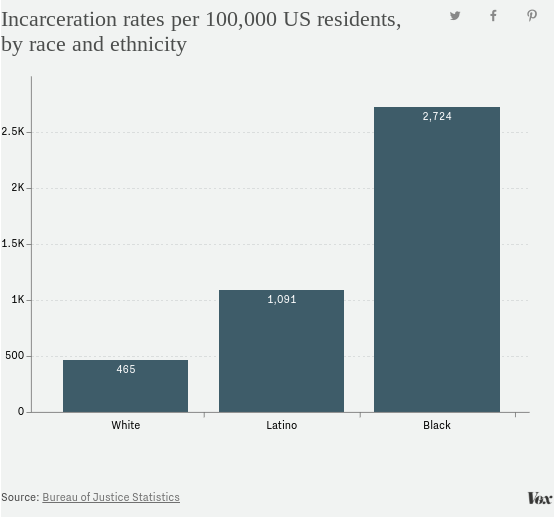
According to NAP, in 1972, 161 per 100,000 of the US population was incarcerated.  However, at the end of 2016, this number had risen to 655 for every 100,000. This means that currently around 2.2 million adults are behind the bars in US prisons and jails. As seen in the bar chart below, it has been claimed that the War on Drugs started in 1971 has disproportionately harmed black and African American communities, particularly black men.(Vox) One of the ways this has happened is through the stop-and-frisk interrogations used by the police to find drug-users and traffickers on the streets. A NYCLU study has shown that between 2002-2017, black people are around 55% of all stop-and-frisk targets of the NYPD, while whites constitute between 9-15% of such targets. This data clearly shows systemic discrimination against black and African-American communities since according to the 2010 census, 33% of NYC population was white, and 26% was black. (furmancenter.org) As a result, black men are almost 6 times as likely to be incarcerated as white men. (Vox) So, if systemic discrimination has been the reason for the disproportionate targeting of black men, why hasn’t Title VI been effective to prevent minority groups from being incarcerated?

Title VI of 1964 “prohibits discrimination on the basis of race, color or national origin in any program or activity that receives Federal funds or other Federal financial assistance.” (hhs.gov) More specifically, this law claims to prevent “a predominantly minority community…[being] subjected to harsher rules than a predominantly non-minority community.” Even though Title VI is supposed to protect minority groups from discriminatory treatment from federally funded institutions like the police department, the law is highly inaccessible in the case of stop-and-frisk operations.

First, the methods based on direct evidence can rarely be used to prove that racial discrimination has happened in the age of political correctness. The method(s) of direct evidence consists of either “express” classifications or “comments or conduct by decision-makers as direct evidence of intent.” (justice.gov) When charged with racial bias in a case of stop-and-frisk, it is very unlikely that a police officer will admit to have interrogated someone based solely on their racial background. Moreover, most states allow the police to stop and interrogate anyone on the street based on their judgement of reasonable suspicion, and anything can constitute reasonable suspicion, including but not limited to suspect “was wearing low-waisted jeans,” or “looked nervous”, or even “didn’t look nervous.” This allows the police to always have a justification if they get charged with a Title VI violation. Once the charge has been dismissed, the prosecution can take place as normal, and lead to conviction of the person targeted in the stop-and-frisk.

While Title VI violations can easily be ignored and covered in individual instances of stop-and-frisk, Title VI also protects minority groups from “systemic or widespread discrimination.” (justice.gov) According to the US Department of Justice, “one means of proving intentional discrimination is through circumstantial evidence showing a statistical disparity that affects a large number of individuals.” In the  case of stop-and-frisk, one could show how police departments tend to systematically target poor African-American neighborhoods over rich, white, suburban or college neighborhoods, which have almost identical chances of having possession of illegal drugs and marijuana. However, reasonable suspicion can be used to justify frisking African-American neighborhoods: the police can effortlessly claim that drug-related activities and crimes have been found to happen in similar neighborhoods. This tactic of reasonable suspicion has been and continues to be used to justify the targeting of black men in stop-and-frisk operations.

Stop-and-frisk operations are unfair and harmful since it gives government institutions like the police immense power to target specific groups and individuals. At the end of the day, each person has prejudices and biases and controlling such variables would be incredibly difficult. A person committing the same crime should not be penalized more than another based on the color of their skin and socio-economic background. In America, black people are thrown under the bus frequently. As long as the police are allowed to conduct stop-and-frisk operations in the neighborhoods that they choose, the enforcement of Title VI to protect black and African-American men from statistically unfair rates of incarceration is next to impossible.

Do dollars translate to quality of life

How is wealth to be measured?

On gapminder.org, I looked at the first article on their homepage called “Welcome to Dollar Street — where country stereotypes fall apart” The article consists of images of individuals/families with the amount of monthly income they make in USD, and the country they reside in. Contradictory to its claim, the photo article perpetuates the stereotypes that we already have of the living conditions of people in different parts of the world.

In the article, the incomes range from $25 to $10,800, and are labelled “poorest” and “richest” respectively. In the United States, an income of $10,000 a month for a family of 9 (as shown in the photograph) will probably not even make it to the middles class status.

You also get to pick from different parts of the world including: Africa, Asia, Europe and the Americas. Moreover, you can choose your own income range or compare between multiple continents/countries. However, they have a lot more data from Africa and Asia than anywhere else.

What are the problems with this approach of measuring wealth?

First, the USD is not the same everywhere. The same amount of money might have different buying powers in different countries. This phenomenon is not difficult to observe at all. Say, you work at an IT firm in San Francisco making $64,000 a year and your firm allows you to work up to 3 months a year from home. So, you decide to live close to your family in Idaho for 3 months each year, paying 2/5 of the rent you would be paying in San Francisco. You still earn the same amount, but you can do a lot more with your money now. You can eat out more, take more uber rides, party every weekend, and still have leftover money you can save for your parents’ retirement! No only that, you can afford more unpaid off-days.

Moreover, the article claims that, “The everyday life looks surprisingly similar for people on the same income level across cultures and continents.” Does it now? For the first 6 months in the United Stated, I would be devastated by how expensive everything was every time I went shopping. Numerically, it is true that $1 = NRP 106 (Nepalese rupees) give or take. However, I have grown to learn that they don’t mean the same thing. I come from a fairly privileged middle-class background. Interestingly however, if I were to quit school and work 50 hours for minimum wage in Denver, I could make my family’s yearly income in about 3 months. Standard of living and quality of life depends predominantly on your income’s value or buying power in the place it is being spent, and the amount of desires it is capable of fulfilling. Living in Denver, however, if I got an average, convenient place, I would probably spend close to 3/4 of my income on rent and utilities alone, and hence, I would have a much poorer quality of life than my parents at home. In this sense, a $2 daily wage somewhere in Asia may be equivalent to an $8 per hour in the United States.

How does this data affect the way we view the world?

Disclaimer: The data in the article is not the whole problem, but it exists within a global framework of social hierarchy.

A lot of big words, let’s break it down! We live in a post-colonial world where Western European countries and the US are considered the standard against which all other countries/continents are to be measured. The former are seen as the most ideal, developed, civilized societies ahead of everyone else. Many tools have be developed to quantify this view of the world and the international monetary exchange rate is one of the more efficient ones.

While I admit that the demographic and numerical data on the website must be accurate, not all interpretations of such data show the true picture. We can look at the numbers on the website, but numbers don’t speak for themselves, and nor can the people in the photographs.

How does this view of the world affect consumer spending behavior?

Whether or not we still use the terms “first world” and “third world”, the ideas have survived. When the “third world” is shown to the “first world”, the narrative is always of a less civilized place torn with poverty, famine, war, illnesses, bankruptcy and more. They are shown as being less than and needing help from the Western world. The gapminder.org’s article paints a similar picture of Asian and African countries. The numbers fail to portray an accurate picture of the kind of lives these people have in relation to the economy of the place they reside in.

These one-sided stories told in the Western parts of the world of Asia and Africa lead to post-colonial white guilt. They become tools of a capitalist economy to commercialize charity and donations to Asian and African countries, a lot of which end up misallocating valuable resources and funding unsustainable development projects. At the end of the day, when the numbers given in the data are not put into perspective, anyone in these countries can appear to be needing financial support.

Are there other ways of measuring quality of life?

Since bigger numbers don’t always translate to better quality of life, let us look at other things we might consider to measure the same. For instance, is a person to be considered wealthy if they have more dollars than another, if they lead a really hectic life and has no time for themselves? In a lot of countries in Asia and Africa, the middle class make significantly less in dollars than the American middle class. However, their jobs are less stressful and more satisfying, they have more personal time and paid off-days, and significantly lesser unfulfilled desires. Should these not be considered when measuring a person’s quality of life?

I think quality of life depends on a lot of things like social equity, how secure you feel in the area that you live, whether you believe the government works in your good interest, and whether you are satisfied or if your economy makes you feel like you constantly need more. None of these can be depicted using USD figures, and so, the article fails horribly at portraying the real lives of the people in their photographs.