Vegetarians in the News

The Whole Foods Market in Sugar House stocks thirteen different brands of milk alternatives.  The options include: soy, almond, coconut, cashew, rice, hazelnut, macadamia nut, pecan, flax, hemp, banana, and pea.  The options for milk alternatives far outnumber the dairy product options.  In the last year, plant-based food sales have increased by 20% (Nielson, 2018).  This is largely the result of the enormous presence of vegans and vegetarians in the media.  Social media platforms such as Facebook and Instagram are filled with users sharing meat free recipes.  Food blogs, cookbooks, and television shows preach concerns about health implications, animal treatment, and environmental impact of meat heavy diets.  With the extended media coverage, one would expect an increasing number people with plant based diets.  How does the actual number of vegans and vegetarians in the U.S. compare to their social presence?

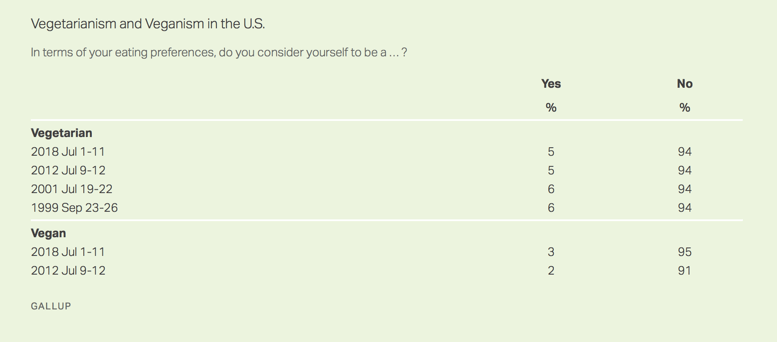
On college campuses especially, topics about the social implications of food choices are discussed constantly and almost all events on campus offer vegan food options.  However, a recent Gallup poll suggests that despite the constant media coverage, this may not be the norm.  In a 2018 telephone survey, people self reported that they were vegetarians only 5% of the time compared to 6% in 1999 (news.gallup.com).  Despite recent media coverage and food science advances in meat alternatives, rates have remained steady and even decreased in the last 17 years.
Veg

There is a common trope of vegans and vegetarians being particularly outspoken about their diet choices. This could partially account for their overwhelming media presence.  In addition, opponents to meat-free lifestyles berate veganism for threatens the status quo and frequently engage in discussion in public forums, which further increases the perceived presence. Despite the fact that more information and pressure is present than ever before, the rates of vegetarianism and veganism have remained relatively steady.  A reason for this could be that many people are “flexible” in their abstinence from meat, and thus may not fully identify as vegetarian.  Meatless Mondays and flexitarian diets should also be considered.  A further study could look into the qualifications are for people to give themselves the title of vegetarian.

References

Gallup, Inc. (2018, August 01). Snapshot: Few Americans Vegetarian or Vegan. Retrieved from https://news.gallup.com

Nielsen Data Release 2018. (2018). Retrieved from https://plantbasedfoods.org/consumer-access/nielsen-data-release-2018/

MorningStar Farms Has a Plant-Based Burger for Every Palate. (2018, September 07). Retrieved from https://www.gfi.org/plant-based-burgers-one-size-does-not-fit
Crash Test Dummies

In 2017, in the U.S., 12,500 men were killed in motor vehicle accidents, compared to 5,151 female drivers (NHTSA, 2018).  Overall, men are more likely to participate in risky driving behavior, such as speeding, driving while intoxicated, and not wearing seatbelts.  However, in crashes of the same severity, women are 47% more likely to be seriously injured and 17% more likely to die than men (Criado-Perez, 2019).  Why, in the same car crash, are women more likely to be injured than men?

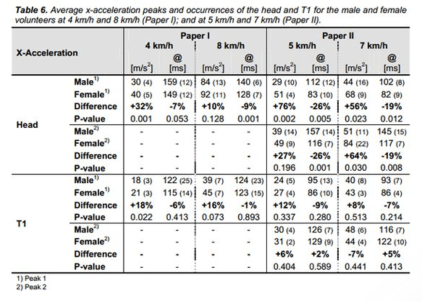
The short answer is male modeled crash test dummies.  The most commonly used model for crash test safety is an average male.  This figure is often taller and heavier than the average woman.  It also does not account for differences in anatomy, especially different pelvis sizes.  In addition, there are differences in driving style.  Because women have shorter legs, they have to sit closer to the steering wheel. As a result, women’s bodies react differently on impact.  In a 2012 study, Swedish researcher Anna Carlsson found that women’s bodies propel faster in a collision (Carlsson, 2013).  The study took men and women in the 50thpercentile for mass, and tested for movement of the head and T1 vertebrae between the two groups at different changes of velocity.  Statistically significant differences head movement were found at 4, 5, and 7km/hour.

graph.png

It was not until recently that this problem began to be addressed.  Beginning in 2011, the federal government has made requirements for the use female proportioned crash test dummies in some vehicle safety testing. The law now requires front crash testing to be done with a 95% male (only 5% of population is larger) and a 5% female dummy (only 5% of population is smaller).  This drastically changed the safety rating for many cars that previously had five-star crash test ratings, even though their designs had not really changed

The more complex answer to the question is ingrained cultural bias. Car safety testers do not overtly want women to be injured. However, they are still being overlooked. Because it is often males designing supposedly objective algorithms, women are often still not considered, and it puts them at risk.  This sort of data bias is not limited to crash test dummies. When female police officers wear ill-fitting body armor, designed for men, they are not able to perform at their job as efficiently (Criado-Perez, 2019).  There are many ways that living in a world designed by men, for men creates data bias and puts women at a disadvantage.  The solution is more diversity.  We need a wider variety of people with different backgrounds designing and developing products and services to better meet everyone’s needs.

References

Carlsson, Anna, et al. “ADSEAT – Adaptive Seat to Reduce Neck Injuries for Female and Male Occupants.” Accident Analysis and Prevention, vol. 60, Nov. 2013, pp. 334–343. EBSCOhost, doi:10.1016/j.aap.2013.02.043.

Criado-Perez, C. (2019). Invisible women: Data bias in a world designed for men. New York: Abrams Press.

Starr, M. (2012, August 24). World gets first female crash test dummy. Retrieved from https://www.cnet.com/news/world-gets-first-female-crash-test-dummy/

United States, U.S. Department of Transportation, National Highway Traffic Safety Administration. (2018). Crashstats.nhtsa.dot.gov.

A Misinformation Outbreak

In the year 2000, the U.S. government declared measles to be eliminated, meaning for more than twelve months, there had been no endemic cases of the disease within the country (cdc.gov).  Widespread use of the measles vaccine since 1968 resulted in steadily declining incidence of the disease. Then, it all began to change.  A 1998 study, that has since been debunked, misguidedly linked vaccines to autism, and accelerated an anti-vaccination social movement. Over the past 10 years, a steadily increasing number of outbreaks have occurred within communities that do not have a high enough percentage of vaccinated individuals for herd immunity to be effective.  In 2018, the CDC reported 372 confirmed cases of measles in the U.S. This is more than three times the count in 2017.  2019 is already off to a raucous start, with 159 cases as of February 21st (cdc.gov).  Despite the fact that “Anti-vaxers” are a relatively fringe group, misinformation has spread widely and rampantly, and has manifested as physical health consequences.  What role do Facebook’s algorithms have in propagating the spread of misinformation?

Websites, most notably in this case Facebook, give small fringe groups a platform to reach a huge audience.  The ease of sharing articles on this platform makes for quick sharing of information and all the associated benefits and consequences.  Facebook’s algorithms are designed to find content that users are most likely to be interested in.  As a result, people see pages similar to those that they already interact with, and content posted by friends, who likely hold similar world views. The result is a bubble effect. People end up seeing only one side of a story.  Daniel Kahneman would refer to it as the “Availability Heuristic”.  There is no shortage of peer reviewed journal articles to combat anti-vaccination messages, but because the links to anti-vaccination content are far more available in certain networks, this is what they see as true and base their beliefs on.

Vax

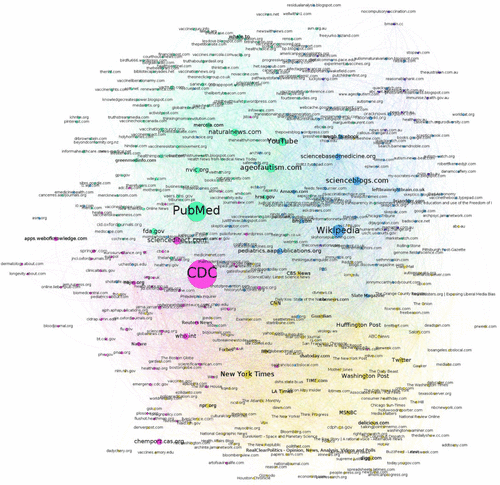
Figure 1. The network map of the top 500 publishers about vaccines by hyperlink degree centrality, demonstrating social clustering, who is linking to one another, and how frequently: a vaccine-hesitant community (green), a health and science community (pink), a provaccine community (blue), and a mainstream media community (yellow) that used language common to both provaccine lay audiences and science.

A 2018 study analyzed the influence of vaccination related information sources based on Hyperlink Indegree Centrality, meaning the number of times the source is linked to on other web pages. The labelling is based on the most common vaccine sentiment found on each of these sources; individual stories from these sources may lean a different direction.  As shown in the figure, there is very little overlap between the different types of sources. When an individual posts on Facebook about a vaccine-related topic, they will see content with similarly hyperlinked sources, and as a result have only have background data from limited sources.

It is a problem that Facebook has recognized, and announced a need to address. A Facebook VP stated, False news is harmful to our community, it makes the world less informed, and it erodes trust. It’s not a new phenomenon, and all of us — tech companies, media companies, newsrooms, teachers — have a responsibility to do our part in addressing it” (Facebook.com). Potential options for changing the algorithm could include not featuring known anti-vaccination posts as suggested content for users, or by putting anti-vaccination material farther down the list of search results (Cohen & Bonifield, 2019).  It is a complicated balance between censorship and limiting the spread of harmful misinformation, but adjusting the algorithms to promote a wider dispersion of verified information would help to limit instances of availability bias when it comes to information about vaccines.

References

Cohen, Elizabeth, and John Bonifield. “Facebook to Get Tougher on Anti-Vaxers.” CNN, Cable News Network, 26 Feb. 2019, http://www.cnn.com/2019/02/25/health/facebook-anti-vaccine-content/index.html.

Kahneman, Daniel. Thinking, Fast and Slow. Farrar, Straus and Giroux, 2015.

“Measles Cases and Outbreaks .” Cdc.gov, Centers for Disease Control and Prevention, 25 Feb. 2019, http://www.cdc.gov/measles/cases-outbreaks.html.

“Working to Stop Misinformation and False News.” Facebook.com, 7 Apr. 2017, http://www.facebook.com/facebookmedia/blog/working-to-stop-misinformation-and-false-news.

Citizenship and the 2020 Census

Beginning in April, the U.S. Supreme Court will hear oral arguments concerning the legality of the Trump administration adding a citizenship question to the 2020 census.  The reasoning that the Department of Justice gives for the addition is that to be able to efficiently enforce Section two of the Voting Rights Act, which prohibits voting discrimination based on race or membership in a minority group (Lind, 2019).  Opponents to the question argue that this addition will discourage millions of immigrants living in the U.S. from filling out the survey, and will threaten the integrity of the data set.  What are the potential problems with underrepresentation in the U.S. census count?

The U.S. constitution requires a count of all people people within the U.S. every ten years (art. 1, sec. 2).  This has been interpreted to include all people, regardless of citizenship status.  This count is used to determine representation in congress, designation of voting districts and allocation of funds. Every ten years, the government goes through the task of trying to count every human being residing within the United States. This is an enormous undertaking that requires public cooperation.  In 2010, only 72% of Americans responded with the forms by mail (Lind, 2019).  Temporary census takers were hired to fill in the rest of the gaps, but renters, people experiencing homelessness, and topographically complex areas made the process much more difficult, census takers in some cases having to visit houses up to six times.  Estimates are around 95% accuracy (Lind, 2019). However, because low-income and minority populations tend to have more transient housing situations, these are the communities in which undercounting more often occurs.

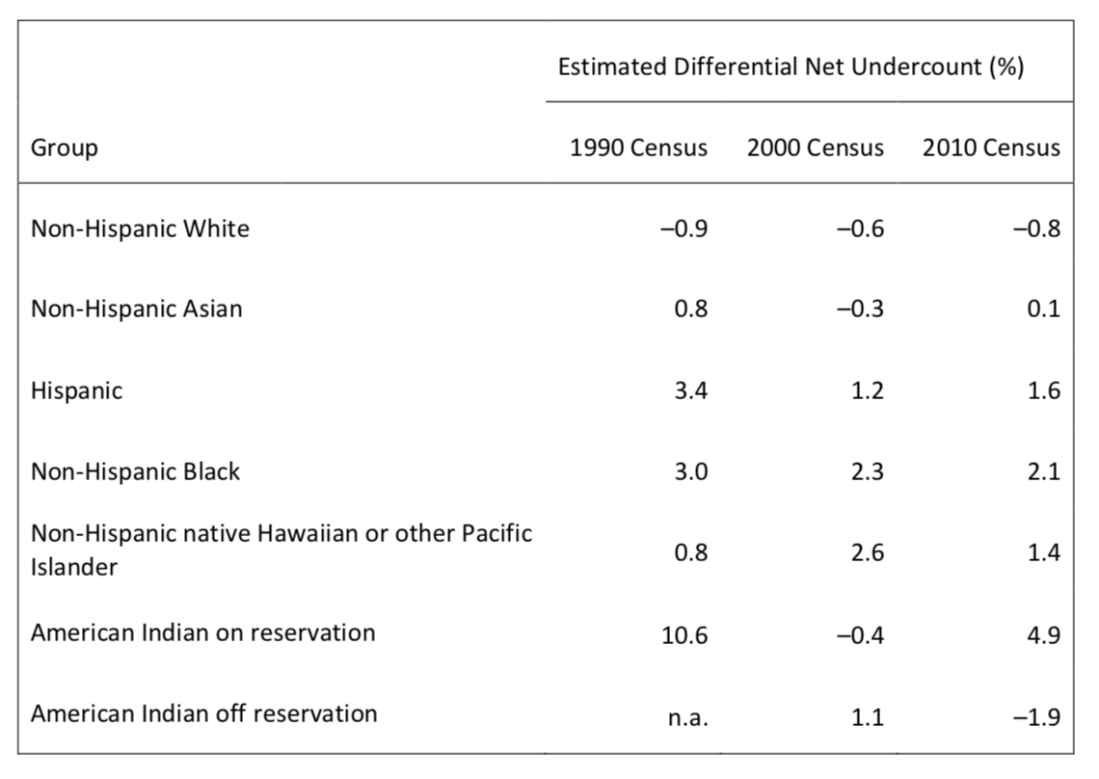
Table 1. Estimated differential net undercount rates for demographic groups in last 3 censuses. Screen Shot 2019-02-16 at 2.03.25 PM

H. Hogan, P. J. Cantwell, J. Devine, V. T. Mule Jr, V. Velkoff, Quality and the 2010 census. Popul. Res. Policy. Rev. 32, 637–662 (2013).

The above chart shows estimations of undercounting in the past three censuses.  With the current census questionnaire, it is estimated that Latino populations were undercounted by 1.2 percent in 2000 and 1.5 percent in 2010. Although the Census Bureau says that this change was not statistically significant, with the growing Latino population, this proportion will continue to grow larger.  The 2010 census had an average measured error of 0.6% for states.  If the same error holds true for the 2020 census, researchers project that Texas loses and Minnesota gains a seat.  If the error increases to 0.7% Florida will lose a seat, and Ohio will gain a seat.  If the error increases to 1.7%, Texas will lose a second seat, and it will go to Rhode Island (Seeskin, 2018). These changes are not the result of demographic shifts, but from errors in data.  States with high minority populations face the impacts of these errors.  Less representation means that their specific needs hold less priority in governmental decisions, and the areas that they live in receive receive a smaller proportion of allocated funds.

This is all before the addition of the citizenship question. The worry is that the census could pass along citizenship data to immigration authorities, which could lead to deportation.  Although the Census Bureau cannot legally share individual’s information with other branches of government, the current administration’s policies on immigration and citizenship do not breed confidence.  Opponents predict that many people without citizenship status, and even immigrants with citizenship would be less inclined to fill out the form if they have to answer a citizenship question.  As of 2016, nearly 44 million immigrants lived in the U.S., making about about 13.5% of the total population (Zong, et al, 2018).  If this huge proportion of the population is not accounted for in the census, it will result in significant changes in allocation of resources, with mainly low-income and minority populations affected.  It should also be noted that this is the first time that congress is using a cost target instead of an accuracy target, which brings into question how committed this administration is to getting an accurate count.

References

H. Hogan, P. J. Cantwell, J. Devine, V. T. Mule Jr, V. Velkoff, Quality and the 2010 census. Popul. Res. Policy. Rev. 32, 637–662 (2013).

Lind, Dara. “The Census Lawsuit Headed Straight to the Supreme Court, Explained.” Vox.com, Vox Media Inc., 15 Feb. 2019, http://www.vox.com/policy-and-politics/2019/2/15/18226578/census-supreme-court-lawsuit-citizenship-question.

Seeskin, Zachary. “Balancing 2020 Census Cost and Accuracy: Consequences for Congressional Apportionment and Fund Allocations.” Northwestern Institute for Policy Research, 11 May 2018, www.ipr.northwestern.edu/publications/docs/workingpapers/2018/wp-18-10.pdf.

Zong, Jie, et al. “Frequently Requested Statistics on Immigrants and Immigration in the United States.” Migrationpolicy.org, 27 Feb. 2018, http://www.migrationpolicy.org/article/frequently-requested-statistics-immigrants-and-immigration-united-states.

Changing Forecasts

In the past 100 years, Meteorology has advanced in what Washington Post Weather Editor, Angela Fritz, has called a five to one ratio, meaning that meteorologists can now predict a five-day forecast with the same accuracy as a one-day forecast 100 years ago (Dankowsky, 2019). Advances in computer and satellite technology allowed meteorologists to predict a five-day forecast with close to 90% accuracy, but it is still not a definite science. There is great variation between individual weather forecasts, and changing climate patterns will continue to make the process more convoluted.  How will climate change affect the accuracy of weather forecasting?

A weather model is created through a combination of concrete data points and mathematical modeling. Weather balloons and satellites collect meteorological data, including: air pressure, temperature, humidity, and wind speed, and then then equations based on current notions about atmospheric physics are used to fill in the gaps and make predictions.  The models, however, are not universal.  Different approaches to atmospheric physics result in different models, which in turn results in different forecasts from individual weather services.

Screen Shot 2019-02-03 at 10.10.19 PM

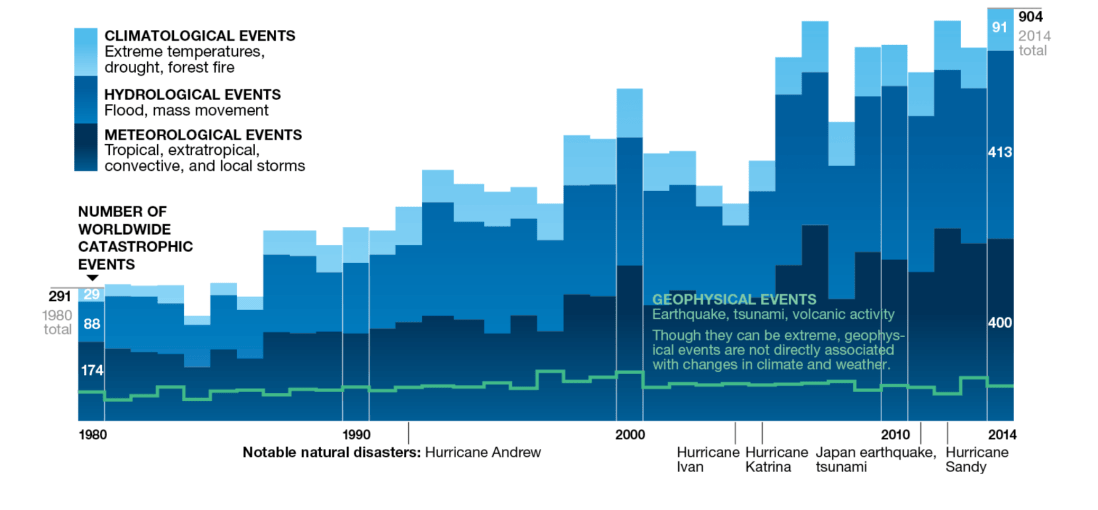
Trends show that there has been an increase in extreme weather events, such as: extreme temperatures, droughts, floods, and tropical storms. Most scientists agree that this trend will continue with climate change, but they differ in their belief in whether or not models will be able to keep up with the changes.  The answers to climate questions are based on averages. Actual weather results tend to be an average of all the forecasts made, and the models themselves are based on averages of historic weather data and patterns.  As climate change progresses and new and more extreme weather patterns emerge, the averages of the past 100 years may not be necessarily applicable, and the models of disparate weather services will continue to differentiate.

The field of weather forecasting is based on prediction derived from mathematical models and previous data.  As we are on the precipice of extreme change in climate, so is the field. Angela Fritz states that the physics of the atmosphere will not change unless something catastrophic happens, but as a meteorologist, her job security relies on her ability to predict the weather. UC Irvine Earth Science professor, Jin-Yi Yu, anticipates that the changes in temperature gradient in the arctic and changing patterns and temperatures in the oceans will be enough to alter atmospheric functions and make current atmospheric models irrelevant. Either way, the field must continue to develop, because as storms get larger and more extreme, the importance of accurately predicting their frequency will be of the utmost importance.

References

Dankowsky, John, host. “100 Years of Your Daily Weather Forecast.” Science Friday, NPR, 25 Jan. 2019. https://www.sciencefriday.com/segments/100-years-of-your-daily-weather-forecast/

“Global Warming Decreases the Reliability of Weather Forecasting Tools.” Phys.org, Science X Network, 19 Jan. 2018, phys.org/news/2018-01-global-decreases-reliability-weather-tools.html.

“5 Ways Climate Change Will Affect You: Wild Weather.” Nationalgeographic.com, The National Geographic Society, http://www.nationalgeographic.com/climate-change/how-to-live-with-it/weather.html.


The Eggs. They’re Full of Cholesterol.

The website Funny or Die produced a video in which a dietician time travels to 1979 and interrupts a couple’s morning, heralding modern science and the health implication of their breakfast.   He returns every couple seconds as time and science progress, each instance with new recommendations.  Although meant as comic relief, the video addresses the problem of where people get their health information while being bombarded by changing health recommendations.  It brings up the question: Is it ethical to present health data to the public without an adequate trial period?


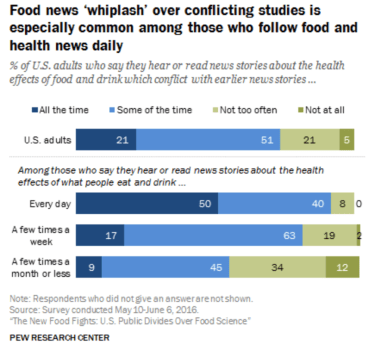
According to the Pew Research Center, 72% of Americans believe that healthy eating is important to living a long and healthy life (pewresearch.org). Diet culture and health trends that play off this belief make up an entire billion-dollar industry. How to go about healthy eating is where the chaos begins.  Because people want to live long and healthy lives, there is a huge monetary incentive in telling people what is good for them.   As a result, information about foods to cut and macronutrient ratios comes from every direction; 72% of Americans say that they frequently hear news about the health effects of certain foods that contradict other previous news that they have heard (pewresearch.org).

screen shot 2019-01-20 at 9.59.24 pm

Because of the direct health implications of the foods that a human consumes, it is in many ways a medication.  Food choices have been shown to be preventative to a variety of diseases, including: cardiovascular disease, diabetes, certain types of cancers, as well as others (McCarty, 1999).  However, food recommendations do not go through a stringent clinical trial process like other medical remedies.  In the scientific process, someone does research, tests their hypothesis, then their conclusions hold true until someone else disproves them.  Disproving previous results is how science progresses; it is part of the process.  However, health culture is one of the only industries in which the results are both widely available and have such an immediate public health effect.  Conclusions are presented directly to consumers, and they are often already implemented when new science rebukes the previous conclusions.   Theories are rapidly updated and changed at the expense of the consumer.

Most people understand the basic tenets of eating healthy, even if they do not always follow them: eating in moderation, consuming fruits and vegetables, and drinking enough water.  However, food science as a verifiable option for preventative medicine (and in some cases a treatment) should not be discounted.  Because of the constantly changing data, 37% of Americans say that “the research about the health effects of what people eat and drink cannot really be trusted because so many studies conflict with each other” (pewresearch.org).  If this field is going to continue to develop, a trial system needs to be established to ensure quality of data that is being presented to the public.

References

Armstrong, C. Stockman, C. [FunnyOrDie]. (2017, July 27). This Is Why Eating Healthy Is Hard (Time Travel Dietician)[Video File]. Retrieved from https://www.youtube.com/watch?v=5Ua-WVg1SsA

Mccarty, M. F. (1999). Vegan Proteins May Reduce Risk of Cancer, Obesity, and Cardiovascular Disease by Promoting Increased Glucagon Activity. Medical Hypotheses, 53(6), 459-485. doi:10.1054/mehy.1999.0784

Public Views About Americans’ Eating Habits. (2016, December 01). Retrieved January 20, 2019, from http://www.pewresearch.org/science/2016/12/01/public-views-about-americans-eating-habits/