The Promise of Injection Facilities

There are currently 13 places in the United States that are planning a supervised injection site for intravenous drug addicts. These previously unsanctioned sites would provide users with clean and safe equipment, a monitored location with trained staff, and readily available treatment specialists. Supporters of the sites say that they will keep people alive and give them easier pathways toward treatment, while opponents say the sites promote illegal drug use. However, as drug-related deaths continue to rise to record numbers in the U.S., more injection site proposals are making headway in local and national courts, although the current federal administration is working hard against them. The largest question that government officials are asking is if legalizing these sites and giving people a place and equipment to do drugs will just enable their addiction rather than reduce opioid overdoses.

Over 100 such sites exist throughout Europe, Australia and Canada. At these locations, users can bring in their own drugs, but are provided with a sanitary location, clean needles and other necessary equipment. Staff trained in overdose rescue oversee the users, and are provided with oxygen masks, naloxone, and plentiful information regarding drug treatment and health services. One site that has been open for 15 years lies in Vancouver BC, just a 2.5 hour drive north of Seattle, one of the cities proposing an injection location. The Vancouver location, InSite, has been the subject of numerous scientific studies regarding the promise of these safe places, and is being closely examined as a comparison to Seattle in Washington state’s fight to legalize the concept.

A 2014 meta-analysis of 75 studies found that injections sites promote safer conditions for users, reduce overdoses, and increase access to health services. They also contributed to less outdoor drug use, and did not increase crime or drug use in the places they were implemented. However, this has been questioned as the individual studies that this analysis examined were all small enough that they were not considered extremely reliable, and one reviewer stated that the scope of the analysis was too broad for the scope of the individual studies. This being said, InSite has never had anyone die in the 15 years they have been open, and they have provided medical assistance to over 6000 overdoses as well as overseen more than 3.6 million injections.

A separate study conducted in Canada began in 1996, before InSite, and continues today with approximately 1500 drug users monitored in one of the largest and most respected long-term drug use studies in North America. They have followed 1050 drug users from InSite since it has opened and have found no record of the location increasing the amount of drug users in the city, and they have found that the “fatal overdose rate sharply decreased in and around the immediate area of the site.” The study does acknowledge that their research is not completely reliable, since they are unable to complete a randomized study where participants are either given treatment or not given treatment since this would be unethical.

This last study is the only one that is being closely examined as a reliable way to advocate for the legalization of similar sites in the U.S., but even it has some drawback when it comes to its methodology. City and state officials have heralded these places as a necessary way to combat the opioid epidemic that is ravaging the nation, but they have yet to convince the leaders at a national level. With over 40,000 opiod deaths in 2016, more than double that of six years ago, it is quickly becoming a crisis that our healthcare system is so far unable to handle. An extremely low amount of the total studies conducted regarding these facilities have found anything but positive results, which leads to the conclusion that cities and communities experiencing high percentages of opioid addiction should implement these facilities to provide a safe and sanitary experience to their citizens, and begin to guide them towards addiction help.

References:
https://www.npr.org/sections/health-shots/2018/07/12/628136694/harm-reduction-movement-hits-obstacles
https://www.washingtonpost.com/politics/awash-in-overdoses-seattle-creates-safe-sites-for-addicts-to-inject-illegal-drugs/2017/01/27/ddc58842-e415-11e6-ba11-63c4b4fb5a63_story.html?utm_term=.6bd4191f808f
https://www.seattletimes.com/seattle-news/homeless/threat-of-federal-enforcement-complicates-seattles-proposed-safe-injection-site/
https://whyy.org/segments/lessons-from-vancouver-u-s-cities-consider-supervised-injection-facilities/
https://www.npr.org/sections/health-shots/2018/09/07/645609248/whats-the-evidence-that-supervised-drug-injection-sites-save-lives
https://www.ncbi.nlm.nih.gov/pmc/articles/PMC535533/

Does Plastic Bag Legislation Have an Environmental Impact?

Utah House Bill 320 would have banned any plastic bag or “auxiliary container” regulation for the state of Utah. The bill was not passed, but it did spark a conversation around the idea of reducing the rights of cities and counties within the state after Moab and Park City enacted plastic bag bans. In 2014, California became the first U.S. state to ban plastic bags, and across the globe plastic bag bans or fees have been implemented since 1990. Plastic producers have lobbied hard to save the plastic bag, and in the past decade many bag bans have been repealed due to the convenience they provide and a ban’s perceived detriment to small retailers. Overall, plastic bags make up a relatively small amount of our plastic waste stream by weight, so does any of this plastic bag legislation actually have an environmental impact?

Plastic bags only make up about 12% of America’s plastic but they take up to 1000 years to decompose and present many environmental problems. Unlike many other plastics now, plastic bags are rarely recycled since they cause problems with the machinery, and even where they are recycled, people are often unaware and don’t recycle them. Once they are disposed of, plastic bags can be carried by wind across long distances, and are easily caught in plants and trees where they can become dangerous to wildlife. Recently, dead whales have been washing ashore with stomachs full of plastics, including dozens of plastic bags. Plastic bags are not only highly visible signs of our waste stream, they also are detrimental to ecosystems.

So can we change the amount of plastic bags that are floating and flying around? A 25 year study that was published in July of 2018 in Science of the Total Environment has presented some of the first evidence to show that bag bans can positively impact the environment. The study was conducted using trawls in specific areas from
1992 to 2017 along the coast of the United Kingdom and it looked at all plastic and fishing waste. Of the categories of plastic that were specified in the study, all showed an increase in abundance throughout the 25 years except plastic bags in the Greater North Sea (GNS) which had a “statistically significant downward trend in both the inshore (p = 0.05) and offshore (p = 0.01) regions”.

The left scatterplot (a) depicts the percentage of trawls containing plastic bags for all three areas of the study by year from 1992-2017. It shows a significant downward trend for both inshore and offshore GNS.

The authors of this study attributed the negative trend in the GNS to plastic bag legislation in Ireland and Denmark in 2002 and 2003. It was reported that plastic bag use was reduced by 90% in Ireland due to a fee placed on them with a similar trend in Denmark the following year. Nearly a decade later, there appeared to be a dramatic reduction in the amount of plastic bags found in the point-samples of the trawlers with averages before 2010 in separate parts of the GNS at 43% and 53%, and post-2010 averages at 16% and 21%. The authors suggested these results show that “behavioural and legislative changes could reduce the problem of marine litter within decades.” Assuming that the results of this study are accurate, we might begin to see a significant reduction of plastic bags off California’s coast around 2024. San Jose, CA who implemented a bag ban in 2011 conducted a much smaller inland study and found a reduction of “approximately 89 percent in the storm drain system, 60 percent in the creeks and rivers, and 59 percent in City streets and neighborhoods.”

As more plastic bag legislation nears its 10 year mark, we may begin to see studies showing the long term effects that legislation can have on the environment. Using these two studies as proxies for other areas that have enacted bans, we so far can see that bag legislation can reduce the amount of plastic in our oceans, streets, and waterways, leading to cleaner communities. Although plastic bags only make up 1/12 of our waste stream, they are a visible reminder of how much plastic we use everyday and where it can end up. Hopefully the U.K. study will serve as an incentive to coastal states and cities to implement their own plastic bag legislation so that we can see cleaner oceans in another 10 years.

References:
https://le.utah.gov/~2019/bills/static/HB0320.html
https://www.sciencedirect.com/science/article/pii/S0048969718306442?via%3Dihub
https://www.nytimes.com/2019/03/29/climate/plastic-paper-shopping-bags.html
https://www.nationalgeographic.com/environment/2018/11/dead-sperm-whale-filled-with-plastic-trash-indonesia/

119.5 Seconds

Approximately 13 million pints of Guinness are consumed on St. Patrick’s Day each year. This popular Irish stout is enjoyed in 150 countries and comes with a very particular 6-step process for creating the perfect pint. The crux of the instructions lies in the 119.5 (or 119.53) seconds that are required to let 3/4 of the pour settle before topping it off. According to Guinness, the wait is required to let the nitrogen bubbles “surge down the sides of the glass and up the center to form the head.” There are other requirements listed for the sequence of first sips to enhance the drinking experience, and of course the characteristic Guinness glass that the beer must be poured into. With all these requirements for the beverage, is the campaign for the perfect guinness drink a strong marketing tactic, or does it alienate the average beer drinker?

The company that owns Guinness, Diageo, first ran their “good things come to those who wait” campaign in 1998. This was the beginning of the advertisements focused on identifying specific traits of drinking a Guinness. A net increase of profits, specifically among older men, was reported for the next few years that was linked to their new branding. Between 2000 and 2005, Guinness attempted to change their branding to appeal to a wider audience, but their profits did not rise as much as they expected, so they reverted back to the “good things” slogan. A commercial titled “noitulovE” released in 2007 used the slogan and received “more awards than any other commercial in the world”and propelled the company to be the U.K. market leader for that year. Not only was it a successful year for Diageo, it also was a year of revenue decline in the U.K. beer market in general, which further highlights the importance of their advertising.

The Guinness Storehouse in Ireland which opened in 2000, has remained the most popular tourist attraction in Ireland and attracted over 1.7 million people between 2017 and 2018. At the Storehouse, visitors can sample beer, learn about advertising history, as well as learn how to correctly perform a 119.5 second pour and receive a “certificate
from the academy.”
The Storehouse has plans to double their bar size and attract even more visitors next year. The steady increase in tourism shows that the Guinness brand is still increasing in popularity, and that people are interested in the trademark culture.

The specificity and patience that is required of drinking a Guinness might be a welcome change in a high-powered world where we rarely take the time to appreciate the nuances of life. To some people, having to wait nearly 2 minutes for their beer to settle enhances the experience, but to others, watching your beer sit for 119.5 seconds just out of reach seems ridiculous. If marketing and profit history are any indicators, Guinness seems to have locked-in a dedicated fan base that expects a certain amount of prestige and ceremony to come with their 119.5 second pour.

References:
https://www.guinness.com/en-us/st-patricks-day/guinness-facts/
http://fortune.com/2017/03/09/guinness-st-patricks-day-pints/
https://en.wikipedia.org/wiki/NoitulovE
https://www.guinness.com/en-us/frequently-asked-questions/
https://www.forbes.com/sites/sujatakundu/2016/03/11/the-science-behind-pouring-the-perfect-pint-of-guinness/#1ceec4e5229b
https://www.guinness-storehouse.com/en/fourth-floor
https://www.thejournal.ie/guinness-storehouse-visitor-numbers-2-3775913-Jan2018/

Lot of Talk, Little Action

In November of 2018, Harvard T. H. Chan School of Public Health released a report on suicide rates and firearms in the State of Utah. The main findings of the report showed that 85% of firearm deaths in Utah were suicides during 2006-2015, firearms account for half of all suicides in the state, and that gun-related homicides were overwhelmingly perpetrated by family members rather than strangers. From this data researchers claimed that lowering access to guns would reduce the number of fatal suicides in Utah without impacting the safety of its citizens. This research was commissioned by and presented to the state legislature, and has temporarily renewed the gun control discussion, but will these discussions progress into action in the stagnant Utah culture?

(Christopher Cherrington | The Salt Lake Tribune)

Representative Steve Eliason (R) proposed a bill in the 2019 General Session entitled Firearm Violence and Suicide Prevention that outlines some possible strategies for preventing suicide based on some information from the Harvard study. Among the items outlined in the bill is a directive for a coordinated effort of the Division of Substance Abuse and Mental Health with the Bureau of Criminal Identification to “implement and manage a firearm safety program and a suicide prevention education course” that would be required for anyone attempting to renew or apply for a concealed-carry permit. According to the Harvard study, suicide prevention “focusing only on those in the hospital for a suicide attempt will miss 90% of suicides,” and since 50% of suicides in Utah in 2016 were firearm deaths, implementing programs at places where guns are bought or when gun owners must renew permits should be a good first step in suicide prevention.

Unfortunately, although Rep. Eliason stated that his bill is “probably the only bill that has the word ‘firearms’ in it that I think we can get a unanimous vote on,” his bill has been stalled in the Rules Committee for months, along with a bill from fellow representative Stephen Handy (R). Handy’s “red flag” proposal would create a list of court orders that would allow individuals deemed in crisis to have any weapons confiscated. The Harvard study does not entirely support this method of harm prevention, stating that “people who died by guns were least likely (6%)… to have been treated for self-harm in the year prior to their suicide death” which implies that there would not be a large percentage of people that would have the opportunity to have their weapons confiscated. However, there is no doubt that Handy’s bill would do more good than harm, as those 6% of people could possibly be helped.

While those two republican-sponsored bills for gun safety are stalled in committees, two other large bills that would loosen gun restrictions have quickly made their way out of committee and through the legislative session. The implications of the Harvard study appear to have been heard by some in the Utah legislation, however it appears that the topic of gun control is still too polarizing to implement any effective legislation at this time. Hopefully the two republican representatives can manage to push their bills through committee and into reality to start the movement toward social change. On the progress of gun control legislation in Utah since the Parkland shooting last year, Rep. Handy said “I think that we’ve done a lot of talking.”

Citations:

House Bill 0017: Firearm Violence and Suicide Prevention

Salt Lake Tribune: One Year After Parkland

Salt Lake Tribune’s report on Harvard study

Harvard’s T.H. Chan School of Public Health Suicide and Firearm Injury in Utah

The Decline of Religion in America

White evangelical Protestants overwhelmingly voted for Donald Trump in the 2016 election. Their conservative, nostalgic beliefs aligned closely to his promises of a return to the ‘good ol’ days’ of the mid-20th century. But unable to usher in a younger generation, their numbers appear to be withering as the older generation dies and is not replaced. This decline in religious identity is strong with white evangelical Protestants, but it is also happening to many other large religious sects in America. A 2016
Public Religion Research Institute (PRRI survey) found that young Americans are leaving religion at an unprecedented rate. Many different sociological or economical explanations for this trend have been circulating, but does this study actually present a true picture of religion in America?

The PRRI study conducted in September of 2016 was picked up by the politically driven blog fivethirtyeight, which produced this chart depicting the generational shift in religious identity among americans, grouped by age and categorized by religious affiliation:

This graphic paints a clear picture in support of their argument that white evangelical Protestants declined by 18% between the youngest and oldest age groups polled. The two other white religious groups, mainline Protestants and Catholics, also showed a sharp decline in their followers in younger generations – while religiously unaffiliated Americans increased from 12% to 38%. But how do we know if this is a new trend, or if Americans have always become increasingly devout as they grow older? Perhaps the polling for this study was only conducted in urban areas with more progressive mindsets?

PRRI, the organization that conducted the study describes themselves as a
“nonprofit, nonpartisan, independent research organization.” Their staff is diverse in race, gender, and religious identity, and the organization is transparent in their partnerships and sponsors. The 2016 American Values survey from which fivethirtyeight’s graph came from was conducted for one month, sampled from “nationally representative adults (18+) living in the United States” and had a total of 2,010 repondants, both online and over the phone.


All PRRI public opinion research is based on probability sampling to ensure that results are broadly representative of the population of interest. All PRRI studies include bilingual (English and Spanish) interviewing. Telephone studies are conducted by professional interviewers and include a high proportion of cell phone interviewing.

PRRI.org

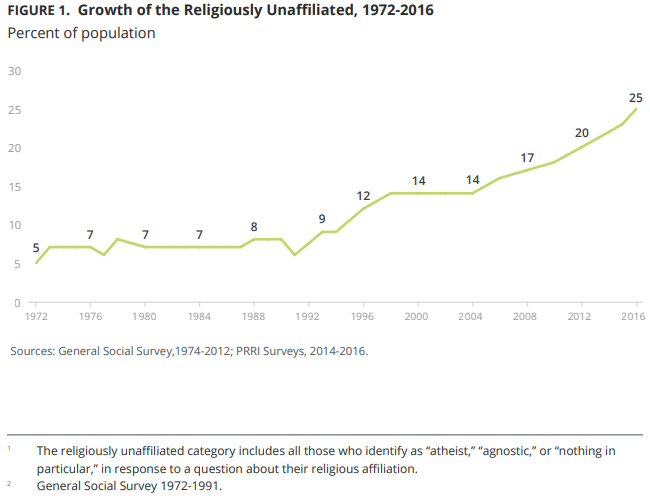
Another graph found in the analysis of the survey puts to rest any further scepticism in fivethirtyeight’s claim. PRRI found that 25% of Americans in 2016 are religiously unaffiliated, up from just 5% in 1972. This shows that the trend of decreasing affiliation is not just found between generations in 2016, but that there has been a larger trend from at least the 1970s that has progressively increased into the early 2000s.

This final piece of evidence shows that PRRI’s and fivethirtyeight’s claim of the precipitous fall of religious affiliation is true and representative of a wide variety of Americans. There are no blatant biases found in the data collection, and no misleading representations of the data presented. So what does this mean for the future of America? Will we become a more liberal nation as the older religious generation dies, or will religion cease to create political boundaries as it loses its base?

Today, one-quarter (25%) of Americans claim no formal religious identity, making this group the single largest “religious group” in the U.S.

PRRI.org

Sources:

fivethirtyeight:Are White Evangelicals Sacrificing The Future In Search Of The Past?
PRRI 2016 American Values Survey Data
PRRI About
PRRI The Rise of the Unaffiliated

Simplifying Recycling May Be Complicating Its Future

Single-stream recycling, the practice of throwing all types of recyclable material into one bin, is incredibly convenient. Some studies have shown that a switch from multi- to single-stream has increased recycling in the U.S. between 30 and 50 percent. But does this user-friendly system really increase the amount of material that is re-purposed, or does it feed our landfills and leave re-processors without usable materials to re-use?

The concept of recycling as it is known today emanates from WWII campaigns to save scarce materials so they can be re-purposed by the military. By the 1960s and 70s, recycling became necessary due to the immense amount of waste that appeared as the U.S. economy boomed after the war. Curbside recycling programs appeared around the 1990s, and were successful, although the mentality of Americans began to shift as they saw recycling as a burden without any direct incentives for themselves. Recycling rates dropped or flattened even as recycling programs increased and improved.

Taken from http://www.container-recycling.org

Single-stream is the newest system implemented in the U.S. to increase recycling by reducing the amount of time the average American spends sorting their waste. New sorting facilities and high-tech machines have been developed to increase efficiency and effectiveness, and larger garbage-sized bins are provided to households to give a visual incentive to recycle. However, single-stream recycling has a 15 to 27 percent residual rate – things that are put into recycling bins but cannot be recycled- compared with 1% for multi-stream systems, and 2-3% in dual-stream systems. This contamination not only increases the amount of material that is sent to the landfill, reducing the 30-50% recycling increase by roughly half, but it also can contaminate the materials that could be recycled. Contamination of materials drastically decreases the quality of the recyclables and does not allow for as much re-processing.


“the quality of the material [that post-consumer materials processors] receive from single-stream recyclers is inferior, which forces the manufacturer to downcycle the material (i.e., use it in a cheaper product) or, even worse, send it to the landfill.”

http://www.container-recycling.org

Depending on the levels of contamination and the type of materials being recycled, the apparent benefits of single-stream recycling may decrease to zero, or possibly result in a negative impact on the recycling stream. As more studies are completed, recycling may once again require more time and effort from Americans.

So what would a decrease in convience do to the recycling rates that are already low? Thinking positively, citizens may now be so accustomed to recycling their waste that reverting back to sorting items into separate bins may not have much of an impact on the percentage of materials recycled. However, it is more likely that as recycling once again becomes more time-consuming and remains without a tangible incentive to the recycler, U.S. recycling rates will once again drop. To environmentally conscious Americans, this could be disheartening and it may force some thought into other sustainable practices like reducing single-use materials or repurposing existing products.

“Recycling is the third R, you have to reduce and reuse first.”

https://www.nytimes.com

Sources:

Albeck-Ripka, Livia. “Your Recycling Gets Recycled, Right? Maybe, or Maybe Not.” The New York Times, The New York Times Company, 29 May 2018, http://www.nytimes.com/2018/05/29/climate/recycling-landfills-plastic-papers.html.

Koerth-Baker, Maggie. “The Era Of Easy Recycling May Be Coming To An End.” FiveThirtyEight, ABC News, 10 Jan. 2019, fivethirtyeight.com/features/the-era-of-easy-recycling-may-be-coming-to-an-end/.

Morawski, Clarissa. “Understanding Economic and Environmental Impacts of Single-Stream Collection Systems.” Container Recycling, Container Recycling Institute, Dec. 2009, http://www.container-recycling.org/assets/pdfs/reports/2009-SingleStream.pdf.

“Single-Stream Recycling.” Scientific American, Springer Nature America Inc, http://www.scientificamerican.com/article/single-stream-recycling/.

Waxman, Olivia B. “America Recycles Day 2016: A Brief History of Recycling.” Time, Time, 15 Nov. 2016, time.com/4568234/history-origins-recycling/.