Does the cheaper educational alternative of online learning have a downside?

The Digital Age has undoubtedly broadened the accessibility of information, and the American education system has begun to evolve accordingly. The Heritage Foundation announced that “online learning is revolutionizing K-12 education and benefiting students” (Lips, 2010, p. 1). The same publication describes that “[a]s many as 1 million children (roughly 2 percent of the K-12 student population) are participating in some form of online learning” (Lips, 2010, p. 1) and cites a meta-analysis from the U.S. Department of Education that found that “students who took all or part of their class online performed better, on average, than those taking the same course through traditional face-to-face instruction” (U.S. Department of Education, 2010, p. xiv). The Heritage Foundation article repeatedly mentions online learning’s potential to reduce taxes because of its lower cost compared to funding educators. However, by advocating for this cheaper alternative to traditional methods of education, the Heritage Foundation supports the reduction of professional opportunities for women in the education sector. 

Despite making up the majority of the field, women are disproportionately underrepresented in schools’ administrative positions.. While 76% of public and private K-12 teachers are female (U.S. Department of Education, National Center for Education Statistics, Schools and Staffing Survey, 2012c), women hold only 51.6% of principal positions at public schools (U.S. Department of Education, National Center for Education Statistics, Schools and Staffing Survey, 2012b) and 55.4% at private ones (U.S. Department of Education, National Center for Education Statistics, Schools and Staffing Survey, 2012a). When it comes to salary, a study in Pennsylvania found pay gaps between male and female K-12 educators that “actually grow” (Barnum, 2018, para. 6) when controlling for outside factors such as the teacher’s education level and experience. Therefore, not only do women complete most of the work in the education profession, they are undervalued as represented by their underrepresentation in more prestigious positions and unfair remuneration. 

Because the majority of K-12 educators are female, the online learning movement, which seeks to replace educators with technology and software, reduces professional opportunities for women. This report from the Heritage Foundation promotes online learning by emphasizing its low cost; specifically, the author cites Terry M. Moe and John E. Chubb’s Liberating Learning, where the authors “estimate that a school could reduce its teaching staff by approximately one-sixth if elementary school students spent one our per day learning electronically” (Lips, 2010, p. 5). Ideologically, replacing educators with digital systems represents a lack of respect for teaching as a profession, and this movement paints teaching as formulaic and mechanical. 

The Heritage Foundation advocates for replacing teaching staff, of whom the majority are women and facing a gender pay gap, with online learning systems. This notion continues to resist the view of teaching as a profession and, if enacted, would mainly disadvantage women instead of men in the sector, who are more likely to hold more powerful positions. 

References

Barnum, M. (2018). Chalkbeat. In female-dominated education field, women still lag behind in pay, according to two new studies. Retrieved from https://chalkbeat.org/posts/us/2018/06/15/in-female-dominated-education-field-women-still-lag-behind-in-pay-according-to-two-new-studies/

Lips, D. (2010). The Heritage Foundation. How online learning is revolutionizing K-12 education and benefiting students. Retrieved from https://www.heritage.org/technology/report/how-online-learning-revolutionizing-k-12-education-and-benefiting-students#_ftn5

U.S. Department of Education, National Center for Education Statistics, Schools and Staffing Survey. (2012). Average and median age of private school principals, and percentage distribution of principals, by age category, sex, and affiliation: 2011-2012. Retrieved from https://nces.ed.gov/surveys/sass/tables/sass1112_2013313_p2a_002.asp

U.S. Department of Education, National Center for Education Statistics, Schools and Staffing Survey. (2012). Number and percentage distribution of public school principals by gender, race, and selected principal characteristics: 2011-2012. Retrieved from https://nces.ed.gov/surveys/sass/tables/sass1112_490_a1n.asp

U.S. Department of Education, National Center for Education Statistics, Schools and Staffing Survey. (2012). Total number of select public and private school teachers and percentage distribution of select public and private school teachers, by age category, sex, and selected main teaching assignment: 2011-2012. Retrieved from https://nces.ed.gov/surveys/sass/tables/sass1112_20170221001_t12n.asp

U.S. Department of Education, Office of Planning Evaluation, and Policy Development. (2010). Evaluation of evidence-based practices in online learning: A meta-analysis and review of online learning studies. Retrieved from https://www2.ed.gov/rschstat/eval/tech/evidence-based-practices/finalreport.pdf
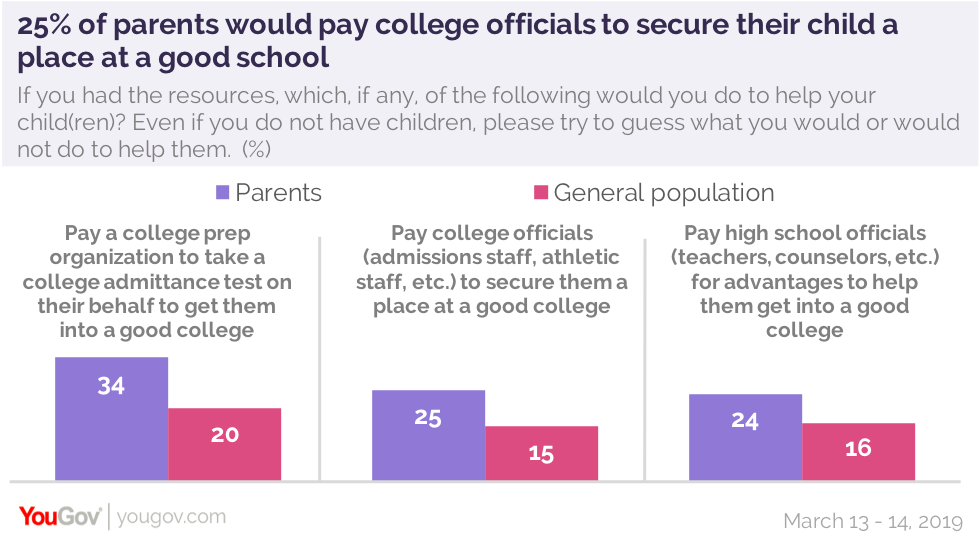
In the midst of the college bribery scandal, would 1 out of every 4 parents really pay their child’s way into higher education?

This month, several celebrities have been caught taking part in a bribery scandal to get their children into highly selective institutions such as University of California schools, Stanford University, and the University of Southern California (Yan, 2019). While the link between wealth and access to education is not new, this outright corruption is somewhat surprising. Recently, YouGov administered a poll to over a thousand individuals to assess how many quotidian (rather than celebrity) parents would also engage in this bribery for their own children. An article about the survey concludes that “25% of parents would pay college officials to secure their child a place at a good school” (Ballard, 2019). However, due to bias in the survey’s data collection, the premise of YouGov, and the context of when respondents were answering, the article is likely over-reporting how many parents would actually engage in this bribery.

As one of my classmates explained in a presentation, the reliability of YouGov’s data is questionable. YouGov is a service that allows individuals to participate in surveys similar to this one for a financial incentive. Presumably, members of the service merely want to get through as many surveys as possible to maximize their earnings. It is possible that some respondents answered a hasty and impulsive “probably would” or “definitely would” to the question without genuinely reflecting on the ramifications of this hypothetical bribery.

To make up for the inherent pitfalls of survey-based data collection, YouGov weights the responding sample “to the profile of the sample definition to provide a representative reporting sample. The profile is normally derived from census data or, if not available from the census, from industry accepted data” (YouGov, 2019, p. 2). Considering the varying proportions of individuals who answered “probably would” or “definitely would” to the question of interest across demographics, I am unsure if adjusting the weights of samples maintains the data’s integrity, especially with the skew already involved in an online survey.

Lastly, the timing of the survey’s administration may have affected individuals’ responses. Many parents of soon-to-be college-aged youth may feel disenfranchised with the education system following the recent coverage of this scandal (for what it’s worth, 64% of parents and 67% of the overall respondents in this survey agreed that “[t]he education system in the US is rigged in favor of wealthy students” (YouGov, 2019, p. 9)). This frustration may have inflated the amount of people who responded that they would pay their child’s way into a good college. This speculation aligns with the data, showing that respondents who make under $30k per year were more likely than those who make over $100k annually to answer that they would bribe a college official on behalf of their child.

Given the premise of YouGov as a means of data collection and its methodology, the finding that “25% of parents would pay college officials to secure their child a place at a good school” (Ballard, 2019) seems to provide more shock value than meaningful information about the prevalence of bribery in the world of higher education. It would be worth investigating if a less biased survey without the adjusted demographic weights and sufficiently after the wake of the scandal would yield similar results.

References

Ballard, J. (2019 15 March 15). 25% of parents say they would pay college officials to get their children into a good school. YouGov. Retrieved from https://today.yougov.com/topics/politics/articles-reports/2019/03/15/lori-loughlin-felicity-huffman-bribery-arrest

Yan, H. (2019, March 19). What we know so far in the college admissions cheating scandal. CNN. Retrieved from https://www.cnn.com/2019/03/13/us/what-we-know-college-admissions-cheating-scandal/index.html

YouGov. (2019). College bribery scandal: Fieldwork dates: 13th – 14th March 2019. Retrieved from https://d25d2506sfb94s.cloudfront.net/cumulus_uploads/document/7q2jjlupn9/Results%20for%20YouGov%20Omnibus%20(College%20Bribery%20Scandal)%20064%2014.3.2019%20(1).xlsx%20%20[Group].pdf

Does Teach For America benefit students beyond their standardized test scores?

Teach For America (TFA) is a nation-wide program where college graduates serve two-year terms as teachers or principals at underserved schools. The organization was founded in 1989 by Princeton graduate Wendy Kopp (“Research,” n.d.). Since then, over 50,000 people have participated in the program (“Who we are,” n.d.). In 2010, the nonprofit received a $50 million Investing in Innovation (i3) grant from the US Department of Education to expand the program (Clark, Isenberg, Liu, Makowsky, & Zukiewicz, 2015). TFA maintains a page on their website detailing (favorable) publications on the effects of the program; the organization claims that one study (Backes & Hansen, 2015) “found suggestive evidence that corps members had an impact on several non-tested outcomes. Students taught by corps members in elementary and middle school were less likely to miss school because of unexcused absences and suspensions than students taught by non-Teach For America teachers in the same school” (“Research,” n.d.). However, this conclusion is unwarranted given the actual, less substantial findings of the study.

Compared to the authors of the TFA site, the study’s authors are more honest in communicating the realistic significance of their findings. Based off of their analysis of data on non-tested indicators of student success, they conclude elementary school students of TFA instructors showed a reduction in unexcused absences and days of suspension. At the middle school level, students of TFA members likewise experienced declines in unexcused absences and days of suspension (Backes & Hansen, 2015, p. 20). While these findings appear promising, the researchers note that only the results of elementary days of suspension and middle-school unexcused absences are statistically significant, the former only marginally. Similarly, initial analysis finds middle school TFA teachers’ students’ unexcused absences to decrease by 7% compared to their non-TFA classmates, but taking into account the higher baseline of unexcused absences among the populations that TFA members are recruited to teach, the change reduces to only 4%. The largest difference in proportions between TFA and non-TFA students was in the change in days of suspension in elementary school students; however, Backes and Hansen (2015) mention that “it is hard to know whether this particular result is replicable in different data” (p. 21) due to a low baseline of days of suspension and a high standard error in the data. With the minor significance of this analysis’ findings, TFA’s announcement that the study yielded “suggestive evidence that corps members had an impact on several non-tested outcomes” (“Research,” n.d.) is misleading. 

This analysis also found that elementary students of TFA instructors experienced a 1.7% increase in GPAs compared to their non-TFA-instructed peers. The TFA site does not include this in their summary of the findings, but given that the organization cites this study in its entirety, it is still worthwhile to evaluate the merit of this conclusion. The authors define the difference in GPAs as only “at least marginally significant” (Backes & Hansen, 2015, p. 20), and the effect was not present at the middle school level. While these considerations diminish this minor difference’s significance, it is also important to note that teachers are the ones who determine these GPAs; not all of a student’s teachers will be TFA-affiliated, of course, but this variable does allow for the possibility of grade inflation by TFA members. 

In an effort to demonstrate quantifiable value in their program, Teach For America evaluated Backes and Hansen’s (2015) overly generously when summarizing it on their site. The incremental and potentially bias-influenced differences in TFA- and non-TFA-instructed elementary and middle school students’ unexcused absences, days of suspension, and GPAs in reality are not as encouraging as TFA claims. 

References

Backes, B. & Hansen, M. (2015). Teach For America impact estimates on contested student outcomes. National Center for Analysis of Longitudinal Data in Education Research. Retrieved from https://caldercenter.org/sites/default/files/WP%20146.pdf

Clark, M. A., Isenberg, E., Liu, A. Y., Makowsky, L., & Zukiewicz, M. (2015). Impacts of the Teach For America Investing in Innovation scale-up. Mathematica Policy Research. Retrieved from https://teachforamerica.app.box.com/s/wyuu1rpqogxmksat86mnuk16sur981le

“Research.” (n.d.) Teach For America. Retrieved from https://www.teachforamerica.org/support-us/research

“Who we are.” (n.d.) Teach For America. Retrieved from https://www.teachforamerica.org/what-we-do/who-we-are

Should K-12 students’ test scores determine their teachers’ pay?

Success in teaching is notoriously difficult to evaluate. The Bill and Melinda Gates Foundation, who funded the three-year Measures of Effective Teaching Project, cites that “[t]wo-thirds of American teachers feel that traditional evaluations don’t accurately capture the full picture of what they do in the classroom” (Bill & Melinda Gates Foundation, n.d.). Berk (2005) suggests using a combination of “student ratings, peer ratings, and self-evaluation… [to] build on the strengths of all sources, while compensating for the weaknesses in any single source” (p. 48). Despite complications in measuring teaching success, the debate around merit pay (also known as performance pay) for educators has existed intermittently since the 1920s (Pham, Nguyen, & Springer, 2017). In the age of standardization, proponents advocate for teachers’ salaries to be based on their students’ test scores or for financial incentives for favorable results. Writing for Forbes, Nick Morrison (2013) acknowledges the lack of evidence linking merit pay with increases in test scores yet takes the neoliberal stance and calls the system “fairer.” Since then, Pham, Nguyen, and Springer (2017) conducted a meta-analysis of 40 merit pay studies to find that “the presence of a merit pay program is associated with a modest, statistically significant, positive effect on student test scores” (p. 2). While the authors are appropriately conservative in their conclusion, the overly broad range of studies included in their meta-analysis prevents their findings from depicting a realistic account of merit pay’s effectiveness in the US should it be implemented nationally.

The researchers narrowed the original database gathering of nearly 20,000 results to a manageable 40, but the range of locations represented in the data complicates their generalizability. Though affiliated with the American Vanderbilt University, the investigators included twelve studies from outside the nation in their meta-analysis. Within these twelve is an unspecified number from developing countries (Pham, Nguyen, & Springer, 2017, p. 20), data that may have questionable applicability to the United States. Furthermore, out of the 28 US-based studies, sixteen were categorized as “merit pay + other,” meaning that “merit pay was implemented in conjunction with other reforms such as additional training” (p. 43). Because merit pay was not an isolated variable in these studies, their findings are not necessarily representative of its effects. Returning to the issue of inconsistency in data origins, only one other study in the meta-analysis fell into this category, making the US results even more skewed.

Also obscuring the meta-analysis findings is the breadth of methods used in the 40 studies. The authors acknowledge that “most studies reported effect sizes at multiple time points, with multiple estimation techniques, for different subject areas, and at different levels of analysis” (Pham, Nguyen, & Springer, 2017, p. 15). While they report accounting for this using a random-effects model, which “allows the true effect size to vary across studies” (p. 15), this substantial variation is still not ideal. As they note, “studies included in the analysis are decidedly different[,] and poorly produced studies may inject considerable bias” (p. 18). Considering that “almost [fewer than!] half of the studies are peer-reviewed publications” (p. 20), this broad of a sampling seems overly generous. For example, the authors mention excluding “case studies of fewer than five teachers” (p. 13) from their meta-analysis. This implies that they used a sample size of five teachers as the threshold for inclusion, which appears to be true according to the lower bound of 323 students in the total sample size range (p. 43) (if the 323 study did in fact only involve five teachers, there would be a student-to-teacher ratio of 64.6—a reasonable possibility assuming that, for instance, each teacher has three classes of 21-23 students). Although the upper bound of sample sizes of the studies included in the meta-analysis is 8,561,194 students, also using as small a sample size as five teachers makes the inclusion criteria seem too lenient. The excessively broad range of data included in this meta-analysis impairs the overall reliability of the findings instead of adding merit to the studies’ generalizability.

Although Pham, Nguyen, and Springer (2017) present the findings of this meta-analysis in an appropriately conservative way, investigation of their data collection reveals a lack of integrity that prevents them from even concluding a “modest, statistically significant, positive effect on student test scores” (p. 2) associated with merit pay programs. The inconsistency in the data’s locations, quality, and methods is a structural flaw in the meta-analysis that invalidates the researchers’ claims.

References

Berk, R. A. (2005). Survey of 12 strategies to measure teaching effectiveness. International Journal of Teaching and Learning in Higher Education, 17(1), 48-62. Retrieved from http://www.isetl.org/ijtlhe/pdf/IJTLHE8.pdf

Bill & Melinda Gates Foundation. (n.d.). Measures of Effective Teaching (MET) Project. Retrieved from http://k12education.gatesfoundation.org/blog/measures-of-effective-teaching-met-project/

Morrison, N. (2013, November 26). Merit pay for teachers is only fair. Forbes. Retrieved from https://www.forbes.com/sites/nickmorrison/2013/11/26/merit-pay-for-teachers-is-only-fair/#7f3b6164215d

Pham, L. D., Nguyen, T. D., & Springer, M. G. (2017). Teacher merit pay and student test scores: A meta-analysis. Retrieved from https://pdfs.semanticscholar.org/6d88/33216d5a96a46a3fced5af4ffac7d5d29077.pdf?_ga=2.257686413.705186148.1550997599-2007298045.1550997599

The implications of online learning for gender equality in the workforce

The Digital Age has undoubtedly broadened the accessibility of information, and the American education system has begun to evolve accordingly. The Heritage Foundation announced that “online learning is revolutionizing K-12 education and benefiting students” (Lips, 2010). The same publication describes that “[a]s many as 1 million children (roughly 2 percent of the K-12 student population) are participating in some form of online learning” (Lips, 2010) and cites a meta-analysis from the U.S. Department of Education that found that “students who took all or part of their class online performed better, on average, than those taking the same course through traditional face-to-face instruction” (U.S. Department of Education, 2010, p. xiv). The Heritage Foundation article repeatedly mentions online learning’s potential to reduce taxes because of its lower cost compared to funding educators. However, by advocating for this cheaper alternative to traditional methods of education, the Heritage Foundation perpetuates the effects of sexism in the workforce.

Despite making up the majority of the field, women continue to face discrimination in education. The number of male principals is disproportionate to how many teachers are men. While 76% of public and private K-12 teachers are female (U.S. Department of Education, National Center for Education Statistics, Schools and Staffing Survey, 2012c), women hold only 51.6% of principal positions at public schools (U.S. Department of Education, National Center for Education Statistics, Schools and Staffing Survey, 2012b) and 55.4% at private ones (U.S. Department of Education, National Center for Education Statistics, Schools and Staffing Survey, 2012a). At the postsecondary level, women are more likely than men to fill lower level professor positions such as the roles of assistant professor, instructor, and lecturer (U.S. Department of Education, National Center for Education Statistics, 2016). Similar to the demographics of hierarchies in the K-12 system, only 30% of college presidents are female (American Council on Education, Center for Policy Research and Strategy, 2016). Furthermore, a study in Pennsylvania found a pay gap between male and female educators, even when accounting for outside factors (Barnum, 2018). Therefore, not only do women complete most of the work in the education profession, they are undervalued as represented by their unfair remuneration.

Because of the gender disparities in the education field, a shift towards online learning would mainly disadvantage women. This report from the Heritage Foundation promotes online learning by emphasizing its low cost; specifically, the author cites Terry M. Moe and John E. Chubb’s Liberating Learning, where the authors “estimate that a school could reduce its teaching staff by approximately one-sixth if elementary school students spent one our per day learning electronically” (Lips, 2010). Ideologically, replacing educators with digital systems represents a systemic lack of respect for teaching as a profession. Rather, this push for online learning paints teaching as formulaic and mechanical.

The Heritage Foundation advocates for replacing teaching staff, of whom the majority are women and facing a gender pay gap, with online learning systems. This notion continues to resist the view of teaching as a profession and, if enacted, would mainly disadvantage women instead of men in the sector, who are more likely to hold more powerful positions.

References

American Council on Education, Center for Policy Research and Strategy. (2016). American College President Study. College presidents, by gender. Retrieved from http://www.aceacps.org/summary-profile/

Barnum, M. (2018). Chalkbeat. In female-dominated education field, women still lag behind in pay, according to two new studies. Retrieved from https://chalkbeat.org/posts/us/2018/06/15/in-female-dominated-education-field-women-still-lag-behind-in-pay-according-to-two-new-studies/

Lips, D. (2010). The Heritage Foundation. How online learning is revolutionizing K-12 education and benefiting students. Retrieved from https://www.heritage.org/technology/report/how-online-learning-revolutionizing-k-12-education-and-benefiting-students#_ftn5

U.S. Department of Education, National Center for Education Statistics, Schools and Staffing Survey. (2012). Average and median age of private school principals, and percentage distribution of principals, by age category, sex, and affiliation: 2011-2012. Retrieved from https://nces.ed.gov/surveys/sass/tables/sass1112_2013313_p2a_002.asp

U.S. Department of Education, National Center for Education Statistics. (2016). Fast facts: Race/ethnicity of college faculty. Retrieved from https://nces.ed.gov/fastfacts/display.asp?id=61

U.S. Department of Education, National Center for Education Statistics, Schools and Staffing Survey. (2012). Number and percentage distribution of public school principals by gender, race, and selected principal characteristics: 2011-2012. Retrieved from https://nces.ed.gov/surveys/sass/tables/sass1112_490_a1n.asp

U.S. Department of Education, National Center for Education Statistics, Schools and Staffing Survey. (2012). Total number of select public and private school teachers and percentage distribution of select public and private school teachers, by age category, sex, and selected main teaching assignment: 2011-2012. Retrieved from https://nces.ed.gov/surveys/sass/tables/sass1112_20170221001_t12n.asp

U.S. Department of Education, Office of Planning Evaluation, and Policy Development. (2010). Evaluation of evidence-based practices in online learning: A meta-analysis and review of online learning studies. Retrieved from https://www2.ed.gov/rschstat/eval/tech/evidence-based-practices/finalreport.pdf
Should public schools with higher proportions of low-income students receive increased funding?

In 2016, the National Bureau of Economic Research (NBER) published a monumental study examining the measurable academic effects of increased school funding. Using individual student scores (instead of combined data from entire schools) on the National Assessment of Educational Progress exam, the researchers found that funding-increasing reforms “lead to sharp, immediate, and sustained increases in spending in low-income school districts [and] increases in the achievement of students in these districts, phasing in gradually over the years following the reform” (Lafortune, Rothstein, & Whitmore Schanzenbach, 2016).

The researchers contextualize their study in the “so-called ‘adequacy’ era,” referring to the shift in many states’ funding strategies following the Kentucky Supreme Court Case Rose v. Council for Better Education (1989). The case yielded requirements to adequately fund education in order for the state to fulfill the Kentucky Constitution’s provision for “an efficient system of common schools” (Education Law Center, n.d.). The decision prompted similarly equitable changes to the funding formulas for several other states’ K-12 public education systems (Education Law Center, n.d.). Because of this partial shift in funding ideologies, the researchers use it as the marker of the “equal funding” mindset’s transition into the current “adequate funding” one.

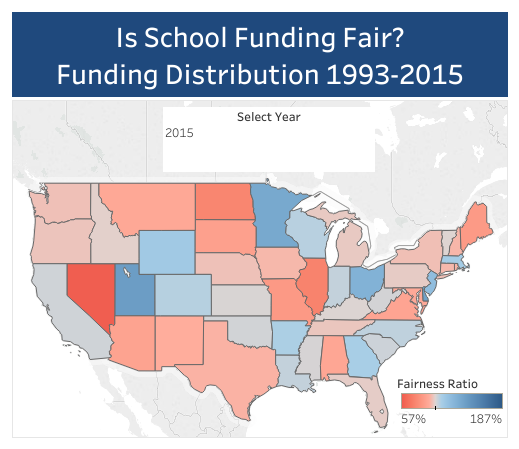
Despite Lafortune, Rothstein, and Whitmore Schanzenbach’s findings, a nationwide study from the Education Law Center and Rutgers Graduate School of Education on school funding by district poverty level concluded that “[t]he majority of states have unfair funding systems… that ignore the need for additional funding in high-poverty districts” (Baker, Farrie, & Sciarra, 2018, p. iv). The photo below is from an interactive map and shows data from the same study. The reality of education funding aligns with the model included in former President George W. Bush’ No Child Left Behind Act of 2001. In the speech he delivered before officially authorizing the legislation, he announced, “we’re going to spend more money, more resources, but they’ll be directed at methods that work. Not feel-good methods, not sound-good methods, but methods that actually work” (Strauss, 2015). The NBER found increased funding to be effective, but Bush based success on standardized test results, which are statistically and unjustly correlated with students’ socioeconomic statuses (Marcus, 2017). Considering this, it is unsurprising that Bush did not consider equitable funding to districts with high proportions of low-income students a “feel-good method.”

While it is important that researchers like these from the NBER publicize data-backed studies promoting equity in school funding, the disconnect between scholarship and practice is alarming. From a social justice standpoint, the education system’s fundamental role in students’ life trajectories makes it responsible for interrupting social reproduction, which describes the upper class’ persistent generational transference of wealth without more equal redistribution in society. Despite findings such as the NBER’s, Baker, Farrie, and Sciarra (2018) demonstrate that most states ignore the proven possibility of equal outcomes between districts and the ability of increased funding to combat outside social-political factors that low-income students face; these states’ decisions perpetuate social reproduction via the education system by failing to interrupt disparities between districts.

References

Baker, B. D., Farrie, D., & Sciarra, D. (2018). Is school funding fair? A national report card (7th ed.). Education Law Center & Rutgers Graduate School of Education. Retrieved from http://www.schoolfundingfairness.org/is-school-funding-fair/reports

Carey, K., & Harris, E. A. (2016, December 12). It turns out spending more probably does improve education. The New York Times. Retrieved from https://www.nytimes.com/2016/12/12/nyregion/it-turns-out-spending-more-probably-does-improve-education.html

Education Law Center. (n.d.) State profile: Kentucky. Retrieved from http://www.edlawcenter.org/states/kentucky.html

Lafortune, J., Rothstein, J., & Whitmore Schanzenbach, D. (2016). School finance reform and the distribution of student achievement. American Economic Journal: Applied Economics 10(2), 1-26. Retrieved from https://www.nber.org/papers/w22011

Marcus, J. (2017, August 16). The newest advantage of being rich in America? Higher grades. The Hechinger Report. Retrieved from https://hechingerreport.org/newest-advantage-rich-america-higher-grades/

Strauss, V. (2015, December 9). Why it’s worth re-reading George W. Bush’s 2002 No Child Left Behind speech. The Washington Post. Retrieved from https://www.washingtonpost.com/news/answer-sheet/wp/2015/12/09/why-its-worth-re-reading-george-w-bushs-2002-no-child-left-behind-speech/?utm_term=.15bc027b16a7

Does school choice save students from a “lagging” public education system?

In recent decades, the American public education system has seen a rise in demands for school choice and privatization. These movements work within a larger shift towards neoliberalism in education. Major proponents of school choice capitalize on parents’ desire to send their children to the seemingly best school; to sell their own schools, they antagonize the public education system in an effort to convince parents to support legislation that would allow the transference of tax dollars from public schools to these stakeholders. In their introductory article on school choice, the Cato Institute’s Center for Educational Freedom supports this movement and (irresponsibly) uses data on federal education spending and test scores to paint a misleading picture of the American public education system.

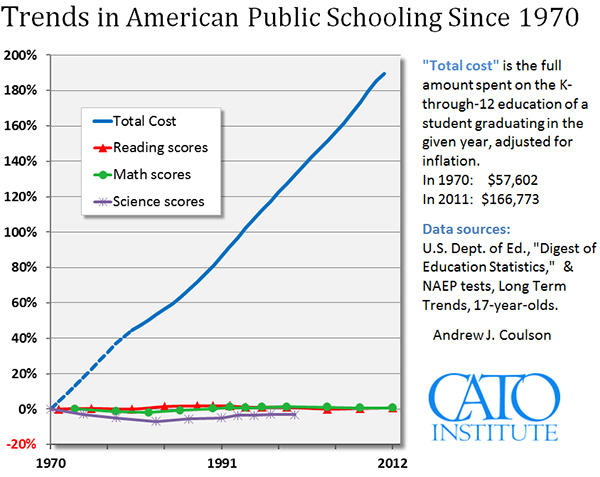
The article displays the above graph to portray federal education spending as wasteful and ineffective. However, the authors fail to consider the plethora of resources that public schools are now expected to provide. Since 1980, districts have increased spending on Title I schools (those with large low-income populations), technology, English language acquisition programs, special education, career and technical education, and assessments (U.S. Department of Education, 2018). These changes and increases in spending reflect a changing social context and student population. For example, in the past almost fifty years, the country’s percentage of people who speak English as a second language has grown (Ravitch, 2014). Considering schools’ growing role as an institution of language acquisition, it is remarkable (and attributable to increased funding) that they have achieved approximately the same scores on the long-term NAEP exam.

Additionally, it is unfounded for the authors to assess schools’ effectiveness or quality on test scores, and this graph in particular misconstrues their meaning. By demonstrating the 90% increase in total cost, the Cato Institute implies that a 90% increase in test scores would be satisfactory. This is unreasonable considering that the average seventeen-year-old’s long-term NAEP score in 1970 was 285 out of 500 — if the score were to match the budget’s increase, it would rise to 541. Not only is this higher than what is possible on the exam, but a perfect score on the exam is itself ridiculous because the long-term NAEP test scores on a scale of accuracy, not proficiency. A perfect score on the long-term NAEP exam does not indicate being at “grade level” or subject proficiency.

The Cato Institute portrays assessment data as reflective of the education system’s quality and links school funding to the expectation of increased “success” on these exams. However, this view of the public education system lacks nuance and regard for the growing role that schools play in youth’s lives. Instead, depending on assessment data for a depiction of schools’ effectiveness disregards the resources that these institutions provide.

References

Cato Institute. Educational freedom: An introduction. Retrieved from https://www.cato.org/education-wiki/educational-freedom-an-introduction

National Center for Education Statistics (2013). The Nation’s Report Card: Trends in academic progress 2012 (NCES 2013-456). National Center for Education Statistics, Institute of Education Sciences, U.S. Department of Education, Washington, D.C. See Digest of Education Statistics 2013, table 221.85. Retrieved from https://nces.ed.gov/programs/coe/pdf/coe_cnj.pdf

Ravitch, D. (2014). Reign of error: The hoax of the privatization movement and the danger to America’s public schools. New York, NY: Vintage Books. 

U.S. Department of Education. (2018). Education department budget history table (1980 – 2019). Retrieved from https://www2.ed.gov/about/overview/budget/history/edhistory.pdf