Marking makes perfect

Dancing full-out requires a lot of energy. Dancers often do what is called “marking” to conserve their energy for when they will perform or show movement more seriously later on. Marking is a way for dancers to reveiw movement and imagine it happening in their heads with few physical movements and low effort. It’s not always allowed or supported in a technique class and is typically frowned upon in a professional performance setting, like when a choreographer is giving movement to the group.

Being a more professional dancer now that I’m studying it in college, I have recently felt as though I need to put maximum or nearly maximum effort into each “run through” of a movement phrase, even when learning it for the first time. It’s crucial to pick movement up quickly and be able to reproduce what was shown as clearly as can be. Due to these high expectations, it appears logical that I would put maximum effort into each step of learning movement for maximum output. I have physically practiced to the level that I want to achieve when showing or performing and I won’t risk giving less than I possibly can. After all, athletes and peformers are always told to “practice like you play/perform”. I question the necessity of pressure from teachers to always put in full effort and to practice like one performs. Can it be beneficial to mark a dance instaed of going full-out? If so, how does this change current class philosophy and expectations?

Research by University of California and Claire Trevor School of the Arts faculty claims that marking is actually more cognitively beneficial to dancers than always going full out when rehearsing. When comparing the performance of dancers after using their full energy or going full out versus marking, the marking rehearsal method resulted in better performance (Warburton et al, 2013). Perhaps moving slowly through movement would give the brain time to attach meaning to each movement and therefore retain it in a more permanent memory storage space than if it were quickly and effortfully performed. This would mean that marking could be used as a method to retain movement or memorize it, something that going full out doesn’t provide time to do. While there aren’t many other studies that exist that are similar to this one and can provide more strength to the claim given, this is still a profound finding with major implications.

If more people are exposed to this idea that marking is more beneficial than going full out, professors, teachers, choreographers, and artistic directors would perhaps no longer hold performers to such high standards of effort and perfection during rehearsal time. Dance pedagogy would shift from stressing heavily on immediately translating replicated movement into the body to a new philosophy of working through and slowly understanding movement while using less physical and more cognitive energy. This transformation of philosophy would alleviate a lot of stress that dancers feel because it would give them time for more movement exploration and detail gathering and allow each performer to feel completely comfortable with movement before fully executing it. By allowing dancers to put more cognitive effort into their learning, it might actually help more with movement retention and leave less stress on the body. It would be very difficult for the negativity surrounding marking to disappear, but challenging current popular ideas such as practicing like you perform definitely helps to at least change the way that people see their methods of teaching and learning.

References

Warburton, E. C., Wilson, M., Lynch, M., & Cuykendall, S. (2013). The Cognitive Benefits of Movement Reduction. Psychological Science,24(9), 1732-1739. doi:10.1177/0956797613478824

Bergland, C. (2013, October 1). Why Is Dancing So Good for Your Brain? Retrieved from https://www.psychologytoday.com/us/blog/the-athletes-way/201310/why-is-dancing-so-good-your-brain

The dangerous lure of (cheap) chiropractic services

A 2002 study published in the US National Library of Medicine National Institutes of Health stated that “Alternative health care was used by an estimated 42% of the U.S. population in 1997, and chiropractors accounted for 31% of the total estimated number of visits” (Coulter et al., 2002). Despite negative stigmas, high costs, and little scientific evidence supporting the effectiveness of chiropractic care, people continue use it as a mode of treatment. Why are people drawn to chiropractic care?

Chiropractic care is very expensive, costing between $30-200 per session depending on the quality and length of treatment and many other factors (Briones, 2017). Clinics realize that monetary cost is a concern, and so they might advertise as better than others due to their monthly plans, low rates, and in some cases the fact that they don’t require insurance. One clinic, the Joint Chiropractic, prides itself on all three of these highlights and even taps into more common concerns that people may have. ” This means fewer trips to the doctor, less time off work, and more money in your pocket where it belongs” (The Joint Chiropractic, 2019). While having low monetary costs, less trips to the doctor, and less time off work, and improved health all sound ideal and convenient, there are many risks to chiropractic care.

In terms of cost, chiropractors can charge more for their services if they have had more than the required 8 years of post-secondary education, trained others in administering care, or have more advanced tools and technology in house (Briones, 2017). With cheaper clinics, their practitioners may not be as educated and trained and they could likely be causing more damage to the patient’s overall health rather than benefiting them. A 2-5 minute “quick-fix” doesn’t always do the trick, either. More respected and usually more expensive clinics can offer a variety of options for care, such as radiography, diathermy, and thermography that focus on particular musculoskeletal issues with more time and detail than mere spinal manipulation, which might be what a patient needs.

“Saving up for or having fewer sessions with a more qualified, experienced practitioner would be much more worthwhile than receiving substandard care from a “discount” doctor” (Briones, 2017).

While convenience and affordability are important to consider in choosing a method of musculoskeletal adjustment or care, the reliability of a clinic and practicioner as well as the availaibilty of proper options for one’s needs are very important to consider. For some people, cheaper clinics with a 5 minute spinal adjustment might seem satisfactoy. If someone has a more severe condition, it’s likely they will need more specialized care and might feel satisfied with the quick chiropractic service but are not actually seeing an improvement in their overall health (placebo effect). This is significant because many people turn to alternative medicine or treatments with little to no scientific support for thier benefits. The convincing advertisements that claim cheap prices, extraordinary claims of overall improved health, and a quick fix catch many people in their webs. These patients could need more specialized or thorough treatment but instead are putting their money and the future of their health into a possibly less respected or scientifically backed service.

References

The Joint Corp. “The Cost of Chiropractic Care: Is It Worth It?” The Cost of Chiropractic Care: Is It Worth It?, 2019, http://www.thejoint.com/colorado/colorado-springs/colorado-springs-38002/193800-cost-chiropractic-care-is-it-worth-it.

Coulter, Ian D, et al. “Patients Using Chiropractors in North America: Who Are They, and Why Are They in Chiropractic Care?” Spine, U.S. National Library of Medicine, 1 Feb. 2002, http://www.ncbi.nlm.nih.gov/pubmed/11805694.

Briones, Danielle. “Cost of Chiropractic Care – Treatment Costs.” DocShop, DocShop, 6 Sept. 2017, http://www.docshop.com/education/chiropractic/cost.

Oral genetics & cavities

Every six months or so a checkup at the dentist results in the news of new cavities or a perfectly clean mouth, which often appears to reflect one’s attention to oral hygiene. If the news is new cavities, reflecting on how detailed one was with their daily regiment and advice from the dentist generally ensues. I recently went to the dentist and was told that I have a cavity on one of my molars which was very surprising because I floss and brush my teeth every single day. This lead me to question what other factors come into play with oral hygiene (besides diet). Knowing that my father has a very unfortunate history with his many tooth-related ventures, I wondered whether or not cavities are merely genetic phenomena and if, even though I floss and brush every day, I’m bound to have oral hygiene troubles.

A study contributed to by many institutions, including the J. Craig Venture Institute, examined the presence of oral microbial bacteria in 485 twins from age 5-11 via mouth swabs. Twins of both dizygotic and monozygotic types appeared, to increase the range of similar genotypes and thus the specificity of the results. Caries, age, and sugar are three factors that were in consideration as a cause of increased bacteria, as shown below. The image below also represents a basic separation of the heritable and environmentally-determined bacteria in the subjects who were more and less similar.

Cell Press 2017

In bacteria that were highly heritable, age, sugar, and caries appeared to increase with decreased bacterial presence, showing a negative correlation. In bacteria mainly modulated by the environment, caries seemed to increase as the abundance of bacteria increased. In other words, the environment has a large impact on the number of bacteria and therefore carries within the mouth, but in cases of heritable bacteria, an increase of age and a decrease of sugar intake will decrease the damaging effects that bacteria can cause. Also, heritable bacteria appear to not have a relationship to caries present in the mouth. All in all, the study found that
1. Heritable oral bacteria do not cause or lessen the existence of caries. 2. Environmentally-derived bacteria, from one’s diet, for example, do impact the presence of caries and often remain similar in number between genetically similar individuals. 3. With age, heritable bacteria may decrease.

“Thus, while the human oral microbiome composition is influenced by host genetic background, potentially cariogenic taxa are likely not controlled by genetic factors” (Cell Press 2017).

In conclusion, the Cell Press study shows that heritable oral bacteria is, in fact, genetic, but has no clear relationship with the presence of cavities and can decrease as one ages. Therefore, having misfortunes with my oral hygiene is partially genetic, but the presence of heritable bacteria that I have will decrease over time and does not cause cavities. It’s my environment (i.e. diet) that most heavily influences my oral hygiene state. Knowing that cavities can’t be blamed on genetics, more caution should be taken when choosing what foods to eat (sugar, carbohydrates, etc…) that could potentially be cariogenic.

*Caries = cavities

References:

Gomez, Andres, et al. “Host Genetic Control of the Oral Microbiome in Health and Disease.” NeuroImage, Academic Press, 13 Sept. 2017, http://www.sciencedirect.com/science/article/pii/S1931312817303463.

Vaccines and Autism

Do people still believe in the link between vaccines and autism? If so, whom?

The flaws behind one survey that seeks to answer this question.

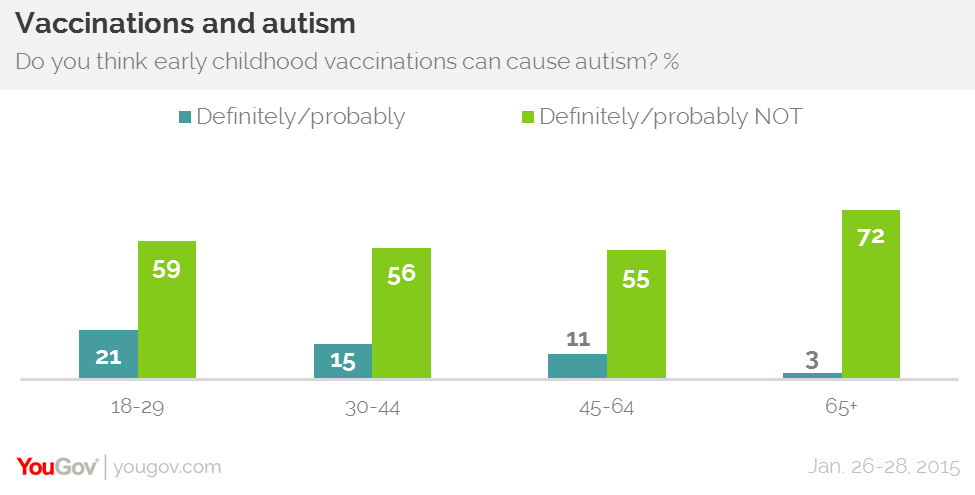
YouGov is an American company that supplies poll data to its paying clients via online surveys taken by its users. In 2015, one of their panelists Peter Moore published an article titled “Young Americans most worried about vaccines”. The article discussed two questions from the survey and displayed a graph for each with the results. These are shown below.


When looking at these two graphs, I realized that each percentage combination per age group does not add up to 100%, which means that participants might have abstained for the question or YouGov simply chose not to display the answer given by the other percentage of participants. This can be problematic because viewers don’t know where the other participants lie. Coupled with this curiosity, I also wondered what types of participants were being surveyed and if this was a representative sample.

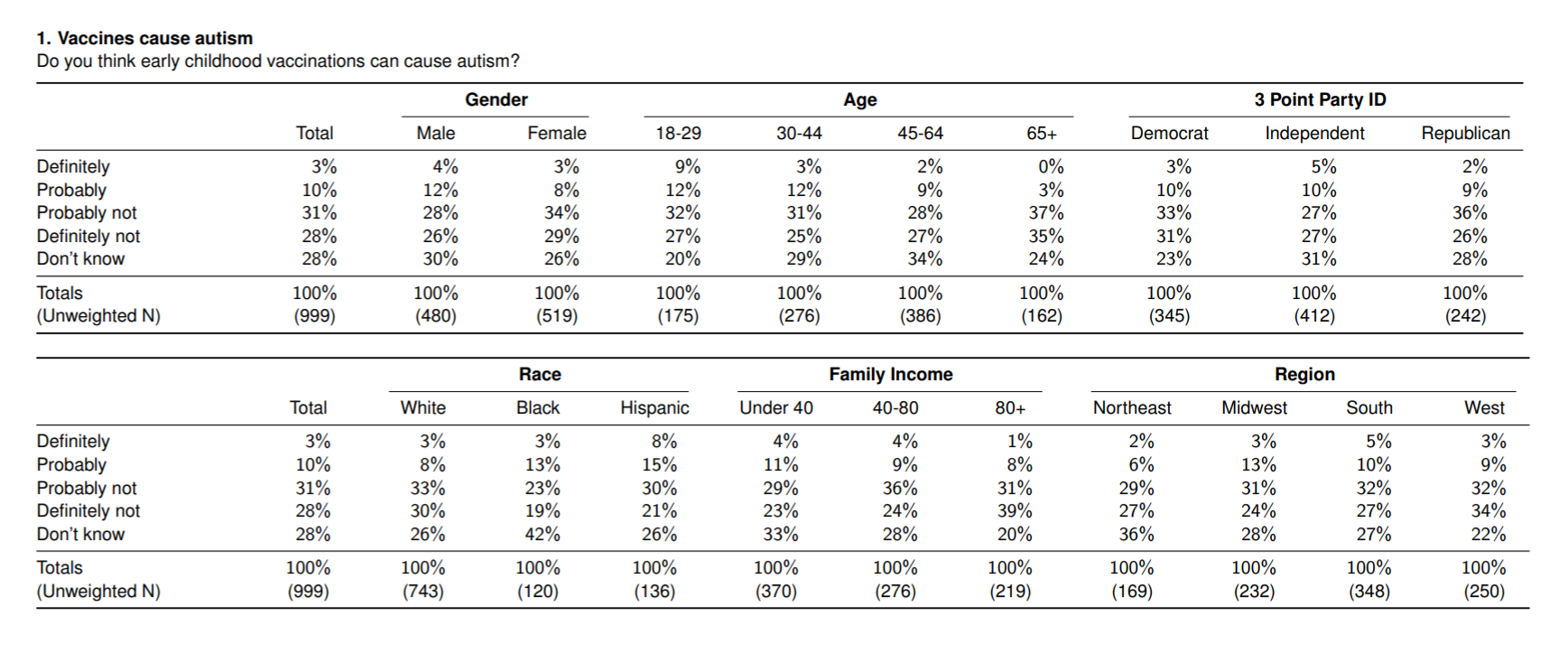
After finding the full version of the results from the YouGov survey, I found that Moore’s graphs and general article information were highly simplified versions of the full results. Simplifying data makes writing easier because one is able to focus on what is important to their claim or pointed subject, like two specific questions in this case; However, Moore left out important details about how the data was collected and grouped for the sake of simplicity. Below is an example of a question from the full report.

YouGov

The full results from the online poll group surveyors by age, race, gender, etc… as well as “Definitely” to “Definitely Not” as well as “Don’t Know”, yet all groups are combined to differ only by age in Moore’s presentation of the findings. Referring back to the missing percentage in his simplified graphs, one can see that there is not a category for “Don’t Know” like there is in the full results, and each response type is combined with another rather than separated. Simplifying data results is not necessarily a good or bad thing, but it can limit the ability of viewers to have accurate and holistic information on the findings, as they only have access to a small piece of the results.

While the data from this survey might be helpful in answering questions related to people’s beliefs of vaccines and autism, it isn’t wholly representative of American and even human/world views. YouGov collects data via online surveys and offers cash prizes to those who participate after they have accumulated a certain amount of points. This means that the people who are represented in these results all willingly took this survey most likely because they were receiving a cash prize, and they are all people who have accounts with YouGov, not general internet participants. An example of this being incomplete representation is the idea that more millennials use the internet than older people, so millennials overall are being better represented, whereas individuals 65+ are being generalized by those who happen to use the internet, have YouGov accounts, and chose to participate in this poll. These are some general issues with online surveys and point out some things to consider when finding data to rely on to answer questions.

Overall, there are some flaws in Moore’s analysis of YouGov’s results detailing people’s responses to questions about vaccines, as well as the initial surveying by YouGov. The information given by both is not representative of all people’s beliefs nor even those of all Americans, but it can give one some idea of what people currently think about the connection between vaccines and autism, especially in relation to their age.

References:

Moore, Peter. “Young Americans Most Worried about Vaccines.” YouGov, 2015, today.yougov.com/topics/lifestyle/articles-reports/2015/01/30/young-americans-worried-vaccines

“YouGov | About.” YouGov, 2018, today.yougov.com/about/about/.

Are young women losing interest in motherhood?

While having kids seemed to be expected of young adults in the past, there appears to be a decline in the appeal of young-adult parenthood today, notably since the year 2000. According to the CDC, the average age for women births was 24.9 in 2000 and had increased to 26 in 2017. Are young women losing interest in motherhood? If so, why?

Mona Chalabi, a data editor for the Guardian US, writes about some of the everyday effects of young-adult parenthood for both males and females in her article titled Read this before you have a baby (especially if you’re a woman). According to Chalabi, women spend less time working when they have children under 7 than when they are without children. Less work means less income, and whatever is being earned most likely goes towards the well-being and care of the child. Not only do women sacrifice more money by having a child, but they also have less time for leisure, namely watching TV. Women with children spend fewer hours in a day watching TV than those who don’t. Having more money to spend on one’s self and time to focus on work and leisure are a few of the reasons that young women are choosing to wait longer to have children. Perhaps having children just isn’t as appealing to young women anymore.


“…if you’re a woman who enjoys paid work or relaxing activities, having kids will cramp your style” – Chalabi

Chalabi uses data from the CDC, a trustworthy, government organization that has many divisions, including the National Center for Health Statistics, Division of Vital Statistics, Reproductive Statistics Branch. She also utilizes the US Dept. of Labor’s American Time Use Survey which is, again, a credible government source. Aside from source credibility, she does something unique and highly valuable- she explains why she analyzed what she did and recognizes possible faults in her methods.


“Obviously averages differ a bit over the course of a week but for the purposes of this analysis, I just took the average day regardless of when it fell during the week or year” – Chalabi

When presenting data, it’s important to explain the process behind the analysis so that readers can trust the methods used and the results formed. Chalabi makes sure to inform her audience of the possible problems with the data in connection to her claims as well.


“Some of these differences could be explained by other factors like age – the older you are, the more likely you are to have children and maybe as men get older they spend more time at work but as women get older they’re less likely to (meaning that it’s the job and not the presence of kids that affects work hours)” – Chalabi

She repeats this tactic throughout each of the ATUS data sets that she analyzes. This ability to recognize uncertainty and alternative hypotheses makes Chalabi’s analysis more thorough and holistic, and therefore a better, less biased reference for answering questions with the use of data analysis.

Overall, Mona Chalabi’s analysis and synthesis of data from the American Time Usage Survey and the CDC holds value in its recognition of alternative hypotheses, uncertainty, and counterclaims, as well as its use of trustworthy, credible sources. Knowing this, it’s safe to say that there is significant evidence pointing towards young women feeling less inclined to have children today than at the start of the 21st century.

References:

Matthews, T. J., and Brady E. Hamilton. “Mean Age of Mothers Is on the Rise: United States, 2000–2014.” NCHS Data Brief, U.S. Department of Health and Health Services, Jan. 2016, http://www.cdc.gov/nchs/data/databriefs/db232.pdf.

Chalabi, Mona. “Read This Before You Have a Baby (Especially If You’re a Woman).” The Guardian, Guardian News and Media, 8 Dec. 2017, http://www.theguardian.com/news/datablog/2017/dec/07/datablog-children-parents-time-read-this-before-you-have-a-baby-especially-if-youre-a-woman.

Shifting Power in the World of Streaming Services

by Cameron Welch

What does the Netflix crisis mean for consumers and other streaming and/or production companies?

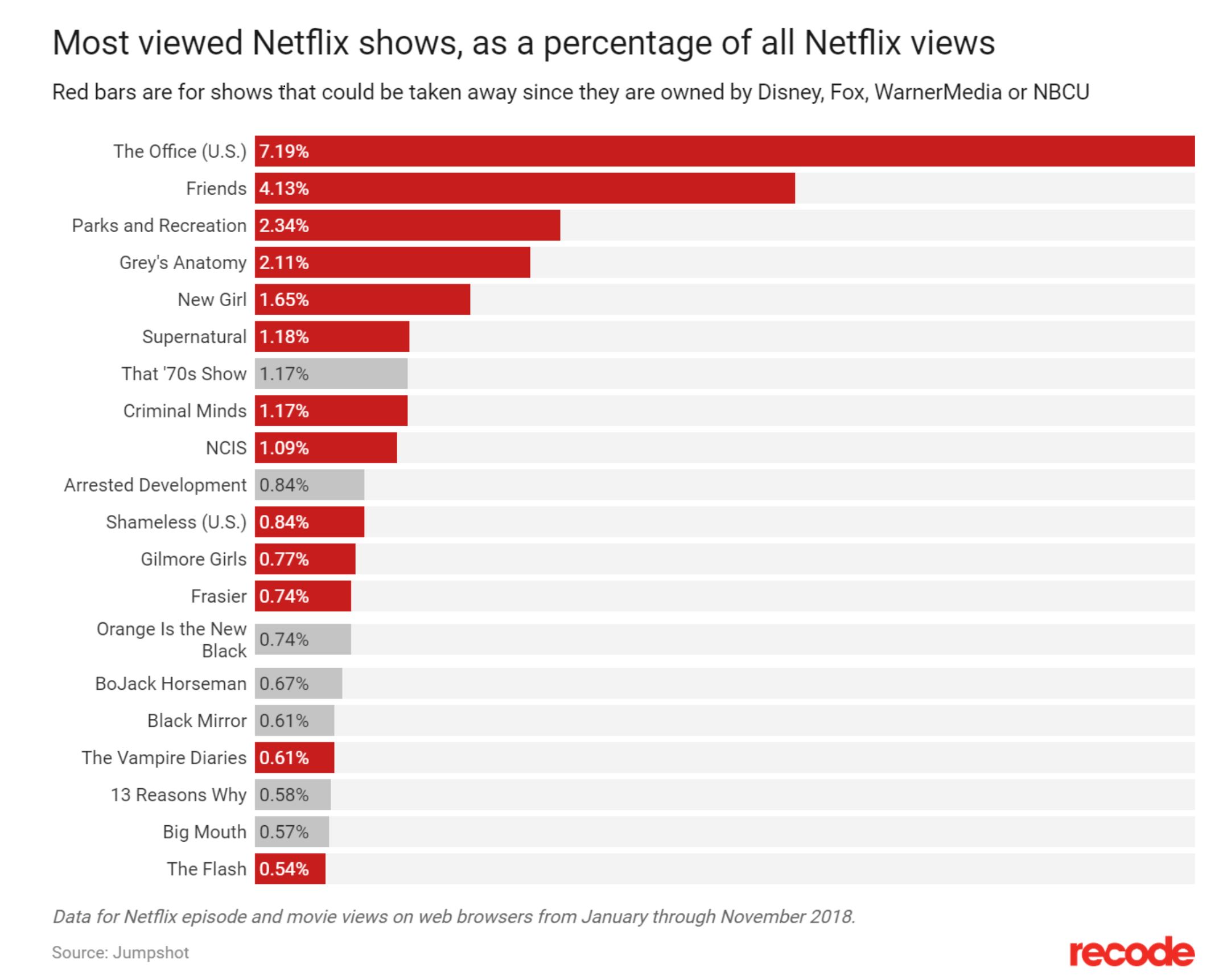
“Netflix’s upcoming content crisis, in one chart” by Todd VanDerWerff details the seemingly-dim future of Netflix as a streaming platform and production company. Recently, Netflix has been desparately trying to make ends meet by producing original show after show. It’s struggling to hold on to its value- streaming shows like Friends and The Office (U.S) – while companies like Warner Media and NBC Universal slowly let it bleed out.

The graph above, provided in VanDerWerff’s article, shows that although Netflix has been creating its own shows lately, the top viewed shows are still those owned by other production companies. To the average consumer, it may seem like Netflix has the ball in its court, being the most popular streaming service available; However, Netflix is in trouble.


“And as more and more media companies increasingly view Netflix not as a way to make money off their older shows while getting those shows seen, but as a competitor, the value of those shows only goes up — as a recent $100 million deal to keep Friends on Netflix for a single year suggests.”

VanDerWerff

As the price continues to rise for Netflix to keep streaming other companies’ shows, like Friends, its chance for sustainability grows slimmer. As a streaming platform, Netflix holds value to companies like WarnerMedia because they still make the profits off of sales since they own the shows. As a production company, Netflix is not as appealing to partner with because now their new, original shows are competing with the other shows they stream. What’s the solution that production companies are coming up with? Of course, creating their own streaming platforms. It gets rid of the middle man, Netflix, and allows them full control and profit off of their own shows. For example, if WarnerMedia wants to take Friends and only allow its own streaming service to show it, people might leave Netflix and subscribe to this new service with Friends as the bait, as VanDerWerff suggests.

What does this mean? Why should the average consumer care?

Imagine a world in which you want to watch Friends. You log into Fox’s streaming service, search “Friends”, and it’s not there. “Okay, wrong one”, you say to yourself. Next, you try NBCU’s service… but you are wrong again. You might just want to keep a list of which of your shows are streaming where… and make sure to keep up on all those bills to pay for your 7 different streaming services monthly.

Although that’s a theoretical situation, things will nonetheless get confusing and frustrating for consumers. Having one streaming service (or more for those who enjoy HBO, Hulu, etc…) has made watching favorite T.V. shows and movies very easy. Having everything in one spot, in any situation, generally tidies up confusion and eliminates extra effort. With Netflix falling off of its throne in the streaming world and big production companies pulling their top shows back and opening up their own, private services, that extra effort and confusion will take its place during the transition of power over T.V. and movie streaming rights.

It’s not too late for companies to drop out or join the race

Other companies that might have goals of becoming part producers and part streaming platforms might want to reconsider. If it’s too difficult to maintain being a middle man between consumers and production companies, and a company as successful as Netflix is even falling short, it doesn’t look like a bright future for pure streaming platforms. On the other hand, this could be an opportunity to turn the situation around and join the streaming competition. If Netflix is struggling and losing rights to stream shows, it could be possible that other companies could swoop in and get the rights for themselves. This would still be expensive, but it’s a possiblity for some of the other streaming services that are doing well, like Hulu, or even game console companies, like PlayStation and Xbox. In times of a power shift like this one, there’s usually an opportunity for new companies to gain more leverage.

Personal reaction to the crisis

When I first read VanDerWeff’s article and saw the graph he provided, I was really shocked that Big Mouth and Black Mirror, the only two shows included that Netflix fully controls, were so low on the popularity list. A large number of my friends and colleagues watch those shows, as well as the ones throughout the whole entire ranking, and I expected them to be more popular. The shows that appear on the graph only account for a very small number of all available media from Netflix, so I understand that even having a .5% for all views in a year is not too shabby.

I agree with VanDerWeff’s claim that there is in fact a crisis for Netflix and their future could be dim to zip. Although this isn’t the end of the world, Netflix is a very important part of pop culture right now because the movies and T.V. shows it streams allow people to connect to one another in a social realm. The generations of now value quality entertainment, comfort, and easy access, and Netflix has provided that thus far. As consumers, we can only hope that the future of streaming services and television/movie production won’t let us down.

Sources:

VanDerWerff, Todd. “Netflix’s Upcoming Content Crisis, in One Chart.” Vox.com, Vox Media, 7 Jan. 2019, http://www.vox.com/culture/2019/1/7/18166911/netflix-friends-the-office-crisis.