

This month, several celebrities have been caught taking part in a bribery scandal to get their children into highly selective institutions such as University of California schools, Stanford University, and the University of Southern California (Yan, 2019). While the link between wealth and access to education is not new, this outright corruption is somewhat surprising. Recently, YouGov administered a poll to over a thousand individuals to assess how many quotidian (rather than celebrity) parents would also engage in this bribery for their own children. An article about the survey concludes that “25% of parents would pay college officials to secure their child a place at a good school” (Ballard, 2019). However, due to bias in the survey’s data collection, the premise of YouGov, and the context of when respondents were answering, the article is likely over-reporting how many parents would actually engage in this bribery.
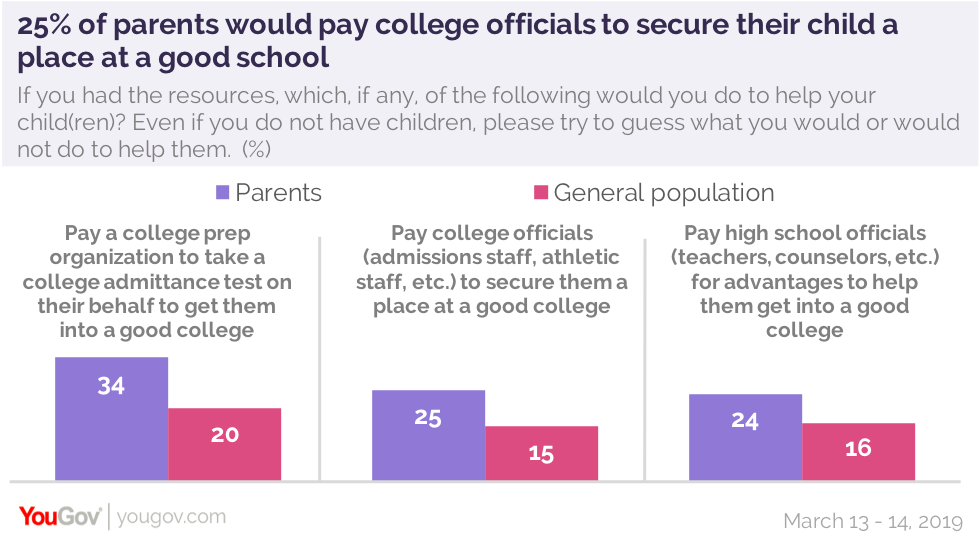
As one of my classmates explained in a presentation, the reliability of YouGov’s data is questionable. YouGov is a service that allows individuals to participate in surveys similar to this one for a financial incentive. Presumably, members of the service merely want to get through as many surveys as possible to maximize their earnings. It is possible that some respondents answered a hasty and impulsive “probably would” or “definitely would” to the question without genuinely reflecting on the ramifications of this hypothetical bribery.
To make up for the inherent pitfalls of survey-based data collection, YouGov weights the responding sample “to the profile of the sample definition to provide a representative reporting sample. The profile is normally derived from census data or, if not available from the census, from industry accepted data” (YouGov, 2019, p. 2). Considering the varying proportions of individuals who answered “probably would” or “definitely would” to the question of interest across demographics, I am unsure if adjusting the weights of samples maintains the data’s integrity, especially with the skew already involved in an online survey.
Lastly, the timing of the survey’s administration may have affected individuals’ responses. Many parents of soon-to-be college-aged youth may feel disenfranchised with the education system following the recent coverage of this scandal (for what it’s worth, 64% of parents and 67% of the overall respondents in this survey agreed that “[t]he education system in the US is rigged in favor of wealthy students” (YouGov, 2019, p. 9)). This frustration may have inflated the amount of people who responded that they would pay their child’s way into a good college. This speculation aligns with the data, showing that respondents who make under $30k per year were more likely than those who make over $100k annually to answer that they would bribe a college official on behalf of their child.
Given the premise of YouGov as a means of data collection and its methodology, the finding that “25% of parents would pay college officials to secure their child a place at a good school” (Ballard, 2019) seems to provide more shock value than meaningful information about the prevalence of bribery in the world of higher education. It would be worth investigating if a less biased survey without the adjusted demographic weights and sufficiently after the wake of the scandal would yield similar results.
References
Ballard, J. (2019 15 March 15). 25% of parents say they would pay college officials to get their children into a good school. YouGov. Retrieved from https://today.yougov.com/topics/politics/articles-reports/2019/03/15/lori-loughlin-felicity-huffman-bribery-arrest
Yan, H. (2019, March 19). What we know so far in the college admissions cheating scandal. CNN. Retrieved from https://www.cnn.com/2019/03/13/us/what-we-know-college-admissions-cheating-scandal/index.html
YouGov. (2019). College bribery scandal: Fieldwork dates: 13th – 14th March 2019. Retrieved from https://d25d2506sfb94s.cloudfront.net/cumulus_uploads/document/7q2jjlupn9/Results%20for%20YouGov%20Omnibus%20(College%20Bribery%20Scandal)%20064%2014.3.2019%20(1).xlsx%20%20[Group].pdf

 Data/Society/Decision-making Spring 2019