

I’ve been talking with friends a lot recently about the quality of higher education in the United States. From personal experience, I believe that overall that quality is very high. When I studied abroad in Scotland, I found the caliber of the computer science program there rather lacking; and from talking to other students who have studied abroad this seems to be a commonality in terms of experience of US students who set out overseas. In many other countries, much less is expected of students. Specifically in Scotland, there are less deadlines, there is often less classroom time, and less assignments and mid term exams. Especially in relation to the liberal arts school I attend, final exams carried a far more significant weight abroad – usually 80- 95 % of the final course mark. This meant that throughout the semester, I was expected to learn mostly independently, and the institution was less responsible for my studies. While this approach likely works very well for many students, I found it uncomfortable. I was used to being policed into keeping up with my classes by following regular attendance, participation, homework, and exams. I still prefer that method, because it helps me stay up to date with my program. I am very happy with my computer science program here in the United States. This thread of thinking lead me to ask a related question: How to computer science programs compare globally? I want to know if I am being as well prepared to enter the competitive and fast-paced industry of computer technologies as students in other countries.
I found a research paper that does a great job of answering this very complex question. The paper is titled “Computer science skills across China, India, Russia, and the United States“; and reports a study that compares industry preparedness of seniors in computer science programs at both elite and non-elite school within Chine, India, Russia, and the United States. The study involved seniors from each school taking a two hour long multiple choice exam, with the following charts detailing the results of the analysis:
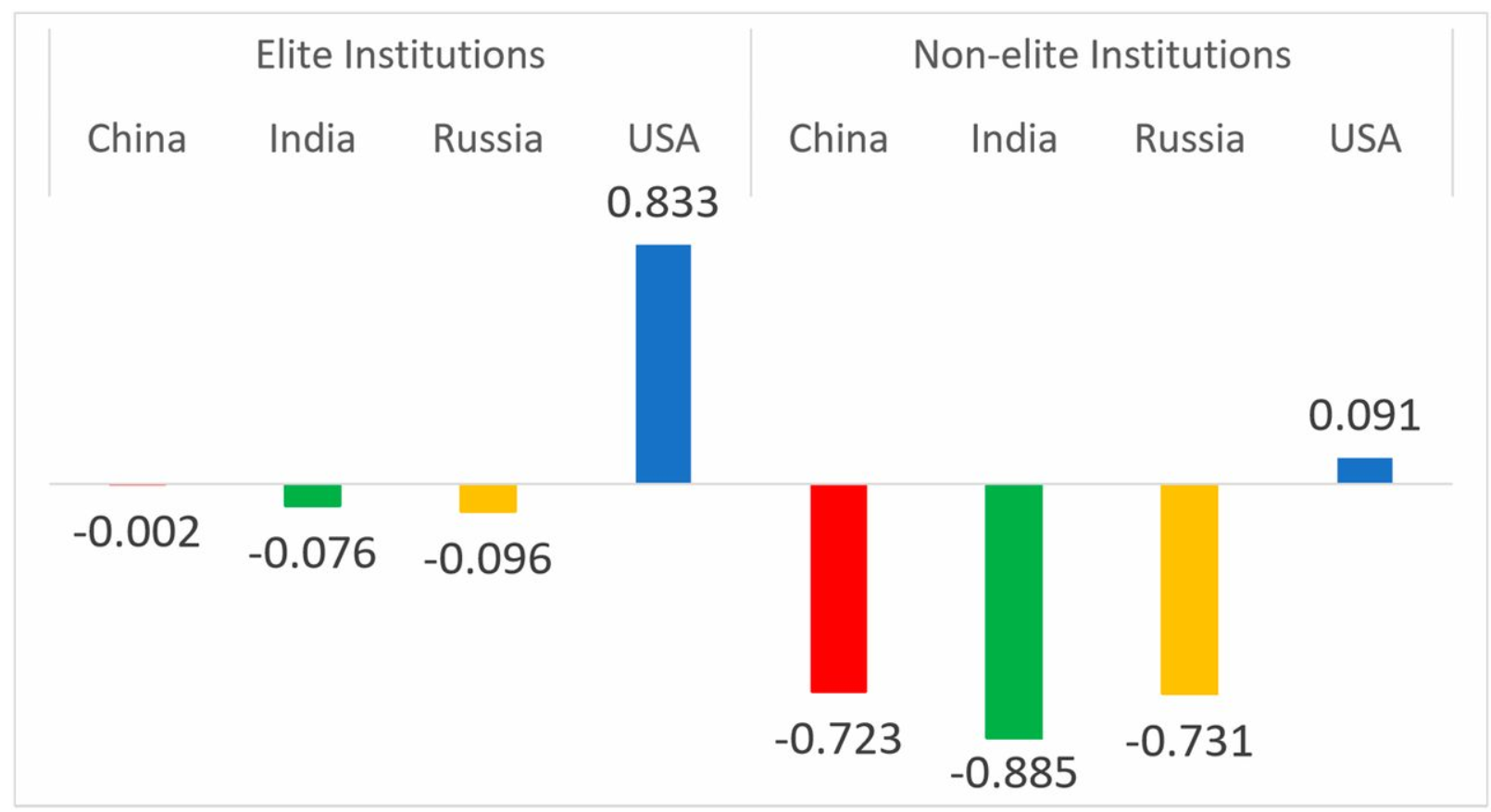
CS skills by elite and nonelite institutions: China, India, Russia, and the United States. Within each country, the mean estimate for elite institutions is higher than the mean estimate for nonelite institutions (China, P = 0.063; India, P = 0.174; Russia, P = 0.084; United States, P = 0.000). The mean estimate for elite institutions in China, India, and Russia combined is lower than the mean estimate for elite (ACT/SAT equivalent >1,250; approximately the top quintile) institutions in the United States (P = 0.008). Mean estimates for nonelite institutions in China, India, and Russia are each lower than mean estimate for nonelite institutions in the United States (P = 0.000). Mean estimates for elite institutions across China, India, and Russia are not statistically different (P > 0.100). Mean estimates for nonelite institutions across China, India, and Russia are also not statistically different (P > 0.100). Estimates reported as effect sizes (in SD units). Scaled CS examination scores converted into z-scores using the mean and SD of the entire cross-national sample of examination takers. As such, the overall mean of the standardized score across all four countries is zero. SEs adjusted for clustering at the institution (university/college) level.
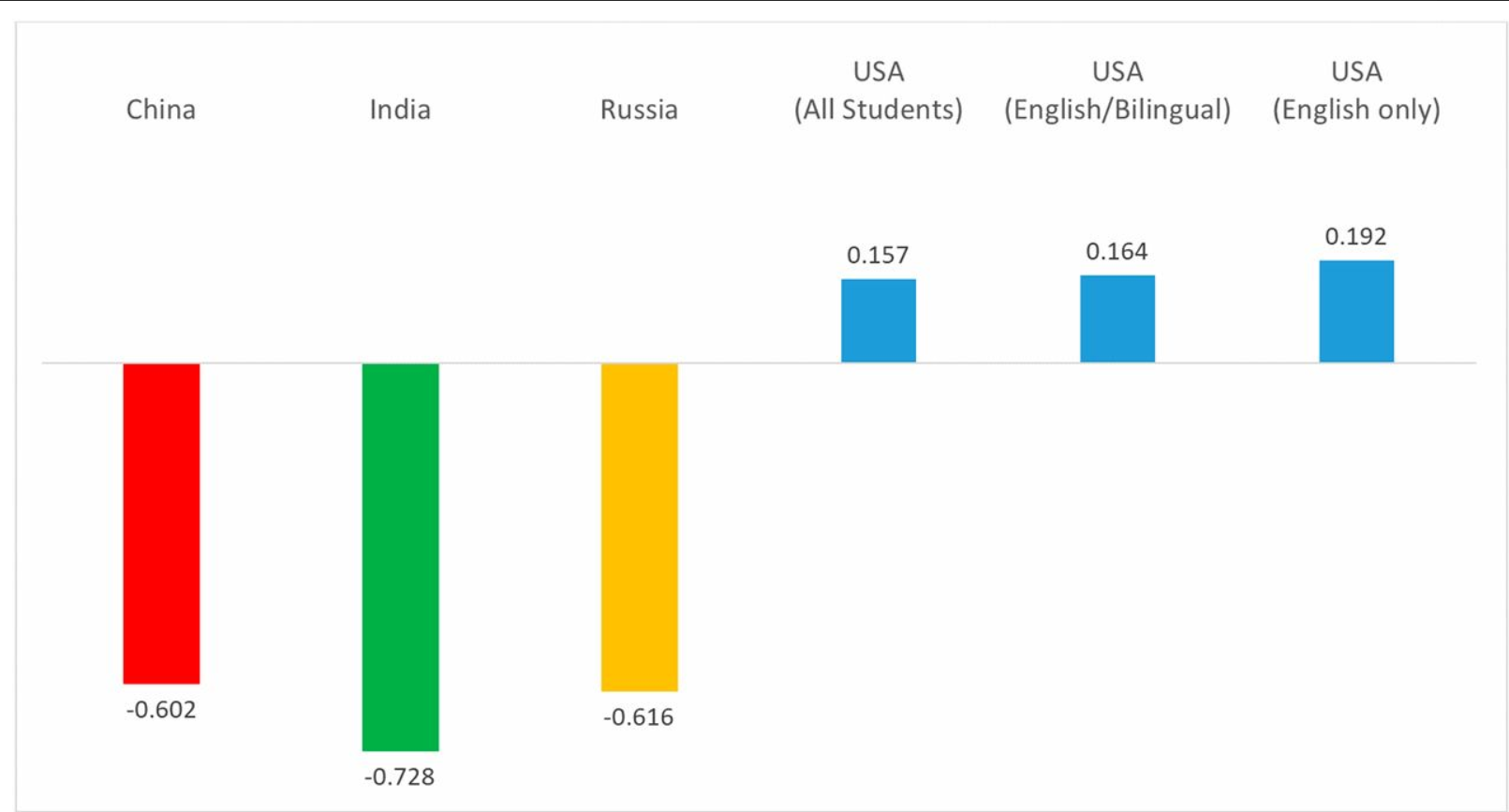
CS skills across China, India, Russia, and the United States after adjusting for United States student’s’ self-reported best language. The mean estimate of CS skills among United States students (“All”) is substantively the same as both (i) United States students who reported their best language is English or English and another language equally (English/Bilingual: 94.4% of all sampled United States students); and (ii) United States students who reported their best language is English only (89.1% of all sampled United States students). The mean estimates of CS skills for each of these categories of United States students are higher those of China, India, and Russia (in each case, P = 0.000). Estimates reported as effect sizes (in SD units). Scaled CS examination scores converted into z-scores using the mean and SD of the entire cross-national sample of examination takers. As such, the overall mean of the standardized score across all four countries is zero. SEs adjusted for clustering at the institution (university/college) level.
While the results are somewhat unbelievable, there are several measures the researchers took to ensure strong, unbiased data. To create the test, they used several international standards for question generation, and also took several steps and checks to ensure the tests were translated properly into each country’s main language. They also conducted the exam questions in pseudo-code, to eliminate possible CS language skill barriers. The researchers also took measures to ensure that each student took the exam in a similar environment, and accounted for unmotivated students by removing scores of students who left 25% or more of the test blank. They also examined the data from a number of different angles in order to remove biases that may have existed within the exam. For example, the second chart (above) shows exam results from different categories of US students to account for the possibility that US students out-performed other countries because of substantial recruiting of the strongest CS students from other countries to US programs. This data shows that all US students performed better on the exam, regardless of their language origin.
I also like that the researchers only included the top 4 stem-major producing countries. This allowed them to conduct an intricate study where many different error-correcting measures could be taken. They did not need to work with data from every country, and such a scale of study would have been unmanageable. It was responsible to take a limited data set of the top four contributors to computer science students globally, and acknowledge that this is the case for the data. The researchers also acknowledge the limitations of using a small pool of countries to compare to US schools, especially considering the diversity between the selected countries China, India, Russia, and the US.
Overall I found this paper answered my question, and told me with seemingly reliable data that US computer science programs are indeed preparing their students well, perhaps even better than the international average.

 Data/Society/Decision-making Spring 2019