

In 2017, in the U.S., 12,500 men were killed in motor vehicle accidents, compared to 5,151 female drivers (NHTSA, 2018). Overall, men are more likely to participate in risky driving behavior, such as speeding, driving while intoxicated, and not wearing seatbelts. However, in crashes of the same severity, women are 47% more likely to be seriously injured and 17% more likely to die than men (Criado-Perez, 2019). Why, in the same car crash, are women more likely to be injured than men?
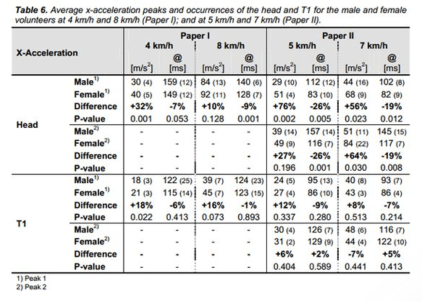
The short answer is male modeled crash test dummies. The most commonly used model for crash test safety is an average male. This figure is often taller and heavier than the average woman. It also does not account for differences in anatomy, especially different pelvis sizes. In addition, there are differences in driving style. Because women have shorter legs, they have to sit closer to the steering wheel. As a result, women’s bodies react differently on impact. In a 2012 study, Swedish researcher Anna Carlsson found that women’s bodies propel faster in a collision (Carlsson, 2013). The study took men and women in the 50thpercentile for mass, and tested for movement of the head and T1 vertebrae between the two groups at different changes of velocity. Statistically significant differences head movement were found at 4, 5, and 7km/hour.
It was not until recently that this problem began to be addressed. Beginning in 2011, the federal government has made requirements for the use female proportioned crash test dummies in some vehicle safety testing. The law now requires front crash testing to be done with a 95% male (only 5% of population is larger) and a 5% female dummy (only 5% of population is smaller). This drastically changed the safety rating for many cars that previously had five-star crash test ratings, even though their designs had not really changed
The more complex answer to the question is ingrained cultural bias. Car safety testers do not overtly want women to be injured. However, they are still being overlooked. Because it is often males designing supposedly objective algorithms, women are often still not considered, and it puts them at risk. This sort of data bias is not limited to crash test dummies. When female police officers wear ill-fitting body armor, designed for men, they are not able to perform at their job as efficiently (Criado-Perez, 2019). There are many ways that living in a world designed by men, for men creates data bias and puts women at a disadvantage. The solution is more diversity. We need a wider variety of people with different backgrounds designing and developing products and services to better meet everyone’s needs.
References
Carlsson, Anna, et al. “ADSEAT – Adaptive Seat to Reduce Neck Injuries for Female and Male Occupants.” Accident Analysis and Prevention, vol. 60, Nov. 2013, pp. 334–343. EBSCOhost, doi:10.1016/j.aap.2013.02.043.
Criado-Perez, C. (2019). Invisible women: Data bias in a world designed for men. New York: Abrams Press.
Starr, M. (2012, August 24). World gets first female crash test dummy. Retrieved from https://www.cnet.com/news/world-gets-first-female-crash-test-dummy/
United States, U.S. Department of Transportation, National Highway Traffic Safety Administration. (2018). Crashstats.nhtsa.dot.gov.

 Data/Society/Decision-making Spring 2019