

After a shooting, there seems to be a clear divide in sides about what the cause was and how to respond. In light of the recent shooting tragedy in Christchurch, New Zealand, it seems like this topic is evermore prevalent: how do we decrease gun violence, not only in America, but in the world?
New Zealand is a frequent example for the USA’s National Rifle Association (NRA) to use in explaining why gun laws don’t have an effect on gun violence. Guns are very prevalent to have in New Zealand- “In New Zealand, civilians hold about 1.5 million firearms, averaging out to about one gun per three people in a country of about 5 million” (Washington Post). Yet, in the aftermath of this massive shooting, their Prime Minister Jacinda Ardern declared that there’s going to be a change in gun laws: “Prime Minister Jacinda Ardern addressed the public Friday evening local time, calling it ‘one of New Zealand’s darkest days.’ Hours later, on Saturday morning, Ardern announced that New Zealand’s gun laws would be changed, as she confirmed that the attacker held a firearms license” (Washington Post) That said, she took a clear stance on the cause: lax gun laws. But are lax gun laws really the cause of gun deaths? Is media using data to give us an honest insight of whether or not gun laws are related to gun death?
As mentioned previously, there seems to be a very clear divide in the cause of frequent shootings and gun deaths, particularly in America. On one side, the argument is that gun laws have no impact on violent shooters; they are criminals, afterall. If they want a gun, they’ll be able to access that. In addition to that, it’s mental health that we should be focusing on. Then, on the other hand, there’s the argument that the problem is the availability of guns. Too much access means too many guns getting into the wrong hands. So… who’s right?
In looking for data, I analyzed several graphs and saw problems in nearly all of them. For instance, take this article from Vox.com, titled “America’s unique gun violence problem, explained in 17 maps and charts.” (Vox.com)
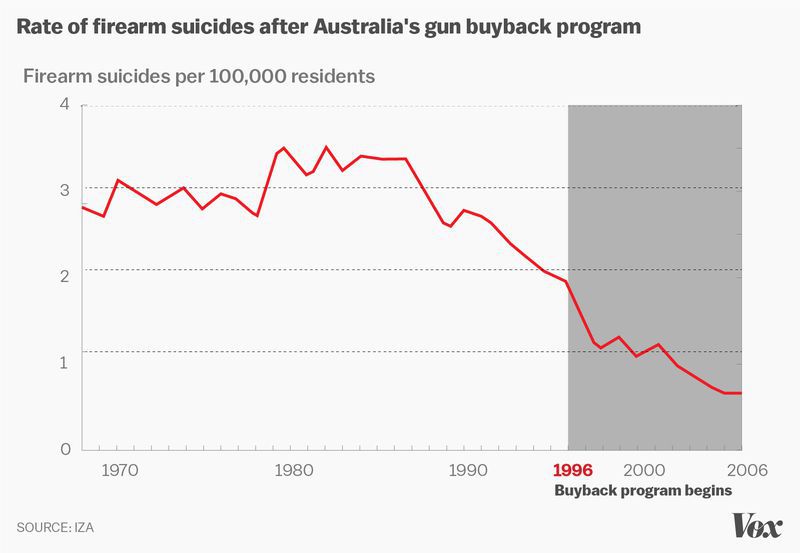
The article here seems to be heavily biased toward stricter gun laws, yet all of the graphs are using the data to indicate things that aren’t necessarily represented by the data. This is a graph that’s supposedly arguing that Australia’s gun buyback program helped to decrease suicide by firearm, and therefore the country benefited from the program: the title of this graph was “. However, the data indicated that suicide by firearm was already on a downward trend before the program even started. Furthermore, it makes logical sense that if there’s less guns, there would be less suicide by firearm, since the supply is less. Yet this sample of data and several others are still used as propaganda to sway people on one side of gun legislation or the other.
When data’s used and interpreted correctly, it can be useful for troubleshooting on many issues. Realistically, there’s probably a variety data to support either side of the argument. However, it seems to be the case that facts are often taken by the media and manipulated to serve as persuasion, and especially on this partisan of an issue, it’s hard to tell what’s reliable and what’s not. To look back at the initial question, is media using data to give us an honest insight about gun violence’s relationship to gun laws? No. But looking at and interpreting data in an honest way for ourselves might be a good place to start responding to this difficult relationship.
Sources:
https://www.vox.com/policy-and-politics/2017/10/2/16399418/us-gun-violence-statistics-maps-charts

 Data/Society/Decision-making Spring 2019