

My whole life I’ve been witness to what drug addiction does to individuals and families. My father has been a heroin addict my entire life and 5 years ago I watched my brother struggle with his addiction to painkillers. Needless to say I’ve been following America’s opioid crisis hoping to see a change, but the problem has only gotten worse and to my surprise heroin and fentanyl have become more popular among opiate drug abusers. I can’t help but wonder have these drugs replaced prescription opioid painkillers amidst this epidemic or are they just adding to the death toll and why have they become so popular?
When most people think of America’s opioid crisis the first thing that generally comes to mind is prescription pain pills. Over the last two decades the U.S. has faced a deadly epidemic. An article on Vox.com asserts that it was started by what was intended to change pain management for the better, legal prescription drugs such as Oxycontin and Percocet prescribed by your family doctor. Ever since 1999 pain killer deaths have been on the rise, however the U.S. is now facing bigger problems amidst this crisis. In 2010 the epidemic started to change and something interesting happened; heroin related deaths started to sharply increase. By 2013 deaths by another drug called Fentanyl, a synthetic opioid, started to rise. By 2016 both heroin and Fentanyl contributed to more deaths than opioid painkillers alone and the Fentanyl death rate even surpassed deaths due to heroin, rising 264% between 2012 and 2015.. The graph below is a visual representation of the lives taken during the U.S. opioid epidemic spanning the last 20 years.
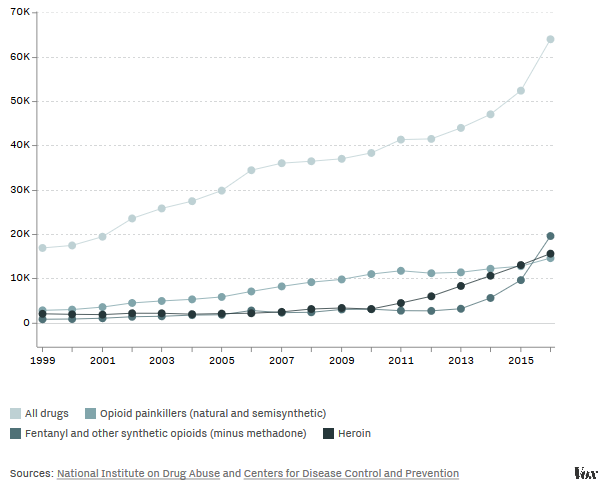
*The numbers for 2016 are preliminary estimates
While the graph is proposed to have been made using data from the CDC and the National Institute on Drug Abuse (NIDA), it only aligns with the data and graph found on the CDC website. A similar graph from the NIDA shows that the heroin death rate has never risen above the opioid death rate. I find this peculiar because they cite the CDC as a source for their graph. The discrepancy between these two well established and trusted entities makes me wonder what the actual heroin related death rate is and who has it right. The article mentioned above states that heroin deaths are currently higher than opioid deaths in the U.S. and the CDC states a verifiable source for their data claiming the same thing, so my bet is on the CDC for accuracy.
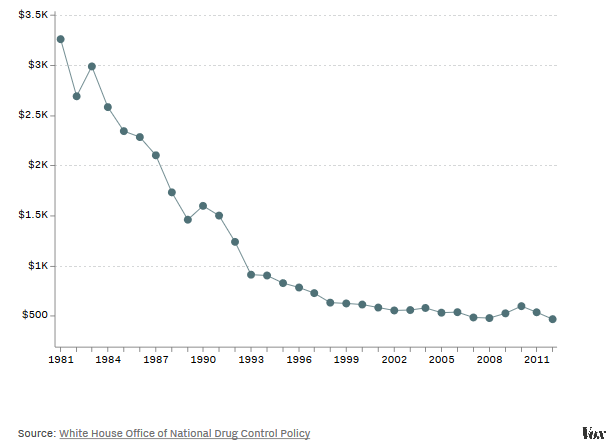
While the graph above shows what happened it doesn’t really show why. According to the Vox article many opioid users switched to using heroin because it’s so cheap, often cheaper than candy bars. The graph below shows that heroin cost $3260 per gram in 1981 and dropped to $465 per gram by 2012, thus making the drug much more available and cheaper than prescription painkillers. The CDC states that individuals who use prescription opioid painkillers are 40 times more likely to use heroin and 45% of heroin addicts are also addicted to prescription opioid painkillers. Many states have even set a limit of 7 days for opioid prescriptions and this too has driven people to find other means to satisfy their need which has led many to start using heroin. Others have turned to fentanyl. Not only is it more potent (50-100 times more potent than morphine) than other opioids, when illegally made it is even cheaper than heroin. However many deaths from this drug are actually due to it being laced in heroin and cocaine because of its low-cost and increased euphoric effects. People who buy the laced drugs are not often aware of the fentanyl and accidentally overdose.
While it’s evident that heroin and fentanyl account for more deaths, opioid painkiller deaths from overdose are still at an all time high. The introduction of cheaper heroin and illegally made fentanyl didn’t replace painkillers in America’s opioid crisis, they added to the problem and significantly increased drug related deaths across the U.S due to their low-cost and availability. As death rates from all three substances continue to rise and account for more deaths than car crashes and gun deaths on a yearly basis it becomes ever more important to reduce prescription opioid abuse, increase access to treatment programs and ensure access to naloxone (a drug that can reverse opioid overdose).
References
Lopez, German, and Sarah Frostenson. “How the Opioid Epidemic Became America’s Worst Drug Crisis Ever, in 15 Maps and Charts.” Vox, Vox, 29 Mar. 2017, http://www.vox.com/science-and-health/2017/3/23/14987892/opioid-heroin-epidemic-charts.
“Opioid Overdose.” Centers for Disease Control and Prevention, Centers for Disease Control and Prevention, 19 Dec. 2018, http://www.cdc.gov/drugoverdose/opioids/fentanyl.html.

 Data/Society/Decision-making Spring 2019