

We have all heard the cliché adage, “money can’t buy happiness”. However, the contradicting grade school retort “well, no one ever looks sad on a jet ski” brings up an interesting ethical question; What is the relationship between money and happiness? The folks at Visual Capitalist believe that they have found the answer to the question, and conveniently graphed it for us. In their survey of the relationship, they came to the conclusion that yes, money is tied positively with happiness, to a point. In line with the diminishing marginal utility of money, the data, based on reports from the World Bank and the World Happiness Report 2017, shows a relationship confirming that money is only as good as it provides for the material needs of a person, and then does not provide the same amount of happiness per dollar, at a diminishing rate.
The graph itself is a visual ensemble of grid points which intersect with nations at points reflecting GDP per capita as an indicator of ‘happiness’.
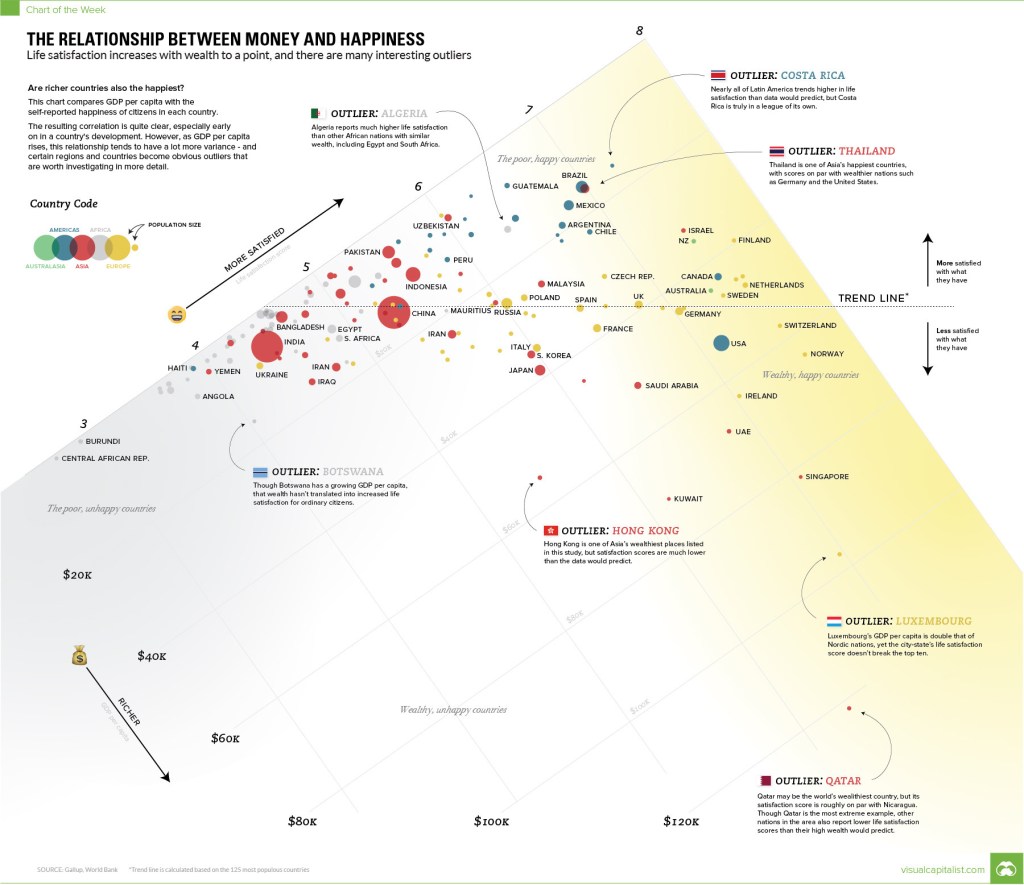
In this chart, average household income is the only variable of happiness used, but shows a surprising trend that money only provides happiness to a certain limit, and that the trend is not a general rule.
Nearly half of the countries used in this data set are below the ‘happiness trend line’, which would refute a supposed positive correlation of an increase in money with an increase in happiness. However, half of the countries are also above that line, almost implying that the study itself is inconclusive. That’s only partially true, because the interesting results are in the early increases of money by regional specificity. Central and South American countries increase their happiness with initial average money increases between $10K and $20K at an incredible amount, whereas middle eastern countries and south Asian countries do not follow the same trend, floating below the trend line. This seems to imply a cultural significance in happiness, which correlates nicely with the variables used in determining happiness in the World Happiness Report 2017; GDP per capita, social support, healthy life expectancy, freedom to make life choices, generosity, and perceptions of corruption.
So, to give money its due credit, it does play a role in living well. The scattered results seem to imply that money increases happiness when it meets living standards, that is can provide the basic material necessities of life. However, money as a measure of GDP per capita is not an adequate measure because the averages taken for a nation ignore incredible gaps of disproportionate incomes (i.e. income inequalities) that may account for datasets from the middle east.
Money and happiness do have a relationship, but that relationship is dependent on other factors and is subject to diminishing marginal happiness (or utility) around the $40K-$60K markers. The strongest case for money increasing happiness seems to lie in actuality in the $10K-$20K markers in Central and South America. However, I personally believe that there are other factors not accounted for here when comparing on a global scale, such as the cost of living standard which varies incredibly between cities, let alone nations. There are also religious and cultural factors which place less on material wellbeing to focus on mental or spiritual enlightenment which may skew the data. As for Ethical Materialism, the jury has still not reached a verdict.

 Data/Society/Decision-making Spring 2019