

The Possibilities of Rank Choice Voting
This weekend the Salt Lake County Democrat Party held a convention to fill the vacancy on the County Council left by new Mayor Jenny Wilson. This was the second such convention held in the first two months of 2019. For those who have not participated in a party convention in Utah before, they follow a predictable and lengthy process. Registration starts early in the morning and is followed by a few hours of speeches, smaller caucus meetings, and the adoption of the rules. Two or three hours into the event, delegates line up to cast their ballot for their top choice to fill whatever office is vacant. That’s when the real waiting starts. Everyone sits and waits for the results of the first rounds of ballots in case they need to be there for a second round. This part can take hours — People start to look frantically at the time, they discreetly slide off stickers of support so that they can check what food other candidates may have brought, and if the thought isn’t spoken aloud, it is clear by the expression on the many faces gathered in the cafeteria of a local school on a Saturday morning: “There must be a faster way to do this.”
It can be difficult to gather voting data in the best way, but one way to make the process faster is to shift away from the Two-Round system and embrace Rank Choice Voting (RVC), or Instant Runoff Voting (IRV). With ranked choice voting, voters can rank as many candidates as they want in order of choice. All the ballots are counted for voter’s first choices, and if no one receives an outright majority the candidate with the fewest first-choice votes is eliminated and voters who liked that candidate best have their ballots counted for their second choice. This process continues until one candidate reached a majority and wins. This blog post will look at RCV, and some research surrounding it, in an attempt to the possibility RCV offers.
There are two different types of elections in which RCV could be utilized. The first is elections for one candidate into an office. When there is only one winner, like when electing a mayor or governor, RCV could offer a more reflective majority when there are several viable candidates in a race.
The video below simplifies the instants runoff vote using post-it notes.
The other type of election in which RCV could be utilized is in a multi-winner election, like for a city council election. In this instance, RCV would serve as a form of proportional representation and could help to elect candidates more reflective of the spectrum of voters.
This video explains how the instant runoff vote works for multi-seat elections.
Fair Vote , an organization that actively advocates for the implementation of RCV, compiled a summary of data on RCV through 2013-2014. In this summary, FairVote talks about the Eagleton Polls at Rutgers University, which surveyed a random sample more than 2,400 likely voters. Half of the respondents were in cities holding RCV elections the other half came from “control” cities with similar demographics that were holding traditional non-RVC elections. These polls did a lot in the way of gaining representative data. The survey was sent out by landline and cell phone, it was given in English and Spanish, and the different cities represented had both competitive and non-completive races. One of the questions asked respondents to report whether the candidates criticized each other “a great deal of the time” or “They weren’t doing this at all”. Both surveys found that cities using RCV reported candidates spent little time criticizing opponents compared to cites that did not use RCV. This conclusion makes some logical sense. With RCV it would be inadvisable to pander to a political base because anyone could potentially be the second or third vote that’s needed. This could potentially assist in diminishing the polarization in contentious races. I think, however, that this data could potentially be more meaningful if the respondent used a semantic differential scale so that respondents would not be forced to express an either/or opinion and leaves room for “some of the time” responses.
Another important finding from the report was that RCV was easy to understnad. FairVote writes, “an overwhelming majority (90%) of respondents in RCV cities found the RCV ballot easy to understand. Similarly, 89 % of respondents in RCV cities in California found the RCV ballot easy to understand” (FairVote 2014). One of the biggest critiques of RCV is the possibility of confusing the electorate so this finding could offer an incredibly persuasive counter-point. They also found that first-hand experience sustains or improves attitudes toward RCV, even in cities with controversial elections.
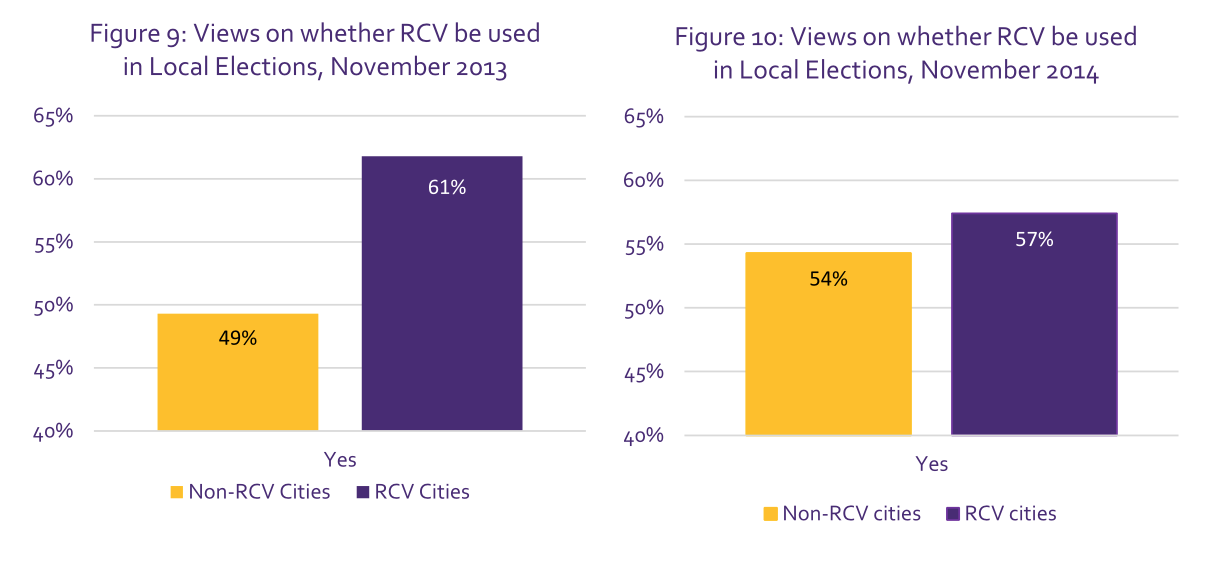
Although, it is a logical conclusion it may be a mistake to assume that experience alone is what resulted in a better attitude toward RCV. This doesn’t take into account awareness campaigns and other things that resulted from the implementation of this voting system that goes beyond experience. The report also fails to acknowledge that from 2012-2014 that views on whether RCV should be used in local elections went down by 4% in RCV cities. I also think it may be an editorialization to call 57% as “vast majority” and “overwhelming support” like they do in the summary.
RCV offers a compelling alternative to the traditional Two-Round voting system. I believe that the voting system could be improves by better representation, kinder campaigns, and increased functionality. I think it would be interesting to see if respondents attitudes towards RCV has changed since the 2018 elections. I also think it would be valuable to survey candidates and the people in charge of tabulation to gain a holistic view on the functionality of RCV.
Works Cited:
“MPR News: Instant Runoff Voting Explained.” YouTube, YouTube, 10 May 2009, youtu.be/_5SLQXNpzsk.
“How Instant Runoff Voting Works 2.0: Multiple Winners.” YouTube, YouTube, 21 Oct. 2009, youtu.be/lNxwMdI8OWw.
FairVote. “Ranked Choice Voting in Practice: Candidate Civility in Ranked Choice Elections, 2013 & 2014 Survey Brief”. https://fairvote.app.box.com/v/APSA-Civility-Brief-2015

 Data/Society/Decision-making Spring 2019