

Do people still believe in the link between vaccines and autism? If so, whom?
The flaws behind one survey that seeks to answer this question.
YouGov is an American company that supplies poll data to its paying clients via online surveys taken by its users. In 2015, one of their panelists Peter Moore published an article titled “Young Americans most worried about vaccines”. The article discussed two questions from the survey and displayed a graph for each with the results. These are shown below.

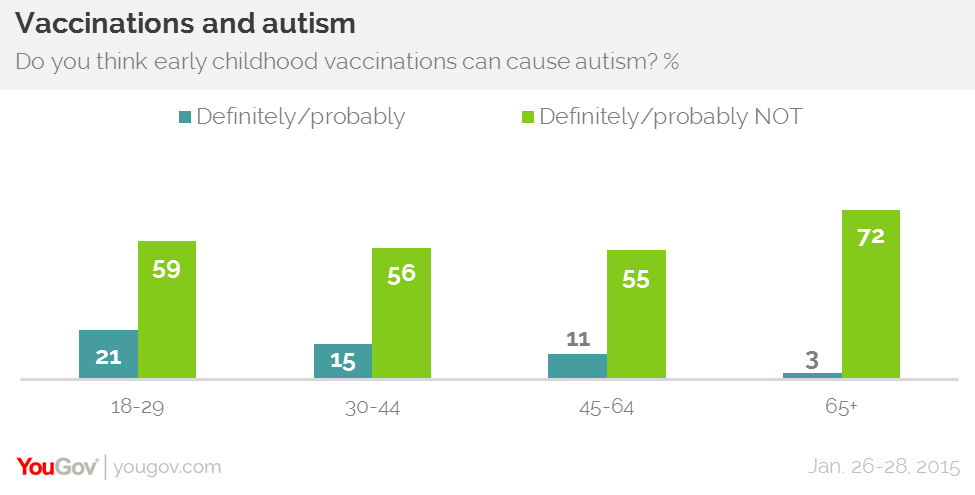
When looking at these two graphs, I realized that each percentage combination per age group does not add up to 100%, which means that participants might have abstained for the question or YouGov simply chose not to display the answer given by the other percentage of participants. This can be problematic because viewers don’t know where the other participants lie. Coupled with this curiosity, I also wondered what types of participants were being surveyed and if this was a representative sample.
After finding the full version of the results from the YouGov survey, I found that Moore’s graphs and general article information were highly simplified versions of the full results. Simplifying data makes writing easier because one is able to focus on what is important to their claim or pointed subject, like two specific questions in this case; However, Moore left out important details about how the data was collected and grouped for the sake of simplicity. Below is an example of a question from the full report.
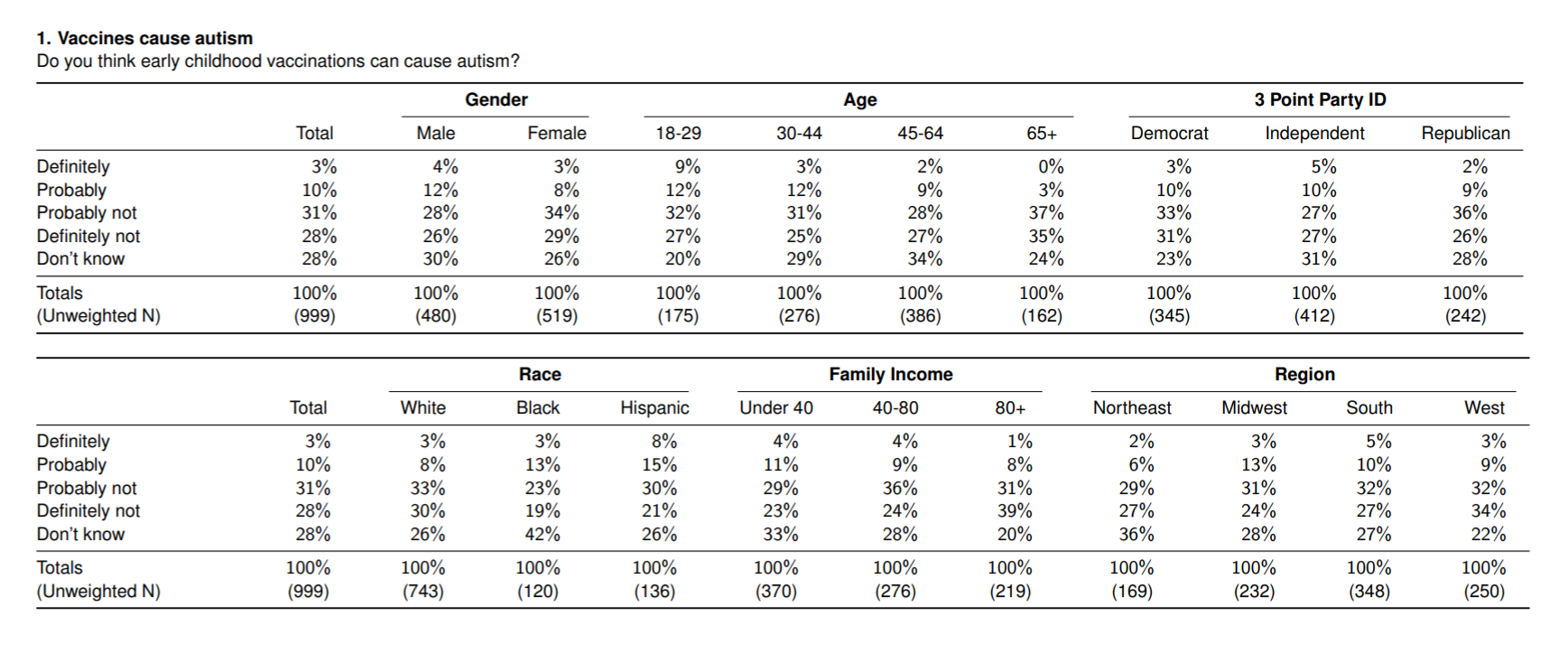
The full results from the online poll group surveyors by age, race, gender, etc… as well as “Definitely” to “Definitely Not” as well as “Don’t Know”, yet all groups are combined to differ only by age in Moore’s presentation of the findings. Referring back to the missing percentage in his simplified graphs, one can see that there is not a category for “Don’t Know” like there is in the full results, and each response type is combined with another rather than separated. Simplifying data results is not necessarily a good or bad thing, but it can limit the ability of viewers to have accurate and holistic information on the findings, as they only have access to a small piece of the results.
While the data from this survey might be helpful in answering questions related to people’s beliefs of vaccines and autism, it isn’t wholly representative of American and even human/world views. YouGov collects data via online surveys and offers cash prizes to those who participate after they have accumulated a certain amount of points. This means that the people who are represented in these results all willingly took this survey most likely because they were receiving a cash prize, and they are all people who have accounts with YouGov, not general internet participants. An example of this being incomplete representation is the idea that more millennials use the internet than older people, so millennials overall are being better represented, whereas individuals 65+ are being generalized by those who happen to use the internet, have YouGov accounts, and chose to participate in this poll. These are some general issues with online surveys and point out some things to consider when finding data to rely on to answer questions.
Overall, there are some flaws in Moore’s analysis of YouGov’s results detailing people’s responses to questions about vaccines, as well as the initial surveying by YouGov. The information given by both is not representative of all people’s beliefs nor even those of all Americans, but it can give one some idea of what people currently think about the connection between vaccines and autism, especially in relation to their age.
References:
Moore, Peter. “Young Americans Most Worried about Vaccines.” YouGov, 2015, today.yougov.com/topics/lifestyle/articles-reports/2015/01/30/young-americans-worried-vaccines
“YouGov | About.” YouGov, 2018, today.yougov.com/about/about/.

 Data/Society/Decision-making Spring 2019