

Or, ‘Did the 19th Century Luddites Understand Capitalist Employment?’
The inequalities of income and wealth in our society is the determining feature of our nation’s economic and political success. In comparison with other developed, capitalist nations, the United States ranks tenth in income inequality and second when state redistributive functions are accounted for. According to Emmanuel Saez’s research, in 2012 the top one percent of families made 22.5% of gross income, up from 10.8% in 1982, while 90% of the population only accounted for 49.6%, down from 64.7% in 1982. Richard Wolff’s research shows that wealth inequality is even worse than income inequality, with the top fifth of families holding 88.9% of all wealth in America. Inequality is a severe economic issue, for our capitalist system of production is based in consumer demand, and the largest demographic of consumers are those most hurt by growing income and wealth inequality. Productivity has increased 74.4% from 1874 to 2013, however, hourly compensation has only increased by 9.2% in the same span of time. The difference between productivity and compensation shows us that employer profits are increasing while workers compensation is not matching the revenue they generate. There are a number of causes for this gap, likely globalization, the lack of collective bargaining, and specifically advances in technology. Simply put, the cause of inequality in its most general form is hyper-efficiency in profit-generation. Further more, new research is showing that advances in AI may replace up to 50% of jobs in the united states. Will the advances in artificial intelligence increase income and wealth inequality in the US? If employment trends follow their historical trends, then the introduction of AI into the workforce will most likely increase the unequal distribution of income and wealth.
In a study posted by the World Economic Forum, the current speculation (the risk) regarding the percent of the workforce that will be replaced by automation in the US is 47%, relatively low compared to less developed nations. However, that is nearly 50% of the US workforce which human workers will be excluded from. This is important because workers are consumers (see Marx’s simple circuit of for laborers, C-M-C), and consumer spending makes up 68% of the US economy. Over 2/3 of the economy is driven by workers, and 50% of the workforce is at risk of replacement- that is, exclusion from a wage.

So how exactly will the introduction of artificial intelligence increase inequality? The answer lies with John Maynard Keynes. In The General Theory of Employment, Interest, and Money, John Maynard Keynes calls the principle of effective demand the “explanation of poverty in the midst of plenty.”[1] As an explanatory device of understanding the allocation of wealth in an economy, the principle of effective demand is a powerful tool in the pursuit of understanding economic inequality because it is the aggregate of the fundamental axioms of allocation and distribution in a capitalist economic system. The first characteristic of the principle of effective demand is that “the propensity to consume and the rate of new investment determine between them the volume of employment.”[2] Employment is determined by the willingness of consumers to part with their money (the propensity to consume is the first factor of the Demand schedule, D1), and the rate of corporate investment into production and wage compensation (The second factor in the sum of the Demand schedule, D2) driven by the expectation of profit (Z). The production schedule of privately owned means of production is dictated by the profit off sales to consumers, and access to the products of the privatized means of production is dictated by money, acquired through a wage.
[1] Keynes, John Maynard. The General Theory of Employment, Interest, And Money. (New York; First Harvest/Harcourt) 1964, page 30
[2] Ibid, page 30
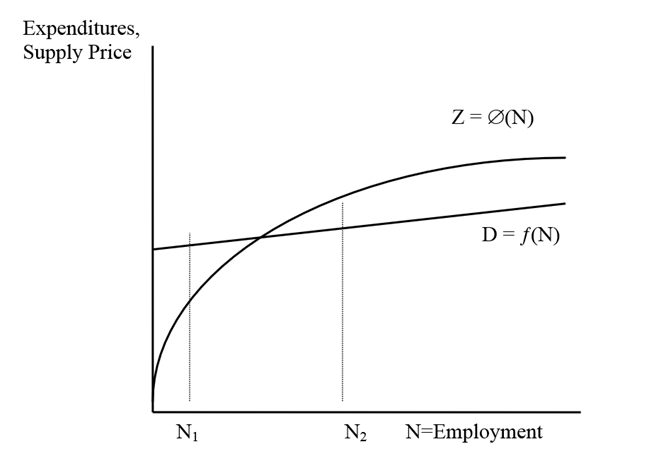
The Principle of Effective Demand, Courtesy of John P. Watkins
The employment of AI (i.e. a preference for capital [K] over labor [L]) is an example of the aforementioned hyper-efficiency in profit-generation. Furthermore, the shift in employment preference towards capital is a result of the neoliberal policies enacted in the Reagan era. The progressive moment following the Great Depression and WWII did cause the cost of human labor to increase, and put more people in employment, but set up the conditions which increased shifting of the employer preference towards the employment of more capital than human labor. Capital does not need humane working conditions. Capital does not take breaks or go on vacation. Humans were not designed. Humans evolved randomly through mutations that happened to benefit our existence. Capital is designed to work. Capital is efficient, and efficiency is the doctrine of profit. The progressive movement saw a decline in the seventies, as did the age of prosperity, and the “need for flexibility in production was extended to the need for flexibility in labor markets.”[1] This is owning to the growth of “post-fordist production techniques based on the information and communication technology revolution”[2],which caused the strengthening of capital utilization unless workers gave up their benefits and left the unions, thus devaluing their capabilities.
[1] Bowles, Paul. Capitalism. (Great Britain; Pearson Education Limited) 2007, page 18
[2] Ibid, page 18
In conclusion, if employment trends follow the same model of the past 50 years, income and wealth inequality will increase with the introduction of artificial intelligence in the workforce. The inequality may even be furthered by the economic crises following the worker displacement and efficient production, such as a crisis of overproduction and underconsumption. Unless policy trends which historically favor the 1% become more humanistic, and take into consideration the workers whose backs the American economy rests upon, artificial intelligence will become the danger to society it has been represented as in fiction. Except, instead of The Terminator, it will be The Baconator (artificial intelligence under the employment of McDonalds, I am aware this is a stretch) which upsets the modern era.

 Data/Society/Decision-making Spring 2019