

Cannabis, marijuana, or its more informal name, “weed”, has an interesting history both globally and specifically in the United States. Upon analyzing actual data about the way that cannabis benefits the people that are treated, one might find it hard to rationalize why cannabis should be illegal in the first place. I pondered this question myself, and specifically thought about Utah and how this past midterm, we just passed a law that would legalize medical marijuana to some extent. The LDS church wasn’t shy to create a “compromise” with the state within weeks of the turnout. This was met with a lot of question regarding how Utah separates church and state- and if that distinction really exists at all.
The overarching question is what’s everybody’s problem with weed in the first place? A quote from History.com even makes a note of marijuana compared to alcohol: “It’s worth noting that research has shown alcohol to be more dangerous than marijuana. In addition, cannabis doesn’t really cause superhuman strength, and the U.S. Drug Enforcement Administration’s fact sheet on the drug says that “No death from overdose of marijuana has been reported.” That said, marijuana’s legality- or non-legality, in this case- seems to have a lot to do with church influence, since multiple sources of data that would be too long to list in this post suggest that there’s no real science to support the danger of marijuana.
The LDS church sent the following email out to all of its members and potential voters shortly before midterms:
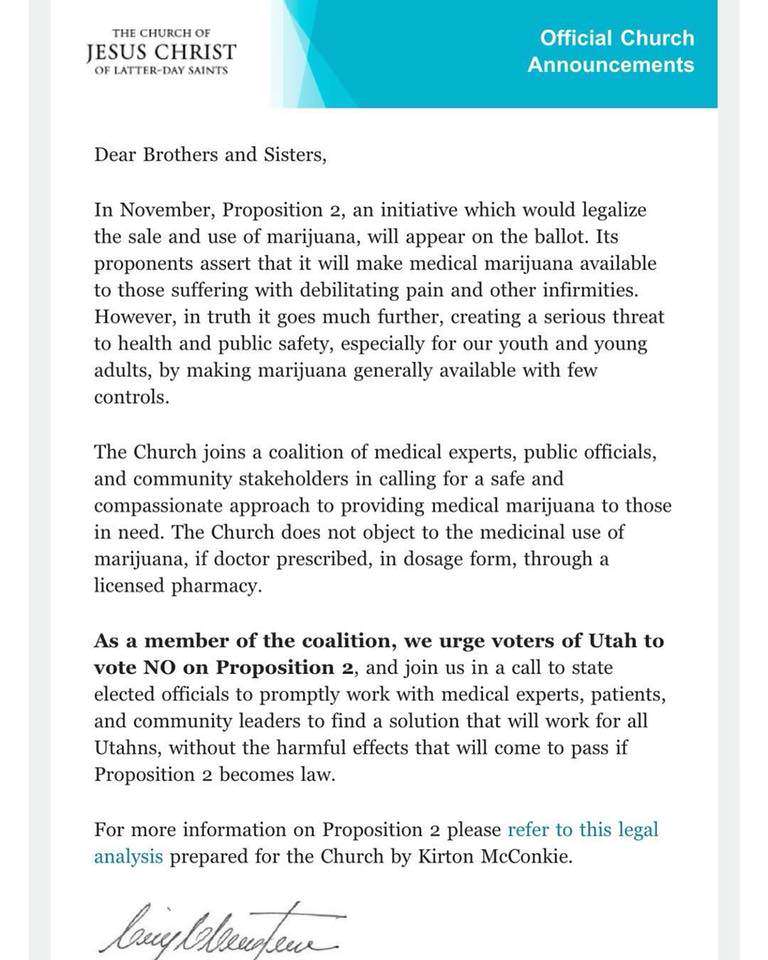
If there was actual data that demonstrated that marijuana is a threat to our youth, there may be a case for their call to action; however, once again, data seems to suggest otherwise. The National Insititute for Drug Abuse, a national goverment website, reports this, following the conclusion that there are few indications from research of cannabis as a gateway drug: “…the majority of people who use marijuana do not go on to use other, “harder” substances. Also, cross-sensitization is not unique to marijuana. Alcohol and nicotine also prime the brain for a heightened response to other drugs and are, like marijuana, also typically used before a person progresses to other, more harmful substances.” Based on this information, and the information earlier cited, it doesn’t seem like the church’s claim of the proposition being a “serious threat to health and public safety” is an actual, legitimate claim.
What happened following the eventual passing of Proposition 2 is the LDS church offering a compromise with the government about the proposition. Because, for whatever reason, the government needs to compromise with a religious body that supposedly is kept separate from the government. What this data appears to show is that the factual data doesn’t actually matter when it comes to decision making, in Utah in this case, but not limited to. It’s all about relationships between different structures of power, which doesn’t seem to discount religious institutes as the constitution would suggest. The LDS church has been a heavy influence on Utah politics for as long as Utah has existed, but it’s not the only example of religion having too big of an influence on politics. The United States’ and Trump’s own secretary of education Betsy Devos has insisted that christian schooling should be mandatory in the education system. As far as building a wall is concerned, perhaps Trump might be more concerned with creating stricter guidelines for how far the church can intervene in politics- especially in Utah.
Sources:
https://www.history.com/news/why-the-u-s-made-marijuana-illegal
https://unewswriting.wordpress.com/2018/11/28/the-aftermath-of-passing-proposition-2-in-utah/
https://www.drugabuse.gov/publications/research-reports/marijuana/marijuana-gateway-drug

 Data/Society/Decision-making Spring 2019