

Choosing a major is the hardest part of college. Despite everyone repeatedly telling you that your major does not definitively define your career, the process feels none the less scary. It’s a big commitment, and there is a lot of societal pressure to have your dreams hashed out as quickly and in as much detail as possible. There is a lot of advice out there for choosing your major. The list includes predicted job security, income, employment rate, overall satisfaction, personality compatibility and more. In the end, it is up to the individual which metric they want to use, as well as what field they are most interested in. However, for people who find themselves good at most things yet passionate about nothing, choosing a major is the most difficult question out there. My question pertains to the hardest metric to gauge in choosing your major; which option is likely to keep me happy in the long run?
A quick google search of this question leads you directly to this article from bestcolleges.com. While this article has lots of information pertaining to the metrics listed above, the chart I want to focus in is titled “Happiest Majors” about half way down the page. Below is the chart from the page, which takes the 25 most popular undergraduate majors and rates their recommendation levels from degree holders. The X axis represents the amount of degree-holding alumni who recommended pursuing each degree.
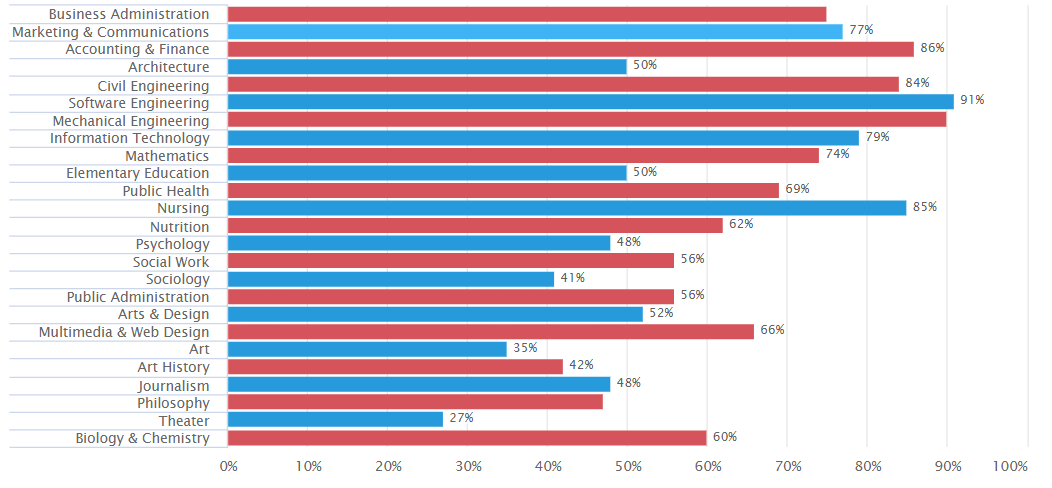
While the article argues that this table is an accurate metric for overall happiness with a major, I would argue that this data does not fully support that conclusion. The data answers a different question than was asked. If I want to know which college major will make me happy, asking degree holders if they recommend pursuing their own major might not be the best way to measure it. Whether or not a person recommends their major or field of study is independent of how happy that field makes them. They could be correlated, but many people choose fields for reasons besides happiness. They could also be recommending their field for monetary reasons for example. A better question might be to ask degree holders of each specific major whether or not they are happy with their choice, rather than give a recommendation as to whether or not it is a good idea. This question would provide us with better data, because it actually mentions happiness, the metric we are trying to gauge. Because happiness is so difficult to measure, subjective-experience based data is a good strategy. While recommendations may hint towards happiness levels of different fields, it is likely that they are heavily influenced by other factors.
Another issue with this data is the lack of context. Because very little is described about the data, it is likely being manipulated to make certain fields seem more attractive. The rest of the charts on this site, as well as this one, seem to have a clear bias against social sciences, arts, and humanities, while at the same time over-recommending STEM and business fields. The lack of context to the data is evidence for this bias. For example, the article never states that each line on the chart represents recommendation levels from people who graduated with that specific major. The only context given is that this data was gathered from degree holding alumni. This does not necessarily mean that the degree holder had a degree in the field they are either recommending or discounting. This lack of context makes it easier for the article to come to the conclusion that business and STEM fields will make you happier, without necessarily having to backup the claim.
For these reasons, I do not believe this article answered the question as to which college major will help a prospective student be happy. Admittedly this is a very hard question to answer, but you should not claim to answer it without sufficiently clear data. I believe that the conclusions made by this article are not fully supported by the data it provides, and that those conclusions are thus clearly influenced by bias towards STEM and business fields.

 Data/Society/Decision-making Spring 2019