

In the past 100 years, Meteorology has advanced in what Washington Post Weather Editor, Angela Fritz, has called a five to one ratio, meaning that meteorologists can now predict a five-day forecast with the same accuracy as a one-day forecast 100 years ago (Dankowsky, 2019). Advances in computer and satellite technology allowed meteorologists to predict a five-day forecast with close to 90% accuracy, but it is still not a definite science. There is great variation between individual weather forecasts, and changing climate patterns will continue to make the process more convoluted. How will climate change affect the accuracy of weather forecasting?
A weather model is created through a combination of concrete data points and mathematical modeling. Weather balloons and satellites collect meteorological data, including: air pressure, temperature, humidity, and wind speed, and then then equations based on current notions about atmospheric physics are used to fill in the gaps and make predictions. The models, however, are not universal. Different approaches to atmospheric physics result in different models, which in turn results in different forecasts from individual weather services.
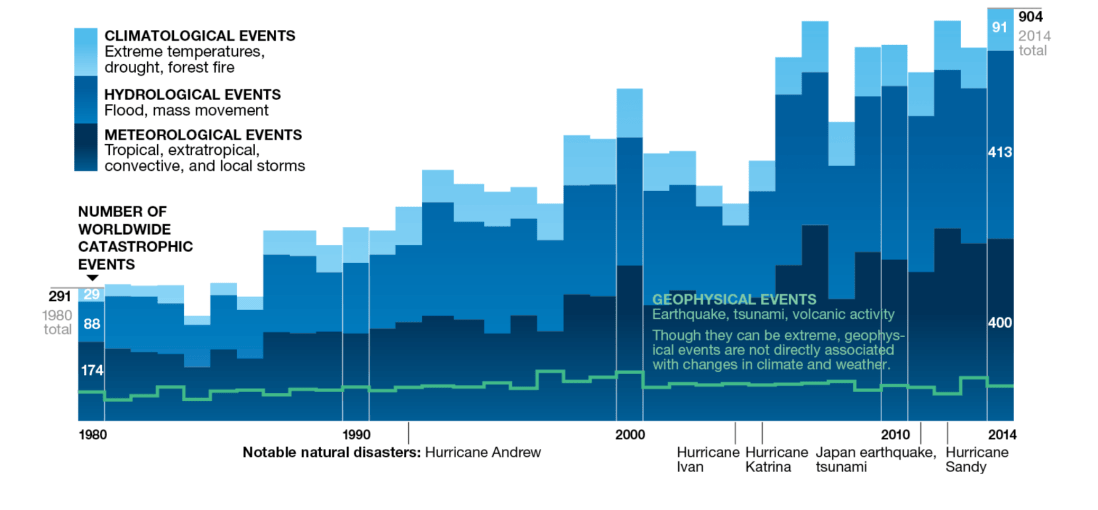
Trends show that there has been an increase in extreme weather events, such as: extreme temperatures, droughts, floods, and tropical storms. Most scientists agree that this trend will continue with climate change, but they differ in their belief in whether or not models will be able to keep up with the changes. The answers to climate questions are based on averages. Actual weather results tend to be an average of all the forecasts made, and the models themselves are based on averages of historic weather data and patterns. As climate change progresses and new and more extreme weather patterns emerge, the averages of the past 100 years may not be necessarily applicable, and the models of disparate weather services will continue to differentiate.
The field of weather forecasting is based on prediction derived from mathematical models and previous data. As we are on the precipice of extreme change in climate, so is the field. Angela Fritz states that the physics of the atmosphere will not change unless something catastrophic happens, but as a meteorologist, her job security relies on her ability to predict the weather. UC Irvine Earth Science professor, Jin-Yi Yu, anticipates that the changes in temperature gradient in the arctic and changing patterns and temperatures in the oceans will be enough to alter atmospheric functions and make current atmospheric models irrelevant. Either way, the field must continue to develop, because as storms get larger and more extreme, the importance of accurately predicting their frequency will be of the utmost importance.
References
Dankowsky, John, host. “100 Years of Your Daily Weather Forecast.” Science Friday, NPR, 25 Jan. 2019. https://www.sciencefriday.com/segments/100-years-of-your-daily-weather-forecast/
“Global Warming Decreases the Reliability of Weather Forecasting Tools.” Phys.org, Science X Network, 19 Jan. 2018, phys.org/news/2018-01-global-decreases-reliability-weather-tools.html.
“5 Ways Climate Change Will Affect You: Wild Weather.” Nationalgeographic.com, The National Geographic Society, http://www.nationalgeographic.com/climate-change/how-to-live-with-it/weather.html.

 Data/Society/Decision-making Spring 2019