

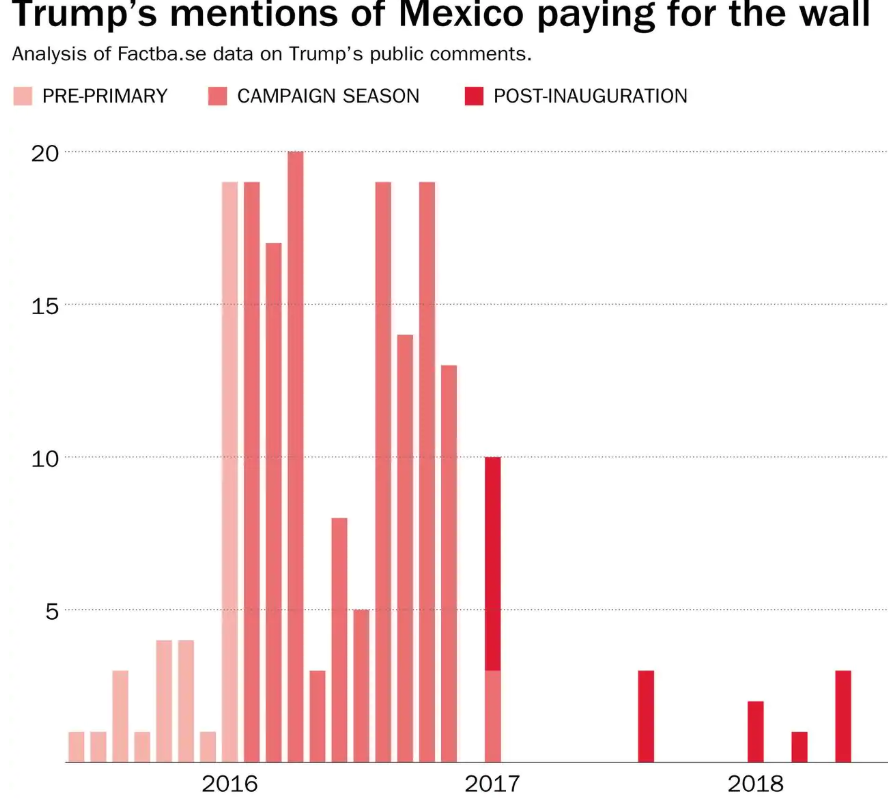
In May 2018, Trump stood in front of signs which read “Promises made, Promises kept” and reassured the general public that Mexico would pay for the wall that would divide the U.S. and Mexico. Trump has made this claim over 212 times, so why has the wall yet to be built?
Clearly this was a wishful promise made on the campaign trail that has had a difficult time facing its reality within the federal government. Unfortunately for the president, Mexico will not be paying for the wall, and cannot be forced to do so. The graph below has an array of implications that must be unpacked prior to analyzing if the data behind building a wall is sound. The density of claims made by Trump lie within his campaign season throughout 2016. This can be attributed to his multiple campaign speeches, rallies, and the building of his voter base. Once Trump was sworn into office, the claims significantly decline in both number and frequency. The Wall was a hefty promise that had fallen to the wayside in the beginning of Trump’s presidency. But, the beginning of 2018 saw an increase in wall mentions due to the discussion of the revision of NAFTA–now known as the USMCA. Now that the context of the wall mentions is known, we can analyze why the wall has yet to be built and/or paid for.
In November 2018 the USMCA (United States Mexico Canada Agreement–essentially a “revamped NAFTA”) was implemented, and with the new legislation came new promises.
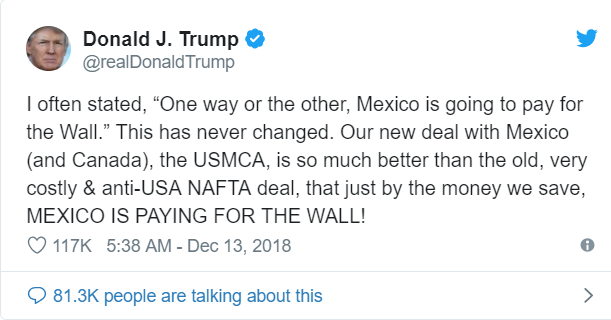
With the release of Trump’s tweet, should Americans not all be reassured that even if Mexico will not directly pay for the wall, then this new trade agreement will? Unfortunately for the president and his supporters, not so much.
In the tweet, Trump is referring to the (potential) decrease of the trade deficit with Mexico from the USMCA. However, a decrease in the trade deficit does not cause an increase in the federal government’s money supply. A trade deficit means that country A buys more goods from country B, than country B buys from country A. With the USMCA, the U.S. will be buying fewer goods from Mexico. Purchasing goods from within the U.S. instead of Mexico will theoretically lower the deficit, but the money saved from purchasing U.S.-based-goods remains with the consumer, and not the federal government. Therefore, Mexico would still not be paying for the wall, even indirectly.
Using relatively simple math, it is clear that the data does not support Trump’s claims.
“What’s more, Trump already starts at a disadvantage. In 2016, the trade deficit with Mexico was $55.6 billion, meaning that it increased by $8 billion during Trump’s first year in office. Presumably then, we need the trade deficit to drop by $26 billion — that $8 billion increase plus the $18 billion cost for the wall — to come out ahead on this thing”. (Bump 2018)
The data above from the Washington Post article is sufficient because the author uses trade data that is well known and federally backed. Furthermore, the data is supported by the simple understanding of how a trade deficit operates and what lowering the deficit implies for each country–meaning that Mexico does not necessarily lose money and the United States does not gain money either.
The conclusions drawn by the Washington Post are sound in math and logic, but it must be noted that the Washington Post is left-leaning and is particularly averse to the current administration. However, political biases aside, the data is against the president’s claims and the wall will most likely have to wait to be built for another time.
Citations:
Kelly, Meg. “No, the USMCA Doesn’t Mean Mexico Is Paying for the Wall.” The Washington Post, WP Company, http://www.washingtonpost.com/video/politics/no-the-usmca-doesnt-mean-mexico-is-paying-for-the-wall/2019/01/08/f22dd079-d74b-4592-a802-6fbd60ff8e03_video.html?utm_term=.460123e14037.
Bump, Philip. “Trump Got Mexico to Pay for the Wall by Simply Changing the Meaning of ‘Pay’ and ‘Mexico’.” The Washington Post, WP Company, 13 Dec. 2018, http://www.washingtonpost.com/politics/2018/12/13/trump-got-mexico-pay-wall-by-simply-changing-meaning-pay-mexico/.

 Data/Society/Decision-making Spring 2019