

White evangelical Protestants overwhelmingly voted for Donald Trump in the 2016 election. Their conservative, nostalgic beliefs aligned closely to his promises of a return to the ‘good ol’ days’ of the mid-20th century. But unable to usher in a younger generation, their numbers appear to be withering as the older generation dies and is not replaced. This decline in religious identity is strong with white evangelical Protestants, but it is also happening to many other large religious sects in America. A 2016
Public Religion Research Institute (PRRI survey) found that young Americans are leaving religion at an unprecedented rate. Many different sociological or economical explanations for this trend have been circulating, but does this study actually present a true picture of religion in America?
The PRRI study conducted in September of 2016 was picked up by the politically driven blog fivethirtyeight, which produced this chart depicting the generational shift in religious identity among americans, grouped by age and categorized by religious affiliation:

This graphic paints a clear picture in support of their argument that white evangelical Protestants declined by 18% between the youngest and oldest age groups polled. The two other white religious groups, mainline Protestants and Catholics, also showed a sharp decline in their followers in younger generations – while religiously unaffiliated Americans increased from 12% to 38%. But how do we know if this is a new trend, or if Americans have always become increasingly devout as they grow older? Perhaps the polling for this study was only conducted in urban areas with more progressive mindsets?
PRRI, the organization that conducted the study describes themselves as a
“nonprofit, nonpartisan, independent research organization.” Their staff is diverse in race, gender, and religious identity, and the organization is transparent in their partnerships and sponsors. The 2016 American Values survey from which fivethirtyeight’s graph came from was conducted for one month, sampled from “nationally representative adults (18+) living in the United States” and had a total of 2,010 repondants, both online and over the phone.
PRRI.org
All PRRI public opinion research is based on probability sampling to ensure that results are broadly representative of the population of interest. All PRRI studies include bilingual (English and Spanish) interviewing. Telephone studies are conducted by professional interviewers and include a high proportion of cell phone interviewing.
Another graph found in the analysis of the survey puts to rest any further scepticism in fivethirtyeight’s claim. PRRI found that 25% of Americans in 2016 are religiously unaffiliated, up from just 5% in 1972. This shows that the trend of decreasing affiliation is not just found between generations in 2016, but that there has been a larger trend from at least the 1970s that has progressively increased into the early 2000s.
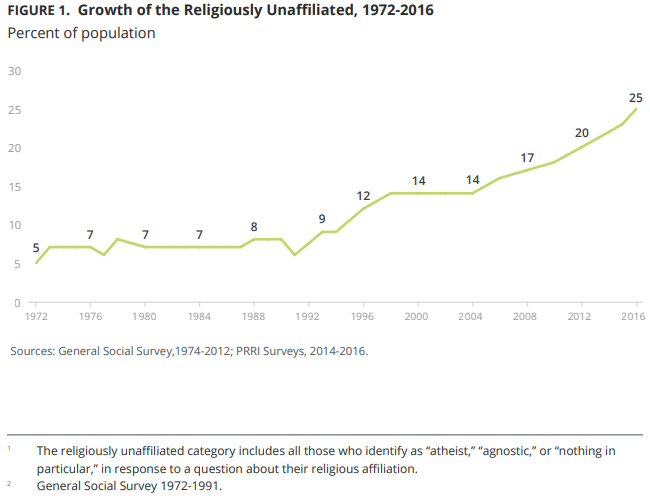
This final piece of evidence shows that PRRI’s and fivethirtyeight’s claim of the precipitous fall of religious affiliation is true and representative of a wide variety of Americans. There are no blatant biases found in the data collection, and no misleading representations of the data presented. So what does this mean for the future of America? Will we become a more liberal nation as the older religious generation dies, or will religion cease to create political boundaries as it loses its base?
Today, one-quarter (25%) of Americans claim no formal religious identity, making this group the single largest “religious group” in the U.S.
PRRI.org
Sources:
fivethirtyeight:Are White Evangelicals Sacrificing The Future In Search Of The Past?
PRRI 2016 American Values Survey Data
PRRI About
PRRI The Rise of the Unaffiliated

 Data/Society/Decision-making Spring 2019