

People doing something with their body/fingers while trying to concentrate on something has been investigated for a long time, particularly during a period of my childhood. This time period, which I’d consider to be around 2007-2012, many doctors/therapists seeing me were insistent on me exhibiting symptoms of ADHD because of my spacey-ness, so to speak. It’s not that I was doing poorly in school- in fact, my grades were more than satisfactory. I just had the tendency to draw on everything- my homework, my notebooks, my body, anything that a marker could reach. Rather than suspecting that I was an artistic prodigy, my parents sought answers to a possible attention deficit.
That said, why are we so fast to align compulsive doodling with an attention disorder, yet normalize other types of fidgeting, such as fidget spinners or cubes? And why are students often punished for doodling on themselves or assignments to (advertently or inadvertently) help them focus? The data I looked at actually supports that doodling increases attention capacity- however, there might not be adequate or enough data in the media to support this claim because unlike fidget spinners, doodling can’t be significantly profited off of.
The first step in processing this would be establishing that doodling actually does increase attention capacity and thinking about the sources that suggest this. An article published by Harvard Medical School discussing doodling related to attention capacity writes about a particular experiment: “In 2009, psychologist Jackie Andrade asked 40 people to monitor a 2-½ minute dull and rambling voice mail message. Half of the group doodled while they did this (they shaded in a shape), and the other half did not. They were not aware that their memories would be tested after the call. Surprisingly, when both groups were asked to recall details from the call, those that doodled were better at paying attention to the message and recalling the details. They recalled 29% more information!” Does this data sufficiently conclude that doodling can demonstrate not only a correlation but causation of increased memory? Not only is this a pretty reputable source but the experiment seems to be reliable in having both a control and variable, where the only distinction between the two was whether or not they’d been instructed to doodle.
Say for the sake of this argument that doodling does increase focus/attention capacity. What about the second half of the claim: is doodling actually demonized because it’s inherently almost impossible for big business to profit off of? This nice graphic from The Economist represents how huge Fidget Spinners boomed within the “toy” industry:
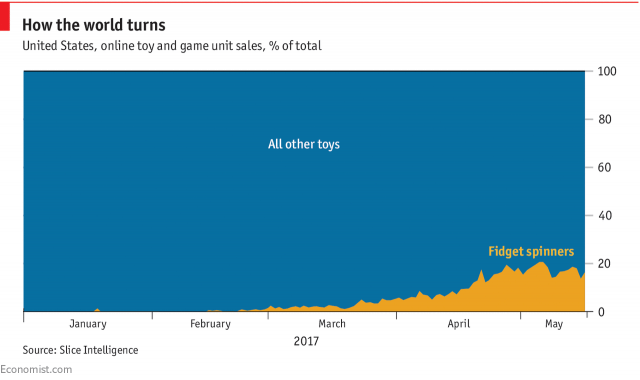
Fidget spinners became over 20 percent of all toy sales at one point in 2017. Another source, Fox Business reports that fidget spinner sales could amass approximately half a billion dollars in revenue. It’s no wonder that these things are normalized opposed to doodling. Doodling doesn’t require anyone to feed into consumerism, only hardly if at all- so that would explain why big business would want you to believe that fidget spinners are more effective.
Following that, what kinds of data does big business have control over? After all, how likely are we to see many investigations on the impact of doodling on concentration (especially ones with a positive conclusion) when studies can be done for something that can be easily profited on? From the research presented thus far, it seems like we can conclude that doodling at least has been demonstrated to help improve attention capacity. Is it possible that the data isn’t all-covering due to the nature of its marketability? Yes.
Sources:
https://www.health.harvard.edu/blog/the-thinking-benefits-of-doodling-2016121510844
https://www.economist.com/graphic-detail/2017/09/08/the-fidget-spinner-boom
https://www.foxbusiness.com/features/the-500000000-trend-spinning-the-toy-industry-upside-down

 Data/Society/Decision-making Spring 2019