

While searching through Science and Health articles on Vox, I came across an article that caught my eye. In large bold letters across the screen the title read, 80,000 Americans died of the flu last winter. Get your flu shot. I thought to myself, wow! That many? In my circles I only know a couple people who even had the flu over the last year. How could this number be so big and where did it come from?
The article asserts that influenza last year claimed more lives than traffic accidents, gun violence, and opioid overdoses. It explains that due to the variability in virus types, flu vaccinations are not always as effective as they should be, stating that the effectiveness of immunizations against influenza A (H1N1) is 54%, influenza B, 67% and influenza A (H3N2), only 33%. This is where the problem lies with flu vaccinations. In years where influenza types H1N1 and B are the main strains, vaccinations have a good chance of being effective. However, in years where H3N2 is the dominate strain, like last year, flu vaccines are less likely to help. This is what the article claims could explain the high incidences of flu related deaths in the 2017-18 flu season.
Even with the vaccination explanation I still felt uncertain about the reported number of deaths, this 80,000, so I went to the CDC website, where the data originated from. I found a slew of information on influenza surveillance. The website indicates that influenza associated deaths are tracked through two systems. the National Center for Health Statistics (NCHS) mortality surveillance data and the Influenza-Associated Pediatric Mortality Surveillance System. The NCHS collects data from death certificates across the U.S. using different codes to identify cause of death. The CDC then uses the data on pneumonia and influenza (P&I) deaths to calculate a seasonal baseline. The other system monitors all confirmed influenza deaths in children, which is reported to the CDC. To calculate an estimate of influenza associated deaths in a given season the CDC uses a ratio of deaths-to-hospitalizations in their statistical model. I found it interesting that the website states they don’t just use P&I data, but a combination of other respiratory and circulatory causes (R&C) and other non-respiratory, non-circulatory causes of death, that are not specified on the CDC website. Even though it’s stated that they use all these categories the only graph I could find shows data from the P&I category only (see graph below). I found this really confusing and furthermore why do they combine so many causes of death to estimate flu deaths? The CDC claims that “deaths related to flu may not have influenza listed as a cause of death” and “seasonal influenza may lead to death from other causes, such as pneumonia, congestive heart failure, or chronic obstructive pulmonary disease”. But association does not imply causation. How can they be so sure that so many of the cases from these other causes of death are related to the flu? Surely many deaths from congestive heart failure and pneumonia are not due to influenza. I’m no statistician, but this seems like a formula for biased data. Lumping all of these deaths together is seriously misleading and a gross overestimation in my opinion.
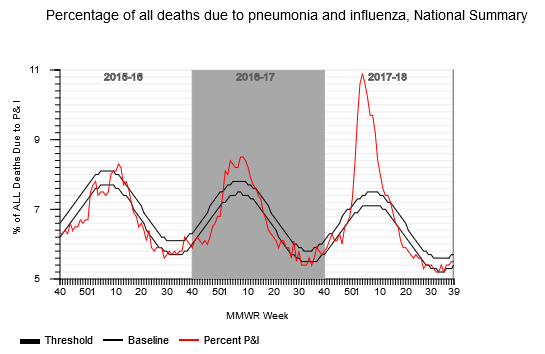
I found other things problematic as well. Throughout the CDC’s webpages on flu data, the terms “influenza associated deaths” and “influenza deaths” seem to be used interchangeably. This too can be misleading as seen in the title of the Vox article. 80,000 Americans did not die from the flu alone last year, they died from flu associated deaths, which may not all have actually been due to the flu. In fact, there were only 54,982 influenza positive tests reported to CDC by Public Health Laboratories, National Summary, which further exhibits how the numbers just don’t add up.
The issue at large here is that when the CDC releases information, the majority of the American public is going to believe and trust in what they say. It is important that the data they use and publish is unbiased and not misleading because it will be repeatedly used and referenced. This data is widely used and accepted. Not only does it affect what people think and the health choices they make, it has the possibility to effect the medical industry and public health policy as well. I’m not trying to say that the CDC is fudging numbers and using scare tactics to get people to vaccinate or is in cahoots with pharmaceutical companies. However I find their use of data to be irresponsible and ambiguous. Perhaps with some rewording on their website and changes to what data they use in determining deaths from influenza, misleading articles such as the one posted on Vox won’t be put out there to misinform the public.
References
Belluz, Julia. “80,000 Americans Died of the Flu Last Winter. Get Your Flu Shot.” Vox.com, Vox Media, 20 Dec. 2018, http://www.vox.com/2018/9/27/17910318/flu-deaths-2018-epidemic-outbreak-shot
“Influenza (Flu).” Centers for Disease Control and Prevention, Centers for Disease Control and Prevention, 19 Oct. 2018, http://www.cdc.gov/flu/weekly/overview.htm
“Influenza (Flu).” Centers for Disease Control and Prevention, Centers for Disease Control and Prevention, 25 Oct. 2018, http://www.cdc.gov/flu/about/burden/how-cdc-estimates.htm.
“Influenza-Associated Pediatric Mortality.” Centers for Disease Control and Prevention, Centers for Disease Control and Prevention, gis.cdc.gov/GRASP/Fluview/PedFluDeath.html.
“National Center for Health Statistics Mortality Surveillance System.” Centers for Disease Control and Prevention, Centers for Disease Control and Prevention, gis.cdc.gov/grasp/fluview/mortality.html.
“National, Regional, and State Level Outpatient Illness and Viral Surveillance.” Centers for Disease Control and Prevention, Centers for Disease Control and Prevention, gis.cdc.gov/grasp/fluview/fluportaldashboard.html.

 Data/Society/Decision-making Spring 2019