

Despite the apparent lack of information pertaining to the content of this post, the title actually does describe what I want to talk about. The internet is plagued with titled links congruent to mine. What I want to explore is whether or not clickbait such as these are successful strategies in promoting content, and if so, which bait catches the most fish? I want to know what factors decide how likely I am to click on something, and what decisions are made in society to profit off of that information.
Clickbait is an extreme consequence of effective headlining. For a normal article, the title needs to be concise and enticing. You need to communicate the promise of your piece, and inform potential readers what they could be in for. Clickbait follows the same guidelines for titles, but the actual content is often more vacuous and less interesting than it was previously made out to be. Clickbait that fails to deliver in content is by far the most unsatisfying, however studies and market values agree that when used effectively, it can be an excellent way to promote and viralize your content. For the purposes of this discussion, the term ‘clickbait’ will refer to articles with titles designed specifically to maximize the amount of visitors to the content, and to see if this is a successful strategy in marketing said content.
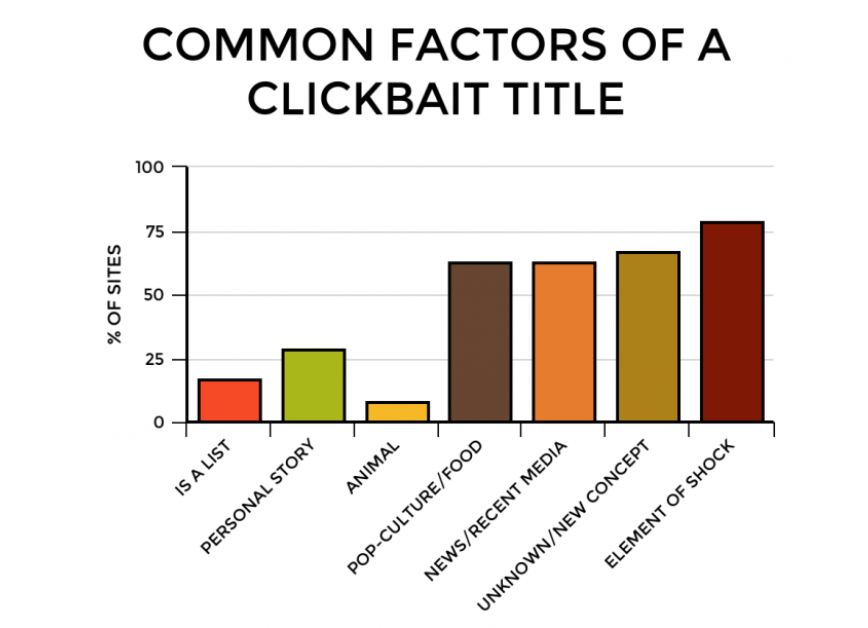
Clickbait titles often employ strategies like mystery, shock factor, and emotional appeal to goad you into clicking. “Find out more”, “You won’t believe”, “Which _____ are you most like”, “The shocking truth behind ____” are all common formulas to get you curious about what’s packaged underneath the title. The chart below shows common attributes of online titles that have been identified as ‘clickbait’. Most of these categories fit in the lines of something that either picks at your curiosity, or something that is designed to feel personable.
Clickbait has success stories as well as horrible failure stories. Perhaps the most famous media outlet focused around the idea is BuzzFeed, which has a remarkably high success rate from articles titles in a clickbait fashion. In fact they use it so successfully that they were even able to write a clickbait article about buzzfeed clickbait articles.
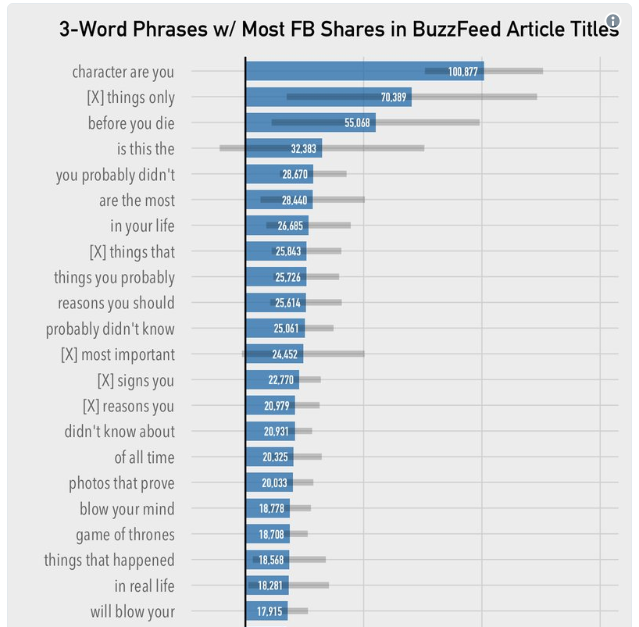
That article is focused around the following chart (sort of), which shows BuzzFeeds most successful clickbaiting phrases. The chart highlights appeals that are most likely to cause clicks. The first and third top phrases, for example, both appeal heavily to emotion; the first likening a reader to a character (probably one they like) and the next expressing the urgency of mortality. If someone tells you to do something before you die, chances are you might be inclined to listen, and it is that emotional appeal that this phrase employs.
While BuzzFeed is able to employ this marketing tactic to their advantage, many experts warn against clickbaiting for any outlet focused on producing more serious content. In his Time article entitled “What You Think You Know About the Web Is Wrong” CEO of Chartbeat Tony Haile describes the issue, ” chartbeat looked at deep user behavior across 2 billion visits across the web over the course of a month and found that most people who click don’t read. In fact, a stunning 55% spent fewer than 15 seconds actively on a page.” 15 seconds is definitely not enough time to get a serious point across, however it is roughly enough time to get a solid grasp on the Buzzfeed meta-Buzzfeed article talked about previously in this post. It comes down to what audience you are targeting, or if visitation numbers is more important to your business model than content propagation. According to Haile, capturing attention for shorter periods of time makes your users much less likely to return. So a 15 second use time is incredibly unlikely to result in a returning user, while a 3 minute one is much more likely to do so. I would argue that this reason is why sites like BuzzFeed use nested clickbaits; where the entire article contains links to more and more clickbait articles “you might enjoy”. If they can grab your attention for longer periods of time, you are more likely to come back. Considering this information, BuzzFeed’s content strategy is well structured around clickbait. Their articles take 30 seconds to read, and provide you with numerous paths to new ones.
Within society the general notion is that clickbait is bad. People don’t like it, and this is proven simply by the cautious name of ‘clickbait’. Being baited into anything is usually considered a negative, like a fish to a hook. From what I read on this topic, clickbait is generally considered a bad marketing strategy, however it can be used extremely effectively. As societal outcry against clickbait increases it becomes less viable. For example Facebook and Google, the two largest content surfing platforms on the web, both take extensive measures in preventing spam / clickbait titles from appearing heavily on their platforms (although neither is successful at preventing it).
Resources:
Haile, Tony. “What You Think You Know About the Web Is Wrong.” TIME, TIME, 9 Mar. 2014.
Khoja, Nadya. “7 Reasons Why Clicking This Title Will Prove Why You Clicked This Title.” Venngage, Nadya Khoja, 23 Feb. 2016, venngage.com/blog/7-reasons-why-clicking-this-title-will-prove-why-you-clicked-this-title/.
Phillips, Tom. “13 BuzzFeed Headlines that Should Really Exist.” BuzzFeed, BuzzFeed, 13 Jan. 2015.

 Data/Society/Decision-making Spring 2019