

The website Funny or Die produced a video in which a dietician time travels to 1979 and interrupts a couple’s morning, heralding modern science and the health implication of their breakfast. He returns every couple seconds as time and science progress, each instance with new recommendations. Although meant as comic relief, the video addresses the problem of where people get their health information while being bombarded by changing health recommendations. It brings up the question: Is it ethical to present health data to the public without an adequate trial period?
According to the Pew Research Center, 72% of Americans believe that healthy eating is important to living a long and healthy life (pewresearch.org). Diet culture and health trends that play off this belief make up an entire billion-dollar industry. How to go about healthy eating is where the chaos begins. Because people want to live long and healthy lives, there is a huge monetary incentive in telling people what is good for them. As a result, information about foods to cut and macronutrient ratios comes from every direction; 72% of Americans say that they frequently hear news about the health effects of certain foods that contradict other previous news that they have heard (pewresearch.org).
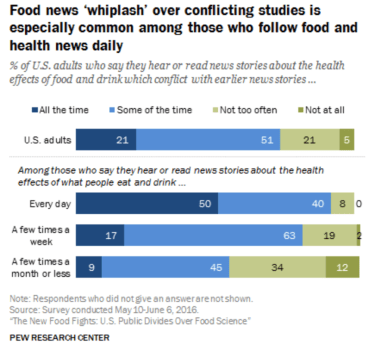
Because of the direct health implications of the foods that a human consumes, it is in many ways a medication. Food choices have been shown to be preventative to a variety of diseases, including: cardiovascular disease, diabetes, certain types of cancers, as well as others (McCarty, 1999). However, food recommendations do not go through a stringent clinical trial process like other medical remedies. In the scientific process, someone does research, tests their hypothesis, then their conclusions hold true until someone else disproves them. Disproving previous results is how science progresses; it is part of the process. However, health culture is one of the only industries in which the results are both widely available and have such an immediate public health effect. Conclusions are presented directly to consumers, and they are often already implemented when new science rebukes the previous conclusions. Theories are rapidly updated and changed at the expense of the consumer.
Most people understand the basic tenets of eating healthy, even if they do not always follow them: eating in moderation, consuming fruits and vegetables, and drinking enough water. However, food science as a verifiable option for preventative medicine (and in some cases a treatment) should not be discounted. Because of the constantly changing data, 37% of Americans say that “the research about the health effects of what people eat and drink cannot really be trusted because so many studies conflict with each other” (pewresearch.org). If this field is going to continue to develop, a trial system needs to be established to ensure quality of data that is being presented to the public.
References
Armstrong, C. Stockman, C. [FunnyOrDie]. (2017, July 27). This Is Why Eating Healthy Is Hard (Time Travel Dietician)[Video File]. Retrieved from https://www.youtube.com/watch?v=5Ua-WVg1SsA
Mccarty, M. F. (1999). Vegan Proteins May Reduce Risk of Cancer, Obesity, and Cardiovascular Disease by Promoting Increased Glucagon Activity. Medical Hypotheses, 53(6), 459-485. doi:10.1054/mehy.1999.0784
Public Views About Americans’ Eating Habits. (2016, December 01). Retrieved January 20, 2019, from http://www.pewresearch.org/science/2016/12/01/public-views-about-americans-eating-habits/

 Data/Society/Decision-making Spring 2019