

by Cameron Welch
What does the Netflix crisis mean for consumers and other streaming and/or production companies?
“Netflix’s upcoming content crisis, in one chart” by Todd VanDerWerff details the seemingly-dim future of Netflix as a streaming platform and production company. Recently, Netflix has been desparately trying to make ends meet by producing original show after show. It’s struggling to hold on to its value- streaming shows like Friends and The Office (U.S) – while companies like Warner Media and NBC Universal slowly let it bleed out.
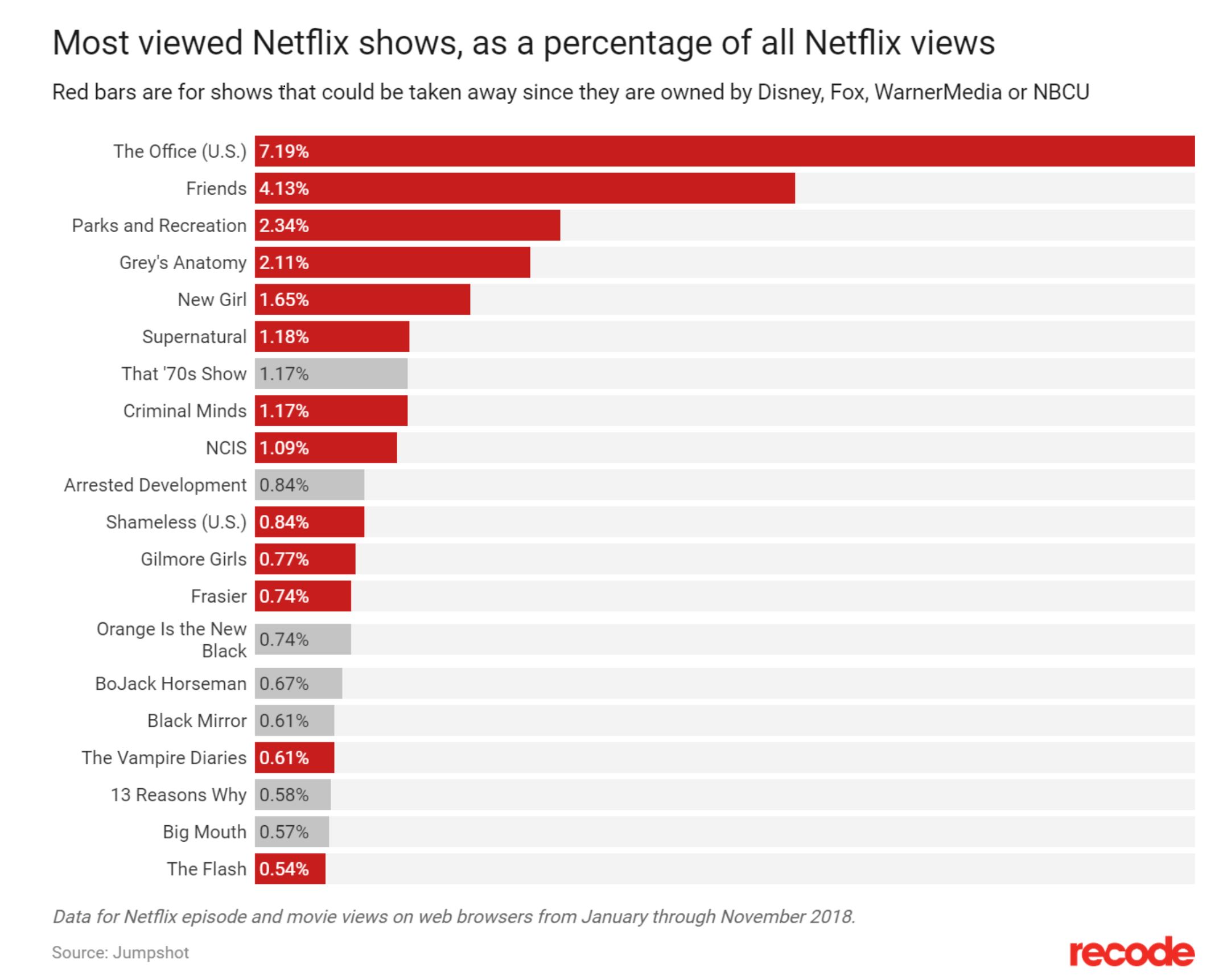
The graph above, provided in VanDerWerff’s article, shows that although Netflix has been creating its own shows lately, the top viewed shows are still those owned by other production companies. To the average consumer, it may seem like Netflix has the ball in its court, being the most popular streaming service available; However, Netflix is in trouble.
VanDerWerff
“And as more and more media companies increasingly view Netflix not as a way to make money off their older shows while getting those shows seen, but as a competitor, the value of those shows only goes up — as a recent $100 million deal to keep Friends on Netflix for a single year suggests.”
As the price continues to rise for Netflix to keep streaming other companies’ shows, like Friends, its chance for sustainability grows slimmer. As a streaming platform, Netflix holds value to companies like WarnerMedia because they still make the profits off of sales since they own the shows. As a production company, Netflix is not as appealing to partner with because now their new, original shows are competing with the other shows they stream. What’s the solution that production companies are coming up with? Of course, creating their own streaming platforms. It gets rid of the middle man, Netflix, and allows them full control and profit off of their own shows. For example, if WarnerMedia wants to take Friends and only allow its own streaming service to show it, people might leave Netflix and subscribe to this new service with Friends as the bait, as VanDerWerff suggests.
What does this mean? Why should the average consumer care?
Imagine a world in which you want to watch Friends. You log into Fox’s streaming service, search “Friends”, and it’s not there. “Okay, wrong one”, you say to yourself. Next, you try NBCU’s service… but you are wrong again. You might just want to keep a list of which of your shows are streaming where… and make sure to keep up on all those bills to pay for your 7 different streaming services monthly.
Although that’s a theoretical situation, things will nonetheless get confusing and frustrating for consumers. Having one streaming service (or more for those who enjoy HBO, Hulu, etc…) has made watching favorite T.V. shows and movies very easy. Having everything in one spot, in any situation, generally tidies up confusion and eliminates extra effort. With Netflix falling off of its throne in the streaming world and big production companies pulling their top shows back and opening up their own, private services, that extra effort and confusion will take its place during the transition of power over T.V. and movie streaming rights.
It’s not too late for companies to drop out or join the race
Other companies that might have goals of becoming part producers and part streaming platforms might want to reconsider. If it’s too difficult to maintain being a middle man between consumers and production companies, and a company as successful as Netflix is even falling short, it doesn’t look like a bright future for pure streaming platforms. On the other hand, this could be an opportunity to turn the situation around and join the streaming competition. If Netflix is struggling and losing rights to stream shows, it could be possible that other companies could swoop in and get the rights for themselves. This would still be expensive, but it’s a possiblity for some of the other streaming services that are doing well, like Hulu, or even game console companies, like PlayStation and Xbox. In times of a power shift like this one, there’s usually an opportunity for new companies to gain more leverage.
Personal reaction to the crisis
When I first read VanDerWeff’s article and saw the graph he provided, I was really shocked that Big Mouth and Black Mirror, the only two shows included that Netflix fully controls, were so low on the popularity list. A large number of my friends and colleagues watch those shows, as well as the ones throughout the whole entire ranking, and I expected them to be more popular. The shows that appear on the graph only account for a very small number of all available media from Netflix, so I understand that even having a .5% for all views in a year is not too shabby.
I agree with VanDerWeff’s claim that there is in fact a crisis for Netflix and their future could be dim to zip. Although this isn’t the end of the world, Netflix is a very important part of pop culture right now because the movies and T.V. shows it streams allow people to connect to one another in a social realm. The generations of now value quality entertainment, comfort, and easy access, and Netflix has provided that thus far. As consumers, we can only hope that the future of streaming services and television/movie production won’t let us down.
Sources:
VanDerWerff, Todd. “Netflix’s Upcoming Content Crisis, in One Chart.” Vox.com, Vox Media, 7 Jan. 2019, http://www.vox.com/culture/2019/1/7/18166911/netflix-friends-the-office-crisis.

 Data/Society/Decision-making Spring 2019